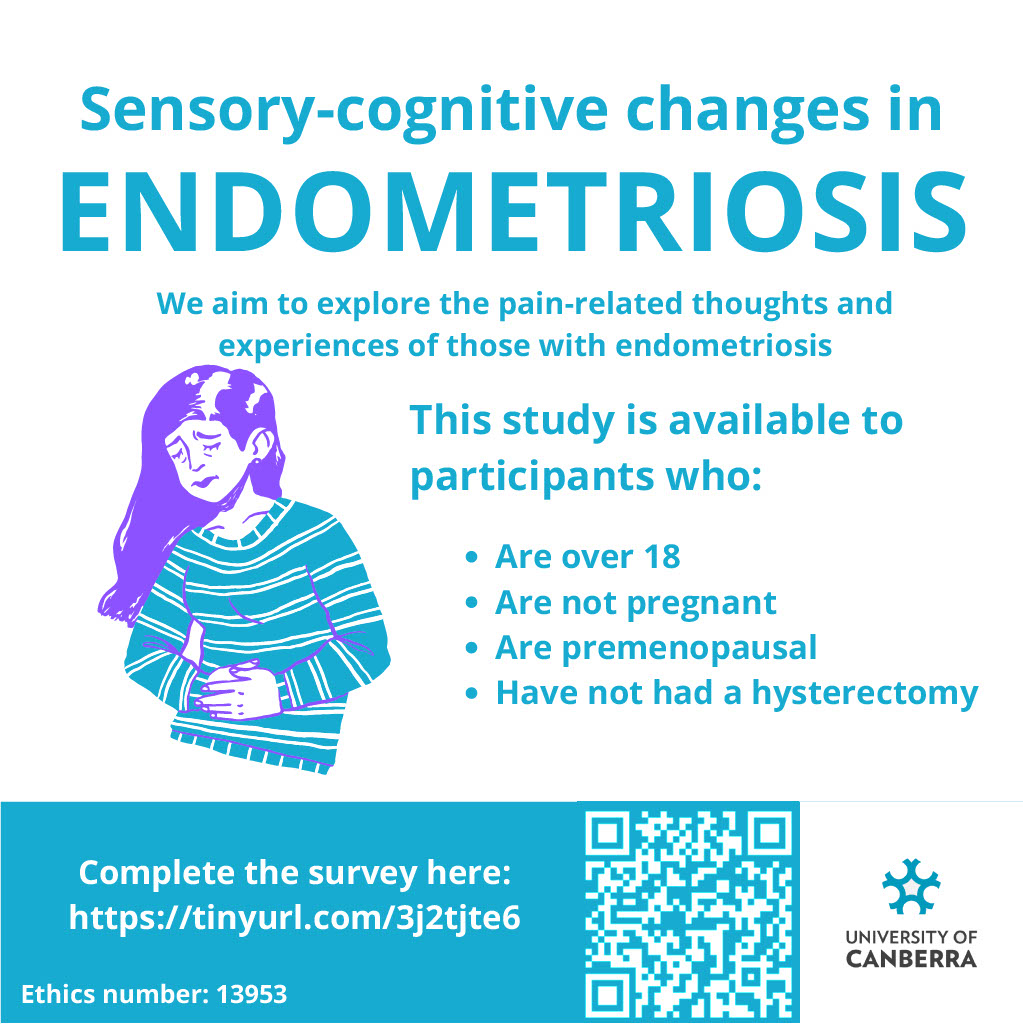
Great to see @AndrewFlood_, @AnnaleiseNaylor and @AidanLewis__ spreading the word on this important research! Are you living with endometriosis, or do you want to help those who are? We want to hear from you! Complete our survey at: https://t.co/4OVw7CVr3K.
Anyone living in Australia with endometriosis or others who want to improve the lives of their friends and loved ones who have been diagnosed with this condition are encouraged to complete an online survey to support a new study by @ActiveBrainUC@UC_RISE
https://t.co/0ajwXfOjj4
I'm very excited to get this out. A very big thank you to my co-authors. The PLAS is a new measure of physical literacy for adults, assessing physical, psychological, social, and cognitive domains. Watch out, more adult physical literacy research to come! https://t.co/xswuSTjzhu
🚨Our latest review all about exercise-induced pain (EIP) during endurance exercise was published last Friday.
https://t.co/BiCmDkLBBQ
See thread🧵for some of the key takeaway points from the article:
*** Postdoctoral Fellow Position ***
Join us for a project aimed at reducing vulnerability to rising temperatures and heat waves in older adults!
@EnvPhysiolLab@UC_RISE
Closing date: Monday 12 August 2024
https://t.co/nWjBm31H8B
Help @AndrewFlood_ and team explore pain-related experiences of individuals living with endometriosis. We are recruiting biological females Australia-wide, with or without endo, to complete this survey-based study. Link here https://t.co/yD3ct5RP6Y ❓ [email protected]
Are you living with endometriosis, or want to improve the lives of those who do? Participate in our survey aiming to understand pain-related experiences and contribute to better support and treatment options! Keen to get involved? Find the survey here: https://t.co/XFnkmURCHz
Do interventions combining PA and psychosocial strategies increase PA for a SMI population? Truth is, we don’t know 🤷♀️, significant advancements are needed. One thing we do know, using device-based measures of PA might help. Read our other suggestions here https://t.co/hyDKL0qKkN
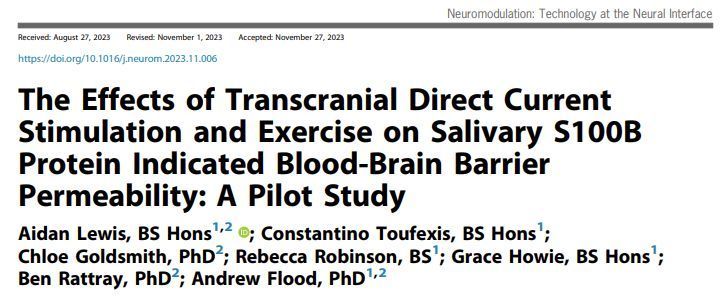
tDCS produces an electrical current to manipulate neural activity. Is there a possibility that it influences the brain via other mechanisms? @AidanLewis_ brand new publication investigates this possibility. Congrats Aidan! 🧠⚡
Check it out here: https://t.co/SrGVMIOnbH
@UC_RISE
1. Not much going on today, so here's a personal magnum opus on how neuroscience is pre-paradigmatic and its results are not even wrong. (link in image, also a 🧵) https://t.co/ZSE81e1J83
Delighted to share my first first-author paper! Our latest publication investigates the effects of tDCS and exercise on blood-brain barrier permeability. Read more here: [https://t.co/nkyT2U5NMv] @ActiveBrainUC#tDCS#bbb#exercise
Final PDF out in @BiologicalPsyc1
Evaluating Robustness of Brain Stimulation Biomarkers for Depression: A Systematic Review of Magnetic Resonance Imaging and Electroencephalography Studies
https://t.co/3RSmplYPFe
Here we performed a systematic review to identify robust predictors of response to rTMS in depression. Two EEG biomarkers (alpha frequency and frontal-midline theta) and two fMRI biomarkers emerged (sgACC-DLPFC anticorrelation and fMRI-based network connectivity).
Now it's time for further investigating clinical actionability (e.g. see Brainmarker-I work for example)!
Great work by @HVoetterl & @DebbyKlooster and thx. @CBaeken
Builds on important work by @foxmdphd@shansiddiqi@cashmachine15
New 📄 collaboration with Matthew Heath in @JSportsSci investigates the effects of different types of exercise on executive function @westernuCCAA#westernuKin @VPRWesternU @WesternU 🔒 https://t.co/iwqwcSJLrn
Our research group's latest work is currently in press!
Bastos, V., Rodrigues, F., Davis, P., Teixeira, D.S., (in press). Assessing affective valence and activation in resistance training with the feeling scale and the felt arousal scale: a systematic review. PLOS ONE.
“results indicate that processes related to affective and cognitive aspects of pain primarily drive placebo analgesia”
https://t.co/lupbb4MsqN
#thepaincoach#chronicpain#placebo
Much of the exercise prescription around tendinopathy is based on evidence from structural/morphological studies. Yet it is pain that brings people to the clinic usually. Is the relationship between the two as clear as we'd like?
https://t.co/M5doFoXE4V
Movement is medicine.
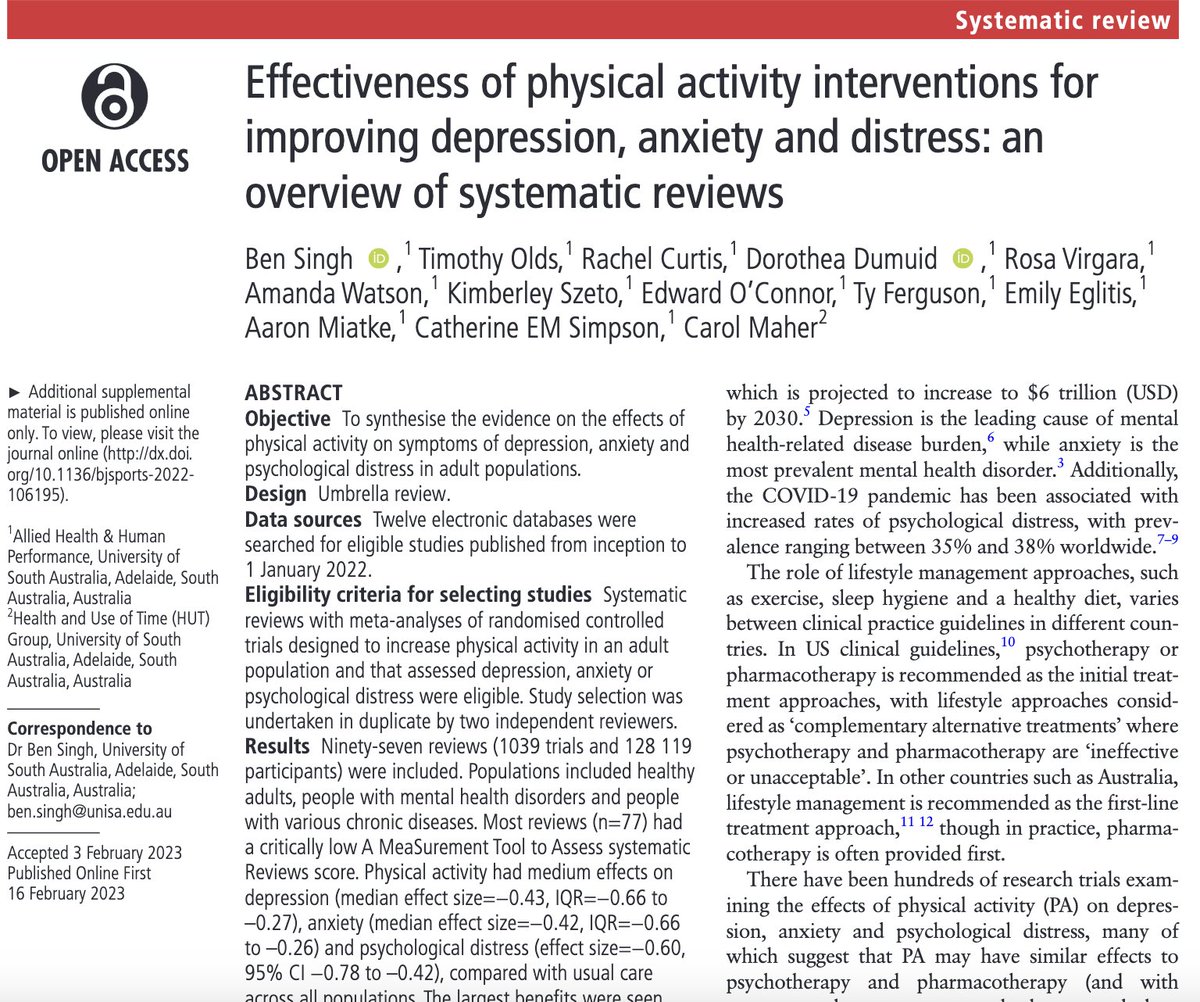
Large systematic review of over 1,000 trials and 120,000 participants finds that exercise has a significant effect on symptoms of depression, anxiety, and psychological distress.
We need to do a better job of integrating mental and physical health.
Our new study in @PeerJLife: How does perception of effort & affect shift during stationary cycling when #virtualreality terrain is altered (uphills, downhills, or flat) but resistance stays constant? How does interoceptive accuracy weigh in?
➡️Read here: https://t.co/umfpy02Drh