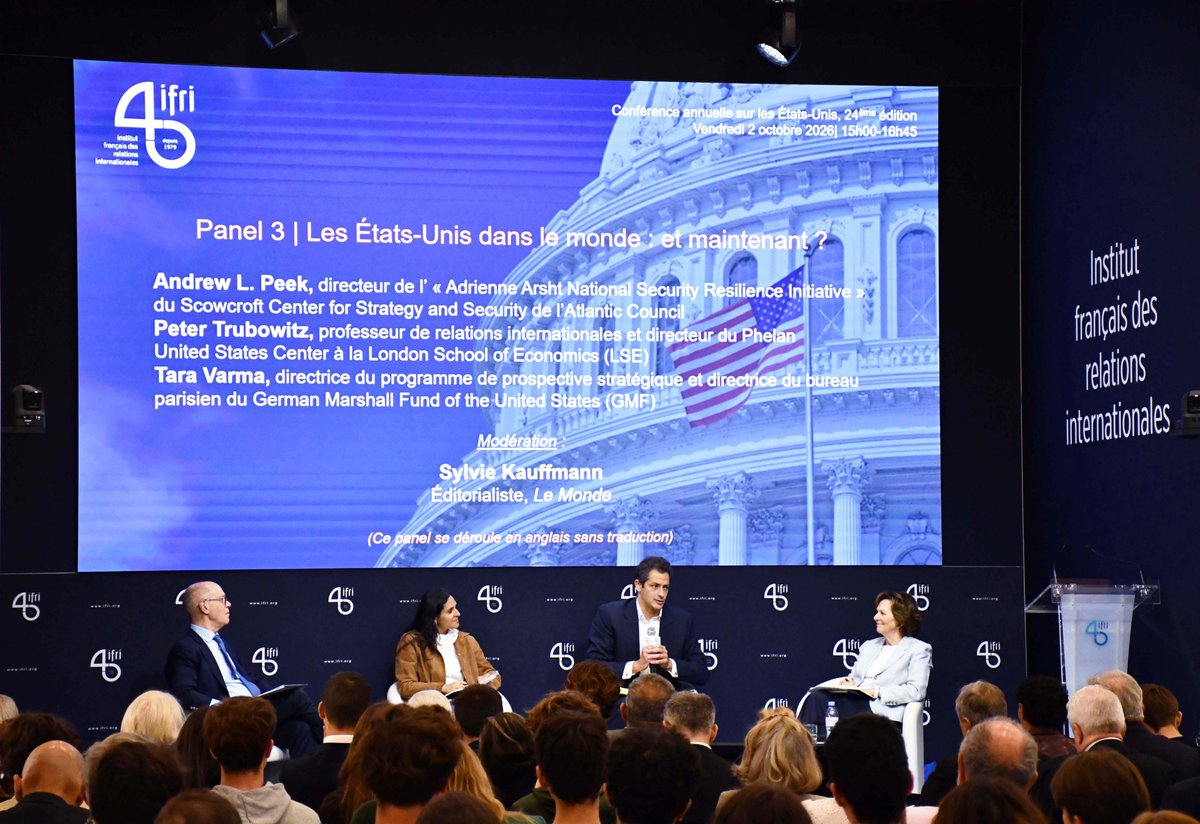
🇺🇸🌎 What Role for the United States in the World?
Debate with:
• @AndrewLPeek, Director of the Adrienne Arsht National Security Resilience Initiative of the Scowcroft Center for Strategy and Security @AtlanticCouncil.
• @ptrubowitz, Professor of international relations @LSEnews.
• @tara_varma, Managing Director, Strategic Foresight and Director @gmfus.
• @SylvieKauffmann, Foreign Affairs Columnist @lemondefr.
🎥 Watch the livestream ⤵️
@RashaAlAqeedi I don't disagree with either of these points in the Iranian context. I think there's some value in not treating every group with arms as beyond the pale. But your point 2 - that this has failed utterly across the broad spectrum of Iranian backed groups - is absolutely right.
Trump’s deterrence gives sanctions their bite
Trump’s sanctions on Iran have been historically effective because of his perceived willingness to prioritize economic pressure over anything else in bilateral relationships. The main economic pressure tool available is secondary sanctions—sanctions on foreign entities that engage with an Iranian entity. The laws governing these sanctions were the same under both Trump and President Barack Obama, and Obama had a global coalition and the United Nations behind him. Trump did not, yet he still forced oil exports from Iran to a historic low.
The reason was that his implementation was much different. Those entities—including state-owned companies in China, Europe, India, and elsewhere—genuinely believed that Trump would sanction them regardless of the diplomatic consequences. This is still true. It may be even more true today than it was eighteen months ago. The president engenders a tremendous amount of deterrence.
Bessent and the rest of the Trump administration are thus starting with a very strong hand. The task now is implementation. It is a challenging diplomatic assignment. In Iraq, the Gulf, China, and elsewhere, entities that deal with Iran have been navigating secondary sanctions for thirty years. They are hedged and do not scare easily. Trump’s envoys thus need to engage the remaining sanctions holdouts and deliver a cease-and-desist message without allowing that deterrent effect to get lost in diplomatic niceties. And there will probably need to be an example.
Lastly, as I argued on Friday, Iran’s leaders will shoot back before they starve. Iran will escalate militarily against its neighbors in the face of this sanctions pressure to prevent them from complying fully. Iran will try to force Iraq and the Gulf states to hedge and allow money to keep flowing. The effects will be limited, since Iran is not exporting oil by ship, but Tehran will try to scrounge enough dollars from its neighbors to survive and outlast this effort.
Andrew L. Peek @AndrewLPeek is the director of the Adrienne Arsht National Security Resilience Initiative in the Atlantic Council’s @ACScowcroft Center.
@ottomanenglish This is actually not as big a shift. If it were a statement condemning the bombing of Syria, that would be significant. But things pretty long standing UAE policy, or at least within the bounds.
In a new piece, @AndrewLPeek and @jpanikoff@ACMideast discuss the long-term outlook for #Iran: "Time is working for the United States, in the medium and long run," but "Iran is maximizing a perceived advantage" in the short term. Read more: https://t.co/z1PR7O0Kpt
@EWErickson It’s only a decline *relatively. There doesn’t have to be a doom and gloom theology to believe that China is becoming more powerful and U.S. strategy should prioritize efficiency above all else.
We’re in a much stronger place with Iran than I think the President gets credit for. Blockades do work. They just take time, and successful ones succeed with an accompanying military strategy, rather than in isolation.
So are the gains from destroying Iran’s military infrastructure is worth a temporary premium on the price of oil? Yes. Might that change with a qualitative shift in oil? Also yes.
Given the decline of its foreign currency reserves after Trump put on maximum pressure in 2018, it almost certainly would have negotiated had he been reelected.
This one is going to require fighting, first because the price premium on oil from Iran’s blockage of the Stait will be reduced with every ship that leaves and second because Iran will escalate before it starves.
@EWErickson I think it’s a combination of the negative externalities of trade being so much higher than we thought, plus the politicization of almost all major corporations during COVID against conservatives that soured the base on free market economics - and probably fairly enough