I’ve already commented on this video below once, but some takes on it from ‘sophisticates’ demand another.
Yes, it’s funny to quip, “Bomb bond holders?” I laughed.
But the U.S. is slipping global hegemon because it won WW2 by force (yes: with others); then built a benign, inclusive world architecture for 1/3 of us when others might have nuked a few capital cities and taken over the world; then won the Cold War, via the threat, and use, of force (yes: with others); then lobbied for a utopian neoliberal world architecture that was never going to work, as I argued over two decades ago, which has weakened it.
We didn’t get to where we were pre-Trump via neoliberalism; we got there via *power*: neoliberalism was a villa built on violently cleared ‘jungle’, as Polanyi put it decades ago - and one that didn’t learn anything about the dangerous climate, flora, nor fauna there.
If you really think the market treats powerless pacifists and nuclear-armed states as true equals when push comes to shove, I have a bridge to sell you. (And it goes nowhere.)
There are a staggering number of Schmitt’s “Sovereign is he who decides the exception” examples out there already on various scales in various geographies. (As well as central banks buying their own bonds and this being treated as “sensible centrist technocracy”.)
And sovereignty starts with power: sorry those thinking it’s solely to do with paperwork and courts.
When Trump implies the U.S. military effectively backs the bond market, he’s not wrong.
If you think that military can OR can’t project U.S. power globally as it once did, that matters VASTLY for market dynamics. Just don’t ask bond analysts to have any idea about it; they have as much of a clue there as generals do about bonds.
Which speaks to why the U.S. is openly —and as predicted— going back to the pursuit of *power*, and a new economic and financial architecture to match, via economic statecraft that can join those dots.
That has already seen massive intervention in parts of the economy.
That will logically see massive intervention in markets —as we saw from 2008 to no real end economically, or politically looking at the current U.S. Watch and see what happens to the Fed and the Treasury.
That will logically include the U.S. physically threatening others via action or INaction (“Nice NATO you have there…pity if anything happened to it…”),
If you can’t see this you are either very kind; and/or very ideological; and/or not very well read; and/or the kind of person who got their lunch money taken at school and who now lives in a nice area where that doesn’t happen - but where your kids might be learning things about liberalism and capitalism that echo Leninism’s view of the world.
It’s a depressing world where Schmitt is relevant again. But he is.
Separate but related point: as I said to @izakaminska re: our global system crumbling, an inverse 70s is the 007-ties: spies, guns, war, world-shattering plots.
Yet ‘James Bond’s “next chapter” needs to make 007 “relevant” to modern audiences, says Amazon MGM Studios boss’.
https://t.co/stl5dwJc06
If you think that’s not seeing the forest (or box office) for the trees, neither is thinking bond markets just happen without tanks, bombs, and Bond.
The protectionist tradition of the west was central to its success .
The US has a long and now largely forgotten protectionist tradition. Hamilton, Coxe , Clay, Carey and later McKinley understood that Britain’s enthusiasm for free trade looked rather different from the perspective of a young country trying to build factories of its own.
Tariffs, subsidies, infrastructure and government procurement protected infant industries, created industrial jobs and built domestic technological capability.
Trump is a protectionist though the political discourse can’t carry that level of sophistication because the economic cult has made it heresy to even discuss such policies .
There is also an uncomfortable resemblance to modern China. Beijing has done much the same thing as the early American protectionists , only at enormous scale: cheap state finance, subsidies, protected domestic markets, infrastructure and deliberate support for strategic industries until Chinese firms could compete globally.
In solar panels, batteries, EVs, steel and increasingly advanced technology, China has practised something remarkably close to the old American proposition: don’t accept the comparative advantage you inherited; use the state to build the comparative advantage you want.
The philosophy was simple: a country should build the industries and capabilities it will need in the future, rather than simply specialise in whatever it produces cheapest today.
They believed comparative advantage could be created through technology, skills, infrastructure and scale.
Protection was therefore a development strategy, not just a tariff policy.
Today’s economists believe we should surrender national sovereignty based on competitive advantage measured by the price of goods .
It’s an extremist wrong headed cultish belief that worships economic efficiency over sovereign and human welfare .
This is a massive Cup and Handle
The mother of all C&Hs
It has broken out
Price is retesting
Price is going MUCH higher
Question is when of course
$SI_H
The end of the end of history.
The Economist now sees Leninism as the reason for China’s competitiveness. Wasn’t a whole-of-state approach supposed to be doomed? China’s escape from shock therapy was the first existential blow to neoliberalism. This is the nail in its coffin.
⚡️This is much bigger than currency intervention.
This is the United States openly treating the yen as a strategic asset.
For decades, exchange rates were presented as market outcomes with occasional central-bank smoothing. This statement abandons that pretense. Treasury is saying that currency stability, alliance management, and national security are now the same problem.
Several lines matter.
“Economic security is national security.”
That sentence changes the frame.
Currencies become strategic infrastructure.
Capital flows become geopolitical tools.
Financial stability becomes part of military planning.
Then this:
“We will not hesitate to participate in further joint intervention.”
That is coordinated sovereign management of a major reserve currency.
The market is no longer being told to discover equilibrium.
The market is being told where the alliance wants equilibrium to exist.
Then comes the most important line:
“The FIMA Repo Facility is an important backstop. We would encourage it to be upsized.”
That is about plumbing.
The United States is reinforcing the emergency liquidity mechanism that allows foreign central banks to obtain dollars without liquidating Treasuries.
That is the architecture protecting the Treasury market itself.
The deeper pattern is becoming impossible to ignore.
The dollar system is evolving from a passive reserve system into an actively managed alliance network.
Money.
Treasuries.
FX.
Repo.
Industrial policy.
Defense.
Semiconductors.
Energy.
All are becoming parts of one coordinated strategic framework.
The post-Cold War separation between economics and geopolitics is disappearing.
The state is openly integrating them.
The final paragraph reveals another layer.
“The Takaichi government is moving into an exciting new phase of Abenomics…”
That language is remarkable because it frames intervention as the beginning of a new growth regime rather than an emergency stabilization measure.
The message to markets is simple:
The alliance will coordinate.
Liquidity will coordinate.
Currencies will coordinate.
Financial stability will coordinate.
That reduces the probability of disorderly sovereign fractures inside the alliance itself.
The deeper implication reaches beyond Japan.
The reserve currency system is becoming explicitly political.
Neutral markets are giving way to strategic markets.
Price discovery increasingly shares space with alliance management.
Capital allocation increasingly shares space with national security.
This is what a multipolar financial order actually looks like.
Not the end of the dollar.
The transformation of the dollar into the financial operating system of a geopolitical bloc.
That is a different architecture entirely.
Rambling Random Ruminations of a Relic - a series
Hey, Gen Z and younger Millennials—especially those of you who trade the markets.
I get it.
You’ve been screwed by the Boomers.
Expensive education.
No clear career path in your chosen field.
Student loans.
Another internship that leads nowhere.
Close-to-minimum-wage work—not a living wage—waiting tables or doing something similar.
And when you finally find a job, the owners expect you to work your butt off. What’s with these four-day, nine-hour-a-day jobs, anyway?
Owning a home is not even imaginable.
Marriage? Why would you want the lives your parents had?
As an early-years Boomer, I fully acknowledge the disaster created for you by your parents’ and grandparents’ generations.
You have every right to be angry.
But I am seeing more and more of you come into equity and futures trading with expectations that are absolutely off-the-charts insane.
You poo-poo this claim!!!!
Many of you are chasing stories about turning $5,000 into $5 million in five years. The Market Wizards stories are incredibly compelling.
One of the things I am most proud of during my 51-year career—supporting my family and building wealth—is having been featured in Market Wizards. I remain deeply honored.
You might be a three-standard-deviation wonder. I am cheering for you—I truly am.
Welcome to trading.
It has been a thrill and an honor to trade my own money as my full-time occupation since I was in my 20s. I am now within spitting distance of 80, living in a body that betrays the fact that I once had a Division I university ice hockey scholarship.
I strongly believe that the pursuit of becoming one of the three in 1,000 will ultimately reveal the full character and integrity of those three.
Am I advising you not to invest in stocks?
Nope.
I am advising you to prepare for a career with a future, work hard and save as much as you can every month.
Then I would advise putting 80% of those savings into SPY, 5% into Bitcoin and 15% into gold and silver.
There is big money to be made in precious metals—but the move does not need to begin next week, Mr. and Ms. FOMO.
There is a very strong chance that, 30 years from now, you will wish you had annualized 20% to 30%. You will recognize that your dream of doubling your money every year originated in Fantasyland.
Please believe me: I am NOT, NOT, NOT trying to insult you.
I believe in you. My grandchildren are Gen Z. Your generation has enormous potential for wealth and happiness.
So, what is my advice to you????
You probably won’t accept it now, but print this X post and place it in an envelope marked, “Open in 2060.”
Believe me—life goes by faster than you can possibly understand right now.
If you want to learn trading—and I mean consistently profitable trading with your own money—it is possible.
But you must get the idea of doubling your money every year out of your mind. Instead, think in terms of reaching 20% annually during years four and five, measured from the first year you begin trading.
The best living investor/trader, in my opinion, is Stan “the Man” Druckenmiller.
The best trading operation? That’s easy: Renaissance Technologies.
Both have hovered in the 40%-plus zone over long periods.
Let me square with you on this next statement:
If you can learn to average even 30% annually over five years—with a Calmar ratio of 2.5 and without much variation across several hundred Monte Carlo simulations—you will have no trouble becoming a millionaire-plus, if money is your thing.
More importantly, you will feel an enormous sense of accomplishment.
Also, in my opinion, futures markets are far superior to equity markets for building an account and supporting any reasonable lifestyle.
Why futures?
Lots of reasons—more than enough to explore in another installment of “my story on X.”
But I mean trading with real money.
Not the pretend “prop shop” nonsense.
If that is what you have in mind, unfollow me immediately. I have nothing to say to you.
There are micro and even smaller contracts available these days, especially if you live outside the United States, where CFDs are permitted. Traders with access to CFDs have an advantage over those of us in the Stars and Stripes gang.
I believe the CME even offers a one-ounce gold contract.
And as more hard assets are tokenized, still more alternatives to traditional futures contracts will become available.
I believe it is entirely possible to succeed in futures trading—if you enter the business with the right expectations.
For your first three years, your primary goal should be simply not to lose money.
If you accomplish that, you will already be way ahead of your peers.
I mean WAAAY ahead.
If you can survive three or four years in futures and still have your original money intact, then you may indeed have a very bright future in futures.
One warning:
DON’T EVER pay some service to provide you with signals, setups or whatever else the YouTube and X Wonder Kids of the Century want to sell you.
You have to do this on your own.
There is no other way.
If there were, I would tell you.
Please believe me.
Perhaps I will wander deeper into this tunnel in the future.
But that’s all the rambling for now.
Why stablecoins only matter on open blockchains like Ethereum: they align the interests of the United States, stablecoin issuers and offshore dollar holders by preserving control at the issuer level while removing the intermediaries in between. https://t.co/i4YGpPYm7J
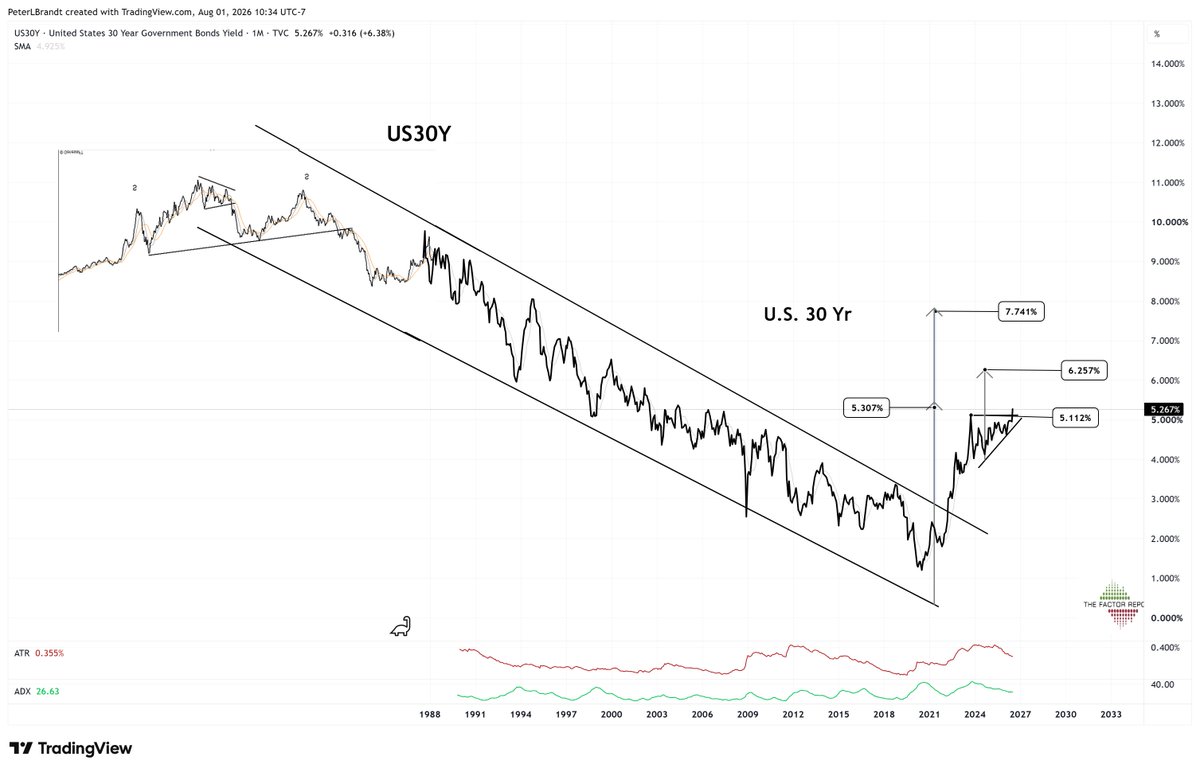
This is where the 30-Yr U.S. Bond came from
The down cycle is OVER
The trend is higher
Seriously, would you want to lock in U.S. govt debt for 30-Yrs at 5%???????
U.S. Bonds back to 7.5% please ↗️↗️↗️