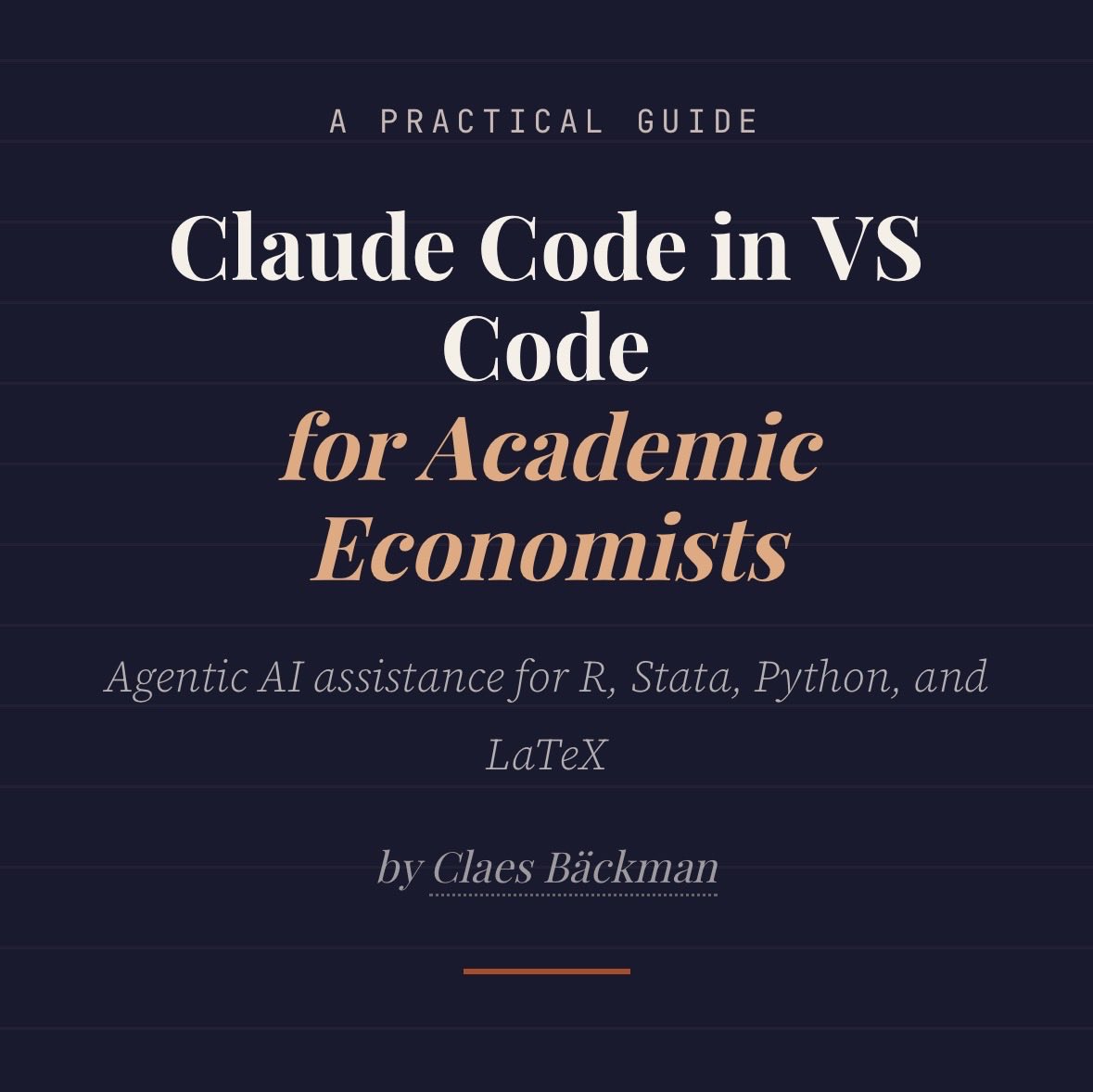
I put together a short practical guide for economists who want to use Claude Code, but who haven't gotten around to trying yet.
The goal is to reduce the start-up costs by using Claude Code within VS Code.
IV-PPML-HDFE. We are happy to introduce an instrumental-variable Poisson pseudo-maximum likelihood estimator with high-dimensional fixed effects. We also provide a robust and user-friendly ‘ivppmlhdfe’ package for Stata and Julia.
More details here 👇
https://t.co/3rXLVQMxbJ
⏰📆I'm looking for a pre-doc based @LSEEcon+@CEP_LSE starting Fall 2026 to support my @ERC_Research Grant agenda on the role of multinationals in development. If interested, apply by May 17 as advised here: https://t.co/FzKnZZcxat @econ_ra
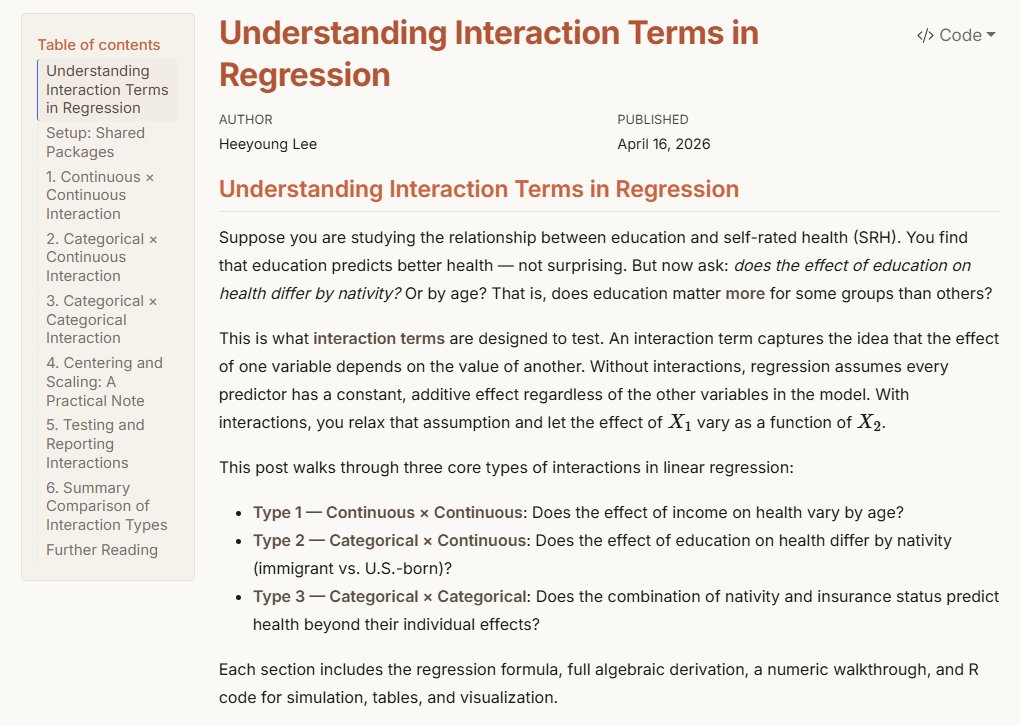
📊Stats Lab: Understanding Interaction Terms in Regression
Basic logic of interaction terms in regression:
1) Continuous x Continuous
2) Categorical x Continuous
3) Categorical x Categorical
Replication R code is available!
https://t.co/sUe7GevdFg
#stats#dataviz
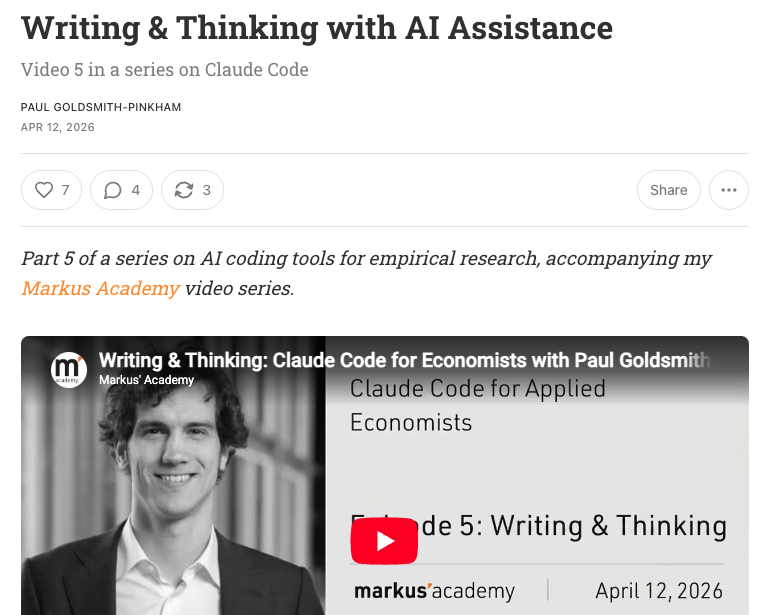
Paul Goldsmith-Pinkham's latest article is the best I've read on writing with coding agents/LLMs - whether for economics research or otherwise.
The most important technique he brings up is creating a style guide for writing which learns from your own past writing.
For academic work, the way I'd operationalize a V1 style guide it is this:
1. Put all your LaTeX files for all your writing in one class of writing (e.g. journal article) in a folder
2. Tell Claude Code "I would like to create a style guide which can be used to help me write academic papers. To this end, spin up a subagent whose purpose is to individually analyze my style in each paper, and then create a style file for that paper. Write them out to ./docs/papers/styles . Instruct the subagents to err towards being more detailed than less, and give exact examples."
3. Invoke the /skill-creator skill and ask CC "I want to create a style guide to help me write academic papers. Using the individual style evaluations in ./docs/papers/styles , help me create a /style-guide skill."
A lot more great stuff in the article and corresponding video.
Article link: https://t.co/RZaHcq3LdC
YouTube link: https://t.co/CuBLANHWRX
You can now give your agent deep knowledge of millions of papers in one line with #paperclip!📎
>8 million papers natively indexed for agents.
Much more thorough + often 10x faster than standard deep research.
Just add the paperclip mcp (instruction below).
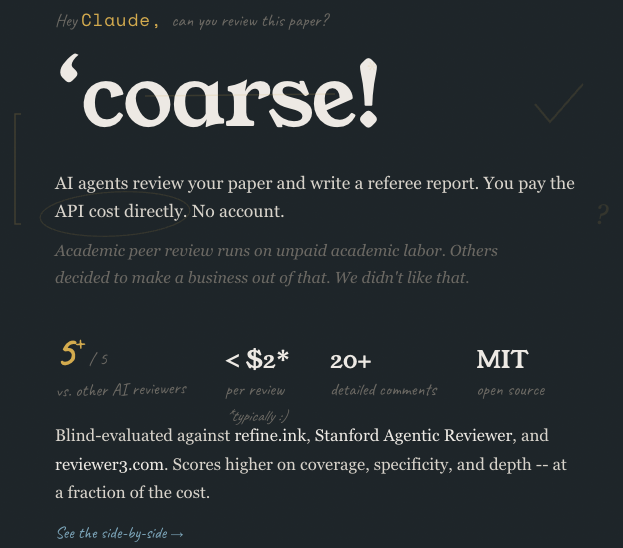
I coded up an open-source, not-for-profit AI paper reviewer that rivals the performance of @reviewer3, @RefineInk, and Stanford Agentic Reviewer (according to @GeminiApp). Costs <$2!
Live @ https://t.co/5m1Srky4H8. Plug in paper, @OpenRouter key, and email. #econtwitter.
Large Datasets: Claude Code for Economists with Paul Goldsmith-Pinkham |... https://t.co/RbWS60LE23 via @YouTube
More on https://t.co/AE52s9awei
Happy Easter!
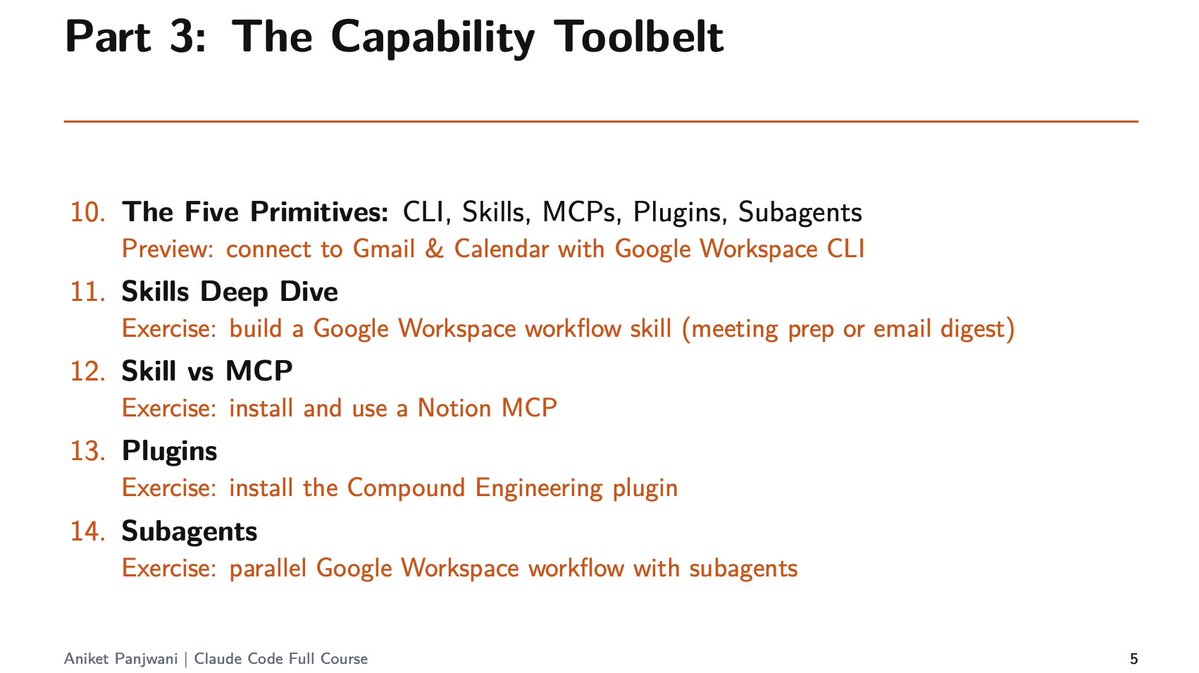
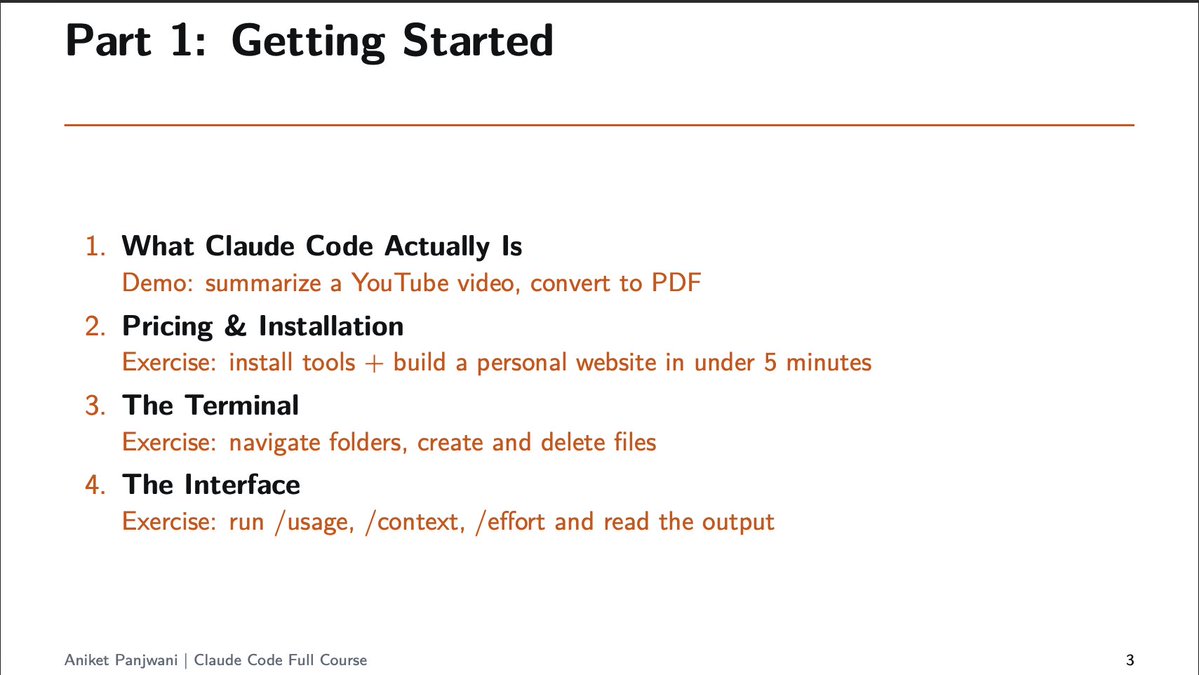
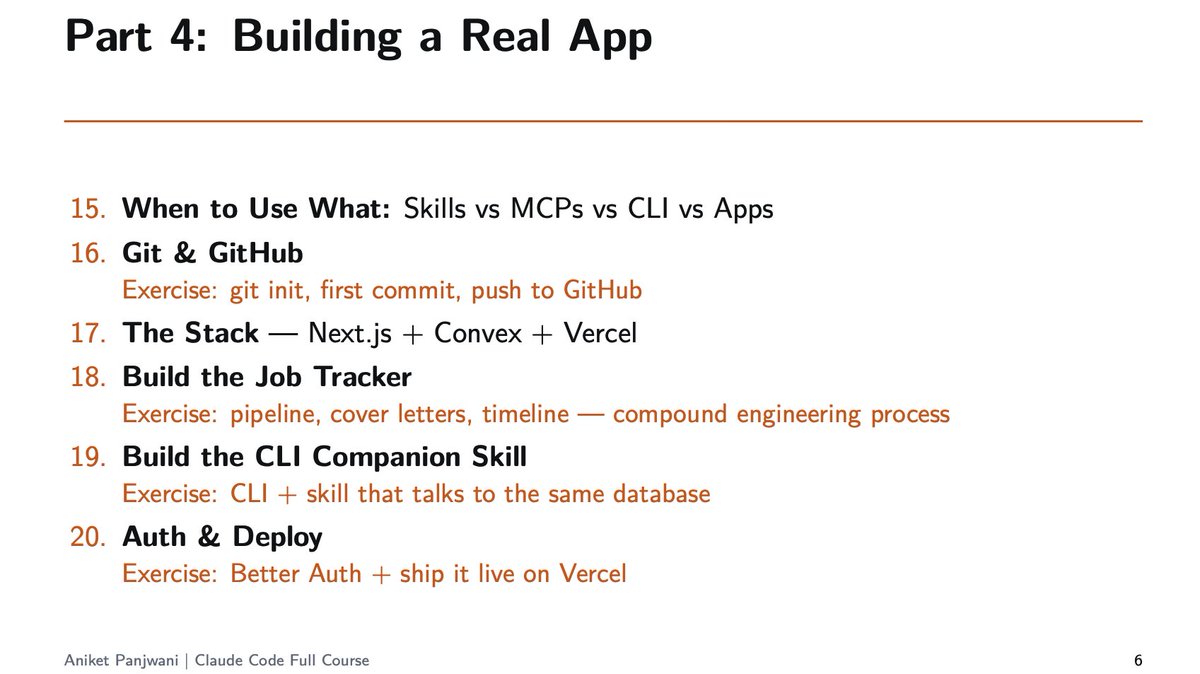
Just finished recording a ~4 hour course on Claude Code for beginners
About half is edited already - should be out on YouTube early next week!
Subscribe if you haven't already and you'll be the first to know: https://t.co/j1pUNOiEcV
Tom and I have finally finished a draft of Dynamic Programming Vol 2! Exhausting but satisfying. New approach to DP theory, advanced material, many applications... https://t.co/PPDk98DFgV
I wrote a substack today where I tried to explain my views about how complementary Claude code is to your work when you have real expertise in that specific area, and how sketchy it is when you don’t.
https://t.co/vTpruOTJmq
You can now use OpenAIReview directly in your browser 📷. This is a part of our mission to make quality AI-assisted reviewing open and accessible to everyone. Reviews on the web version are free of charge, and you can get up to 3 reviews a day. Try it here!
https://t.co/w4NcWPwpie
It was a delight to join the LSE Beverage Report Podcast @LSEEcon team to discuss FDI attraction policies, the gains from joining multinational supply chains, and the multifaceted effects of “responsible sourcing” policies.
We also discussed how my recent ERC Starting Grant (@ERC_Research) will use cross-country big data to shed new light on the (in)ability of multinational supply chains to foster development. Finally, we talked about the growing role of data, collaboration, and AI tools in empirical research.
The podcast episode is available here: https://t.co/Sv7ImkH8dY
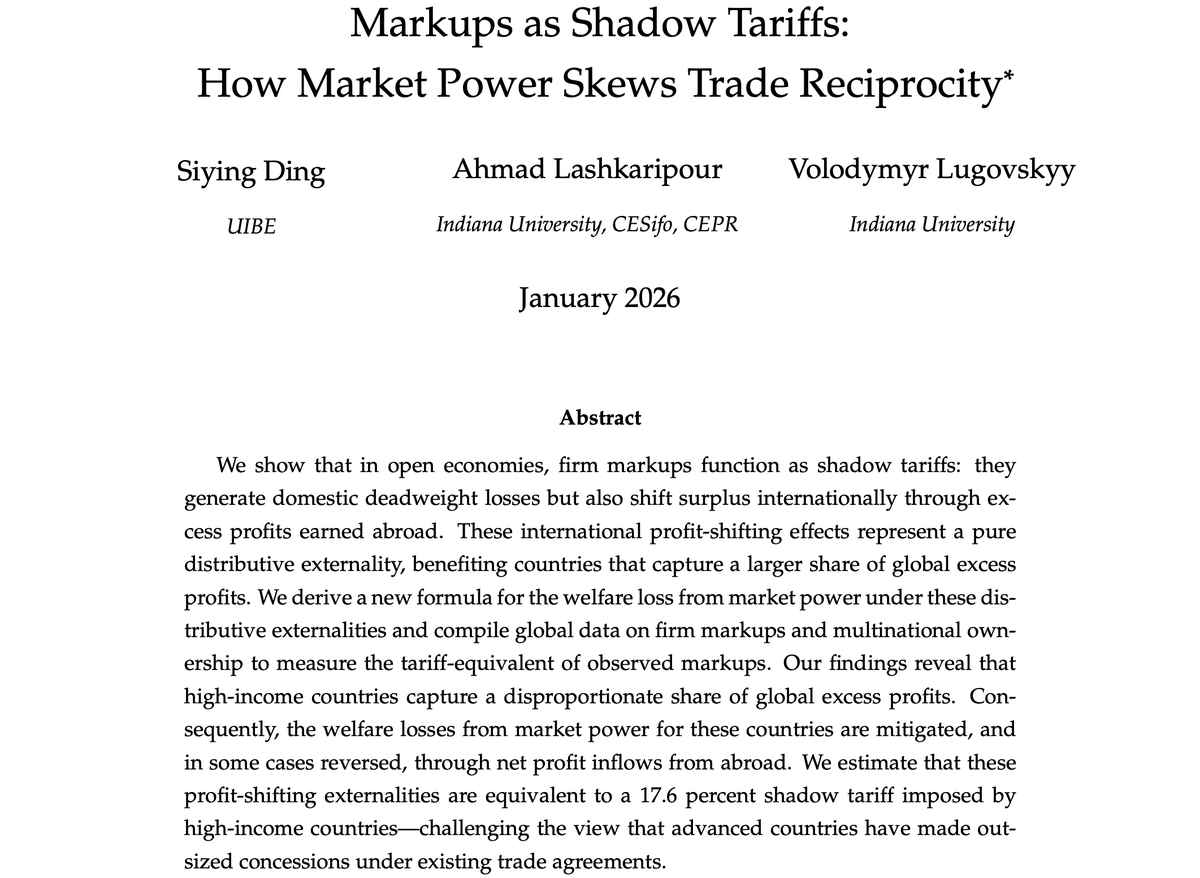
Our new paper argues that the "tariff reciprocity" debate rests on a mistaken premise.
The common narrative that the U.S. conceded too much in past trade deals and now needs higher tariffs to restore reciprocity gets it backwards.
1/ A thread 🧵
Intermediate macro instructors: You probably need to talk about the impact of AI on the labor market. But to make contact with the notion that this can destroy jobs and potentially reduce wages you need to introduce the task-based model of production. Cobb-Douglas (or CES) just doesn't cut it for this issue.
You might consider using my undergrad textbook chapter on production where I cover this topic in a way that (I hope) is accessible to undergrads (see section 7 of the chapter):
https://t.co/m5lKx5rM3I
I also have a pretty detailed discussion of how technical change affects the labor share and the recent apparent fall in the labor share (section 6), which is obviously related to the AI issue.
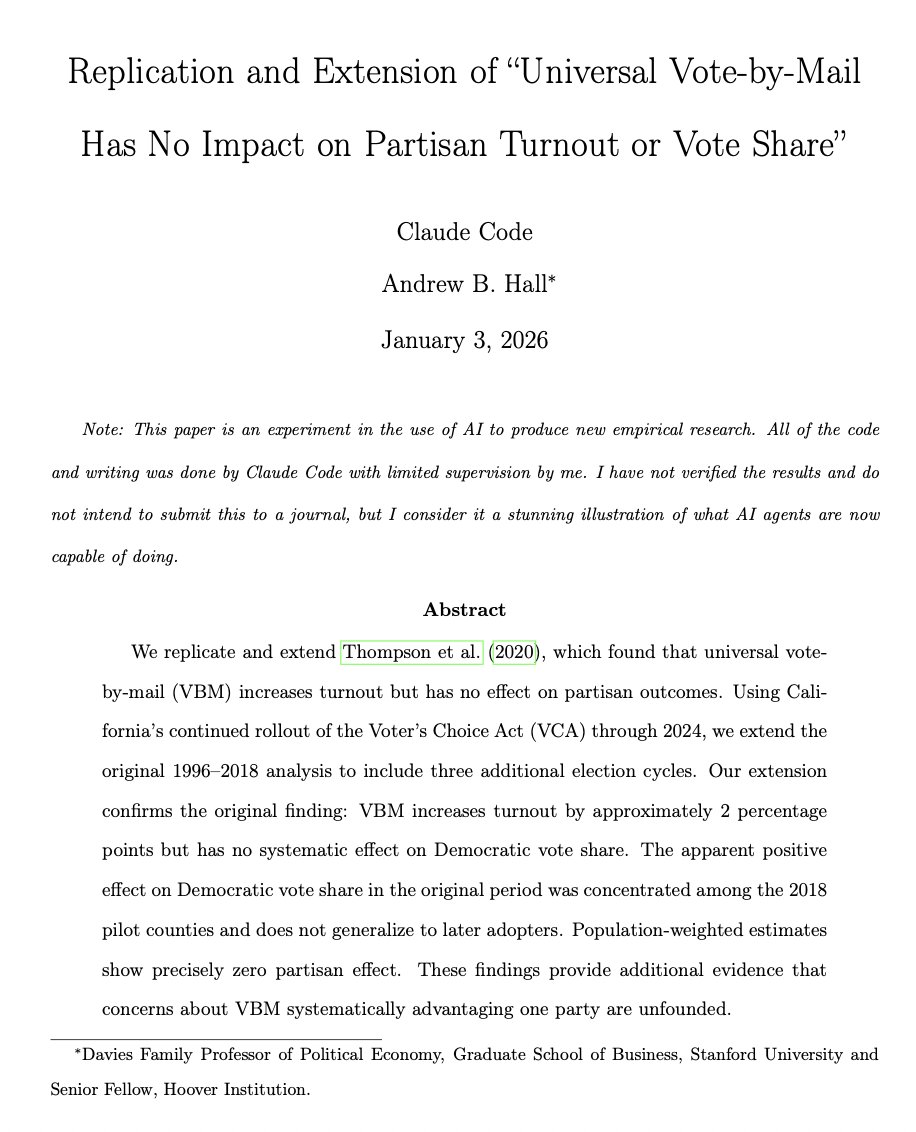
Here's proof that Claude Code can write an entire empirical polisci paper.
To validate my claim that AI agents are coming for polisci "like a freight train", today I had Claude Code fully replicate and extend an old paper of mine estimating the effect of universal vote-by-mail on turnout and election outcome...essentially in one shot.
After careful prompting, Claude Code:
(1) Downloaded the old paper's repo and replicated the past results, translating our old Stata Code into Python
(2) Crawled the web to get updated official election data and census data
(3) Ran new analyses extending the results through 2024
(4) Created new tables and figures
(5) Performed a lit review
(6) Wrote a wholly new paper
(7) Pushed the whole thing to a new github repo
The whole thing took about an hour.
This is an insane paradigm shift in how empirical work is done.
It also validates the point that several people including @BrendanNyhan made yesterday---it's going to be especially easy to scale observational research with AI.
Thanks to @alexolegimas, @arthur_spirling , and many others who gave me feedback. .