How much do the video generation models really understand physics? We build a novel benchmark inspired by the intrinsic physical properties of dynamical systems: the conservation laws. Please check our latest work if you are interested 🥳⚛️
Preprint of today: Zhang, Cherniavskii, Zadaianchuk, Tragoudaras, et al., "MORPHEUS: Benchmarking Physical Reasoning of Video Generative Models with Real Physical Experiments" -- https://t.co/i2N9KY9OoT
Can we use off-the-shelf video models to simulate physics? Perhaps not yet.
In MORPHEUS, we also showed that any prerequisites for quantifying physical plausibility in VGMs is objects permanence, which most model were also strangling with. Great to see approaches that are significantly improving it.
https://t.co/988ExVIVjI
[1/3]Happy to share Gaussian-JEPA, our work on joint-embedding predictive learning for 3D Gaussian splats. 🧩
It replaces raw-attribute reconstruction with latent prediction, improving consistency, partial-input robustness, and shape completion.
Regretfully unable to attend #ICML this year due to unexpected visa processing delay. Still, I’m very keen to discuss Morpheus and explore physical consistency in video generation with fellow researchers. If you're interested, I am happy to share my thoughts!
🎬Video models now make stunningly realistic clips — and we already call them "world models." #ICML2026.🇰🇷
But looking real ≠ being real.
Before trusting them for robotics, self-driving & science: do they actually obey physics?
Morpheus puts them to the test 🧵(1/6)
🎬Video models now make stunningly realistic clips — and we already call them "world models." #ICML2026.🇰🇷
But looking real ≠ being real.
Before trusting them for robotics, self-driving & science: do they actually obey physics?
Morpheus puts them to the test 🧵(1/6)
Large foundation models have made enormous progress in modeling language, images, and video. These systems can generate highly realistic outputs and capture complex statistical structure in data. However, they still operate on projections of the world, text sequences and 2D pixel grids, rather than the world itself.
The real world is not a sequence of text tokens or frames; the real world is inherently anchored in 3D metric space, and dynamics across time. Objects occupy space and persist over time. They interact according to physical laws. Any model that aims to support real-world intelligence, e.g., for robotics, simulation, design, or spatial computing, must capture this structure.
This is where current approaches fall short. While most video models can generate visually plausible frames, they often lack a consistent notion of the underlying scene due to limited context windows. As a result, geometry drifts, scale is ambiguous, objects appear and disappear, and interactions are not physically grounded. The model produces superficial appearance without a persistent world representation.
For many downstream applications, this is not enough.
The first step toward addressing this is modeling 3D space and keeping it consistent. A model should recover a coherent spatial representation of the scene, including layout, geometry, and scale. This not only allows the environment to be rendered from new viewpoints but also, more critically, reasoned about in metric space. If a model cannot produce a stable 3D representation, it is not grounded in the physical world, and it will fail to model the world due to its inefficient contextual memory.
However, 3D is only the beginning.
A truly useful world model must also be temporally and physically consistent. It should not only reconstruct a scene, but also simulate it, predicting how it evolves, how objects interact, and what happens under intervention. Eventually this requires moving beyond static representations toward models that capture dynamics and causality.
I believe that generative approaches are highly compelling in this context, as they can be trained on large-scale data in a self-supervised fashion. In particular, comprehensive 3D world modeling is a highly-promising path forward, since richer environmental representations directly enable deeper and more effective learning of physical reality. Crucially, such generation enforces consistency: for instance, to generate a scene across viewpoints, a model must implicitly recover its underlying 3D structure. To generate it over time, it must capture its dynamics. This forces the model to internalize the latent state of the world, including geometry, scale, materials, motion, and physical behavior.
This also highlights a limitation of purely abstract representations. High-level embeddings or action-centric models can be effective for specific tasks, but without the ability to model and simulate the world, they will eventually remain incomplete. They compress observations, but do not fully model the underlying process that generates them.
The next generation of AI systems should therefore move beyond text and pixels, and toward physically-grounded world models: models that represent space, maintain consistency over time, and enable simulation and interaction.
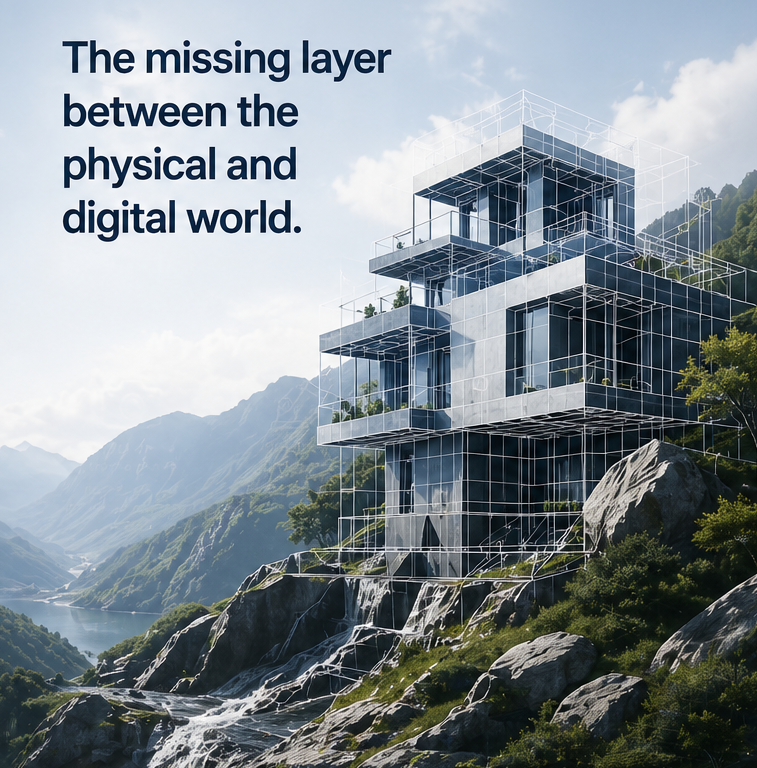
This is the missing layer between the physical and digital world, which will ultimately enable AI systems not just to observe the world, but to understand and operate within it.
At the end of DeepSeek's official blog in Chinese:
"Unmoved by praise, unafraid of slander, one walks the way and keeps oneself upright."
Original: 不诱于誉,不恐于诽,率道而行,端然正己
We keep striving to build things that bring long-term value to everyone.
We hope you enjoy our latest model — try it now on web, app, and API 🚀
「不诱于誉,不恐于诽,率道而行,端然正己」
“Science cannot solve the ultimate mystery of nature. Because, in the end, we ourselves are part of the mystery.” — Max Planck
Max Planck was once told by his professor that almost everything in physics was already discovered, leaving little room for new work. Rather than chasing novelty, Planck replied that his aim was to understand the deeper principles governing the field.
That mindset carried him forward. Instead of being held back by skepticism, he went on to redefine physics itself, laying the foundation of quantum theory. His work reshaped our understanding of the atomic and subatomic world, and his impact remains fundamental to modern physics.
For these groundbreaking contributions, he was awarded the Nobel Prize in Physics in 1918.
Collective intelligence for AI-assisted chemical synthesis
Chemistry has a knowledge problem. Hundreds of thousands of new reactions are published every year, joining millions of known transformations across databases and patents. Yet translating that vast literature into actionable experimental protocols—the specific reagents, stoichiometries, temperatures, and workup steps that determine whether a reaction actually works—still depends heavily on individual expertise and laborious manual searches.
Haote Li and coauthors take a different approach. Instead of training one massive model on everything, they partition the chemical reaction space into 2,498 Voronoi regions using a learned distance metric, then fine-tune a specialized LLM expert for each region using LoRA adapters on Llama-3.1-8B-instruct.
The result is MOSAIC: a searchable ensemble where any new reaction query gets routed to the most relevant experts, who generate complete, human-readable synthesis procedures—not just condition suggestions, but full protocols with quantities, timing, and purification steps.
With a 71% experimental success rate across 52 attempted transformations, the system enabled synthesis of over 35 novel compounds spanning pharmaceuticals, materials science, agrochemicals, and cosmetics—most on the first attempt using top-ranked predictions.
Remarkably, MOSAIC also guided development of a genuinely new reaction methodology for azaindole synthesis that was absent from its training data, suggesting the model can extrapolate beyond known chemistry when related patterns exist.
The message: by combining domain-specific clustering with specialized fine-tuning, it's possible to transform millions of scattered experimental procedures into an accessible collective intelligence—one that provides not just predictions, but executable protocols with built-in confidence metrics, democratizing access to the kind of synthetic intuition that previously required decades of laboratory experience.
Paper: https://t.co/TyUpQntdF9
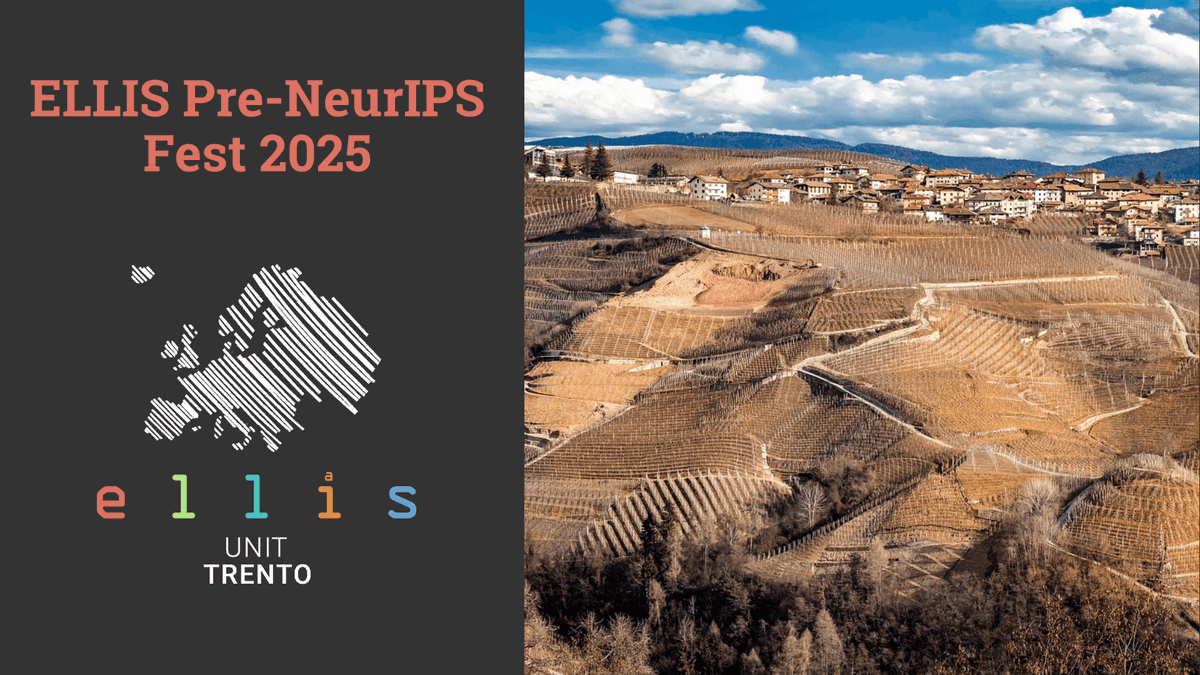
We're ready to connect at the ELLIS Pre-NeurIPS Fest...in Trento 🇮🇹
On Dec 16th at Fondazione Bruno Kessler, meet the local AI/ML community and connect with the broader ELLIS network with the ELLIS Unit Trento.
🔗 More info → https://t.co/PHBIkeZTCZ
#NeurIPS2025
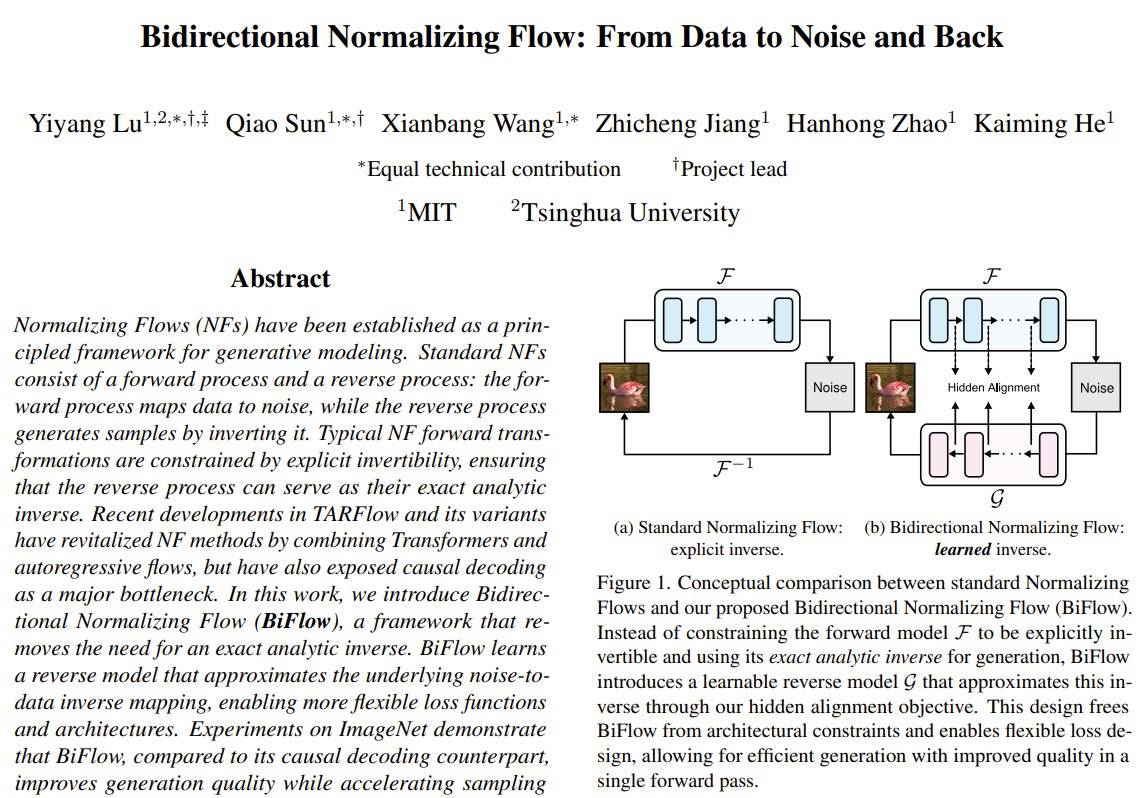
What if you could generate high-quality images 100x faster?
A new AI model, Bidirectional Normalizing Flow (BiFlow), breaks a key bottleneck in generative AI by learning a flexible reverse process, achieving state-of-the-art results on ImageNet.
Bidirectional Normalizing Flow: From Data to Noise and Back
Paper: https://t.co/6Sh1zWBof5
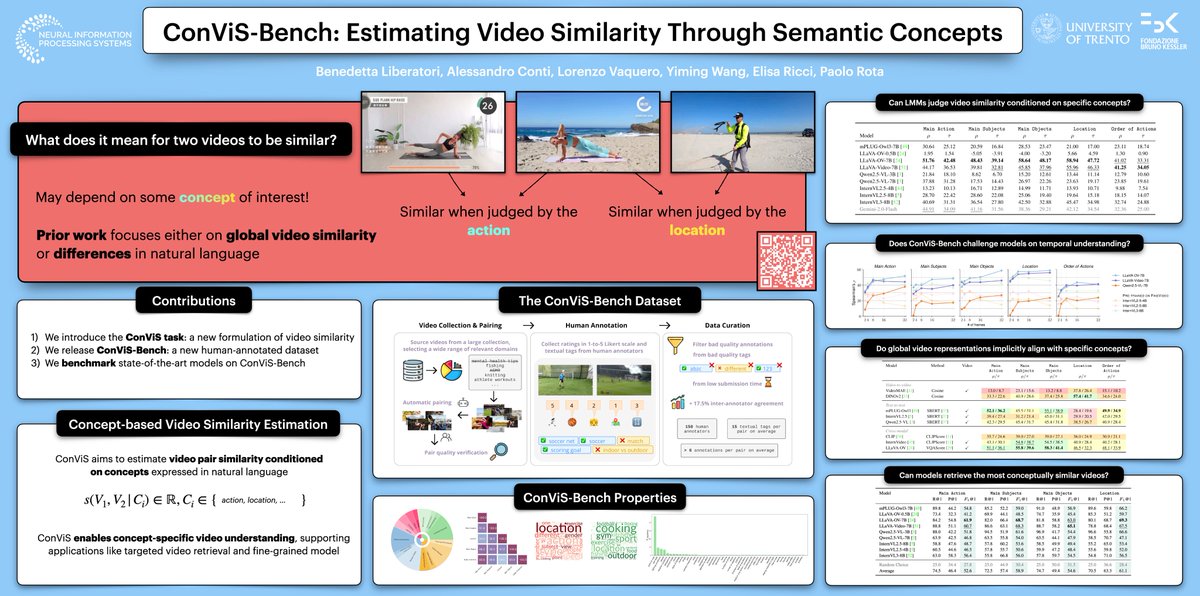
What does it really mean for two videos to be similar?
At #NeurIPS2025, we’ll present ConViS-Bench: Estimating Video Similarity Through Semantic Concepts.
Stop by our poster for a chat!
📍Exhibit Hall C,D,E — Poster N.4618
🕒 Thu, Dec 4, 2025 • 11:00 AM – 2:00 PM PST
I'll be #NeurIPS2025 next week! DM me if you want to chat about AI4Bio, protein design & engineering or AI-Biosecurity. We’re also building in the AI×Bio space and excited to talk with other founders and investors.
Check out some of my works here: https://t.co/5FhiGfra96
I call @iclr_conf to send an official email to ALL authors & reviewers regarding the leakage incident:
- We need transparency in communication. A conference cannot rely on social media; a direct email ensures everyone gets the same facts.
- We need clear guidance on the remediation & protocols going forward (how fairness will be maintained, options for reviewer recusal)
This is essential to prevent a breakdown in community confidence.


![Hello_RenBin's tweet photo. [1/3]Happy to share Gaussian-JEPA, our work on joint-embedding predictive learning for 3D Gaussian splats. 🧩
It replaces raw-attribute reconstruction with latent prediction, improving consistency, partial-input robustness, and shape completion. https://t.co/BZOzsEW1OM](https://pbs.twimg.com/media/HQBhwuqaMAAQcHI.jpg)