When the smartest mathematician in the world talks about 'nonlinear dynamics,' he means: we're not driving a car where we can just tap the brakes. We're lighting a fire. We're making AI super powerful, but completely ignoring whether we'll actually be able to control it when it really takes off.
Mathematician Terence Tao:
"we have to slow down AI. the pace is insane, and there's no reason to be this fast — no reason at all"
It's amazing how willing we are to change everything without any idea what happens afterward
These are extremely nonlinear dynamics
I wrote about the state of AI, why I’m concerned about the next few years, and the choices we need to make to keep the future in humanity’s hands.
An Alien Mind: https://t.co/FeIfWNe0UE
I wrote about the state of AI, why I’m concerned about the next few years, and the choices we need to make to keep the future in humanity’s hands.
An Alien Mind: https://t.co/FeIfWNe0UE
@ChaseLochmiller@OpenAI GPT-6 Astra, trained on ~100K+ NVIDIA Grace Blackwell NVLink72. From ChatGPT to o1 to Astra in 4 years.
AGI has arrived. Congratulations @OpenAI team.
400K GPUs coming online next.
@ChaseLochmiller@OpenAI GPT-6 Astra, trained on ~100K+ NVIDIA Grace Blackwell NVLink72. From ChatGPT to o1 to Astra in 4 years.
AGI has arrived. Congratulations @OpenAI team.
400K GPUs coming online next.
Checking that a major mathematical proof is correct can take years. Formalization—converting the mathematical reasoning into a form computer proof assistants like Lean can verify—can help.
Last month, Claude completed the first formalized proof of Fermat’s Last Theorem, one of the most famous theorems of all time. This was a project experts thought would take many years. It is the largest Lean proof ever written.
Fermat’s Last Theorem was first proven in 1995 by Sir Andrew Wiles, more than 350 years after it was conjectured. Our proof, which totals over 13 million lines of code, provides machine verification. More importantly, it proves over 29,000 other theorems that the proof requires, across many areas of math which had never before been formalized.
We see this as a major step in the long process of firming up the core of mathematical knowledge, building on work from three centuries of mathematicians and hundreds of contributors to Lean and Mathlib. We are optimistic that AI-assisted verification of mathematical proofs will help reduce the burden of refereeing mathematics in an era where more proofs are being produced than ever before.
You can read about the process on our Science Blog: https://t.co/ryYnDEAU6J
And see the complete proof on GitHub: https://t.co/wlYMXYnofz
Exciting day for NVIDIA and @huggingface.
Open models strengthen safety and cybersecurity, accelerate innovation and diffusion, and enable sovereignty. They allow every developer, startup, university, industry and country to build with, customize and benefit from AI.
Thank you @ClementDelangue for coming to me.
NVIDIA is going to be a great home for Hugging Face, its community and the future of open models. 🤗
https://t.co/q8Om2Xc5ye
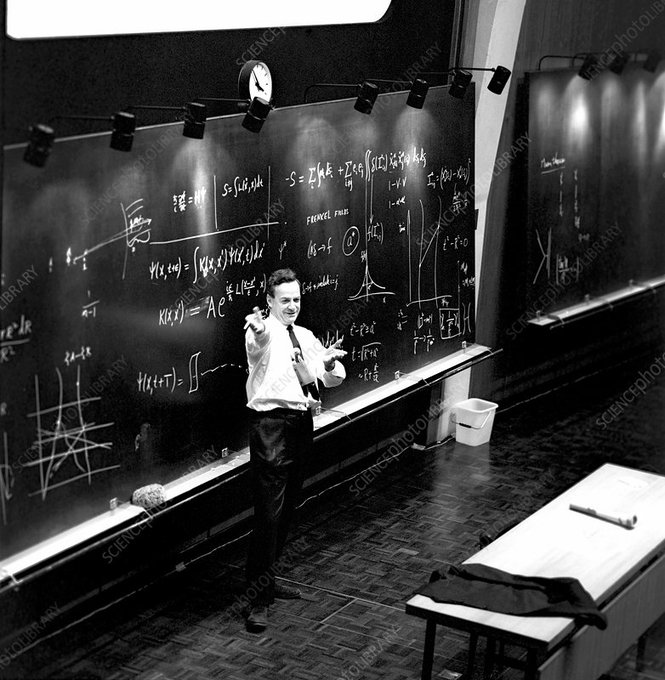
Richard Feynman's Lectures on Physics are timeless: their main strength is in demonstrating how to reason about physics.
You may not know that all the lectures are completely online:
Vol 1: https://t.co/yDpyRViG61
Vol 2: https://t.co/oEctaDhy2X
Vol 3: https://t.co/eXS03nu9fE
How have software engineering fundamentals changed with agentic coding? Here is our AI Engineering Skills map for software engineering fundamentals. https://t.co/cnRLj43DLs
Neil Movva (@neilmovva) started his career at Nvidia, working on GPUs and kernels, and has an unusually deep understanding of inference, from software to chips to power.
We spend a lot of time on each of those layers, how they connect, and where the important tradeoffs are.
What makes this conversation special is how detailed it is (like a 401-level class), yet Neil makes it remarkably clear and easy to follow.
Today he runs Sail Research, a company building infrastructure for agents to make tokens as cheap as possible.
We discuss:
- Latency versus throughput
- Why there are no bad chips, only bad pricing
- The end of kernel engineering
- Buying chips and power no one else wants
- New chip architectures
- Nvidia lore + his contrarian view of the company
- Open source and the frontier labs
I learned a ton. Enjoy!
TIMESTAMPS
0:00 Intro
0:38 Building a “Token Factory”
4:21 The Future of Background Agents
13:09 Nvidia and the GPU Stack
23:27 Chips, Memory, and Transformers
36:14 The Future of AI Training Data
44:32 Chip Scarcity and Compute Arbitrage
52:44 Reinventing the AI Data Center
59:01 Power and the “Scavenger Strategy”
1:10:10 Open vs. Closed AI
Today I'm publishing a new essay, Policy on the AI Exponential. AI is progressing extremely fast—much faster than the policy process was built to handle. The essay lays out where I think the technology is now, and the action needed to close the gap: https://t.co/Lh6PWae178
For about 10 years now, I have argued that the *only* way forward is for AI technology to be widely available, shared, and open.
Like the printing press and the Internet, AI amplifies human intelligence and efficiency by improving access to knowledge.
To empower individuals, societies require a high diversity of AI systems with different value systems, linguistic abilities, philosophical/political biases, and specific expertise.
We need diverse AIs for same reason we need a diverse press.
Given the cost and complexity, this can only be achieved through open foundation models on top of which anyone can build systems with their languages, biases, expertise, and value systems.
I have been more vocal about this over the last 4 years, since AI popped into the public discourse.
I have made the argument in various forums: corporate C-suites, AI safety discussion groups, professional meeting, the US Senate, the UN Security Council, and the public sphere through media interviews, podcasts and social media posts.
I totally agree with @finkd Mark Zuckerberg's recent piece in which he writes: "the notion that AI is so dangerous that the only safe path is an extreme concentration of power seems inherently problematic. Historically, hoping that an absolute power will benevolently provide for humanity if sufficiently enlightened has not led to safe or positive outcomes.”
When @DarioAmodei writes: “some may object that we can simply keep AIs in check with a balance of power between many AI systems, as we do with humans", he is talking about me, among (thankfully) many others. It is the only good path forward.
There will be nefarious uses of AI, as there have been with every technology ever invented.
But it will be your Bad AI against my Good AI.
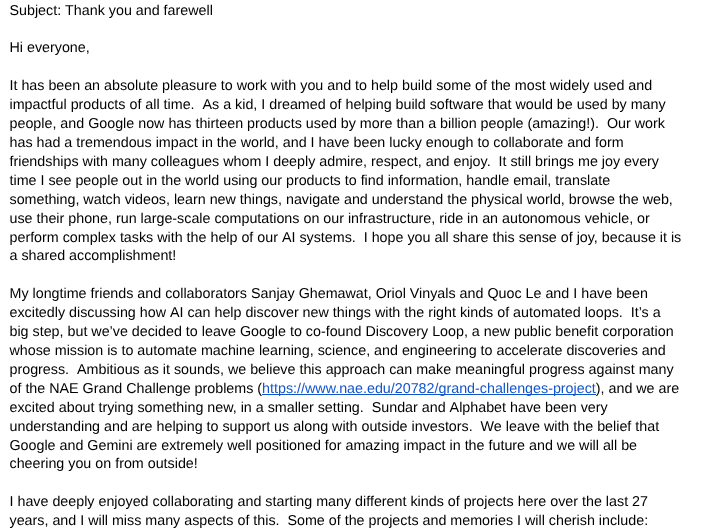
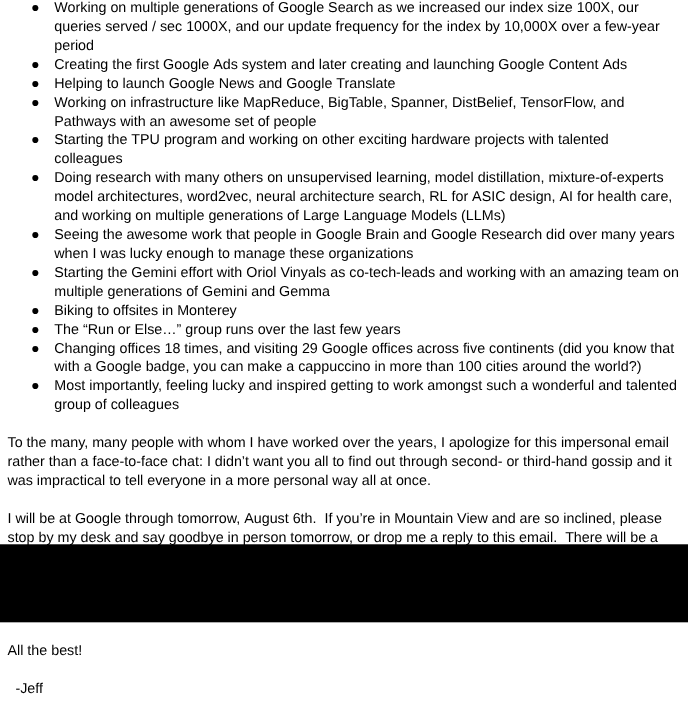
Tomorrow will be my last day at Google after 27 years, and watching it grow from 25 people to 190,000+ has been an amazing journey. Below is a note I shared with many people internally at Google today. An excerpt is:
It has been an absolute pleasure to work with you and to help build some of the most widely used and impactful products of all time. As a kid, I dreamed of helping build software that would be used by many people, and Google now has thirteen products used by more than a billion people (amazing!). Our work has had a tremendous impact in the world, and I have been lucky enough to collaborate and form friendships with many colleagues that I deeply admire, respect, and enjoy. It still brings me joy every time I see people out in the world using our products to find information, handle email, translate documents, watch videos, learn new things, navigate and understand the physical world, browse the web, use their phone, run large-scale computations on our infrastructure, ride in an autonomous vehicle, or perform complex tasks with the help of our AI systems. I hope you all share this sense of joy, because it is a shared accomplishment! Thank you to all of my colleagues at Google over many years!
Now I'm excited to go start @DiscoLoopAI with my longtime friends and colleagues @Sanjay_Ghemawat, @OriolVinyalsML, and @quocleix.
(Updated post: slightly redacted to not have some personal info)
I’ve been working towards AGI my whole life, and as we enter this pivotal moment, I’m stepping into a new role as Chair of Google DeepMind & Chief Scientist of Alphabet. This will allow me to focus on long-term strategy, and accelerating scientific breakthroughs, including leaning into my work at Isomorphic to help cure disease.
I’m excited that @koraykv will be stepping up to lead GDM as SVP, alongside @joshwoodward and our exec team. I could not be more excited and confident about our amazing next chapter! 🚀
https://t.co/2WtlIIlTUa