Super interesting!
"A History of Macroeconomics" by Francesco Sergi, Beatrice Cherrier, Aurélien Saïdi, Pedro Duarte, Aurélien Goutsmedt, Matthieu Renault, and Juan Acosta.
"The history of macroeconomics outlined in this book is dense and complex. This mirrors both the flourishing historical scholarship and the richness of the subject itself. Yes, macroeconomics is complicated and hard (much more than usually acknowledged in macroeconomics textbook narratives). But this is a good thing, especially as it results from the sheer diversity of topics, of theoretical and methodological patterns, and from the entanglements with other fields as well as policymaking. And yet, the chronology that we offer (birth, bridges, frictions, constellation) helps navigate such a complex story by pointing to our main takeaways. We believe that the different audiences of macroeconomics deserve such an evidence-based, encompassing history, and that our history should, and can, be integrated into macroeconomics textbooks."
https://t.co/ps6Db8cbNp
INSTEAD OF WATCHING NETFLIX TONIGHT. Spend 2 hours with this. Claude AI FULL COURSE that teaches you how to BUILD and AUTOMATE anything. The people who watch this tonight will wake up tomorrow with a new skill. Watch it and bookmark it now.
INSTEAD OF WATCHING NETFLIX TONIGHT. Spend 2 hour with this.
Claude AI FULL COURSE that teaches you how to BUILD and AUTOMATE anything.
The people who watch this tonight will wake up tomorrow with a new skill.
Watch it and bookmark it now. 🔖
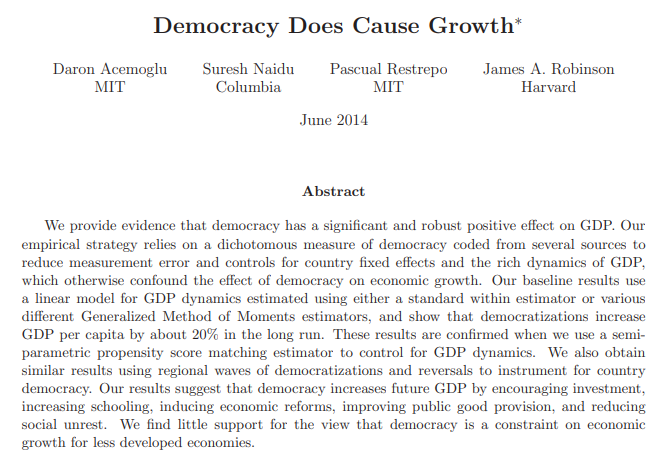
"even if it produces demonstrably worse outcomes"
It doesn't, though.
"Democratizations increase GDP per capita by about 20% in the long run"
https://t.co/s1XSWAAaxD
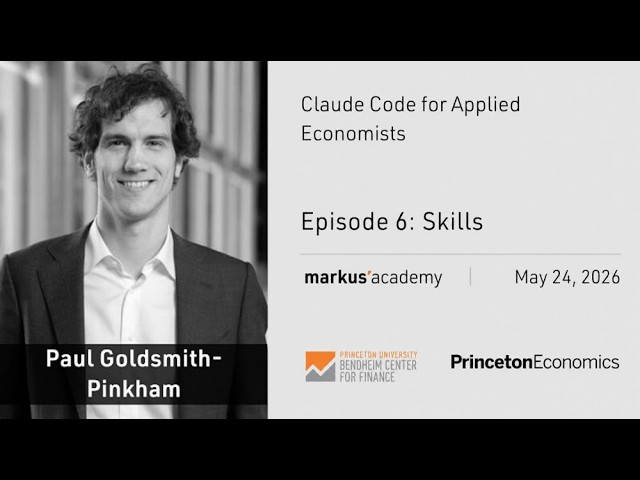
Claude Code for Academic Research
Paul Goldsmith-Pinkham from Yale is back has another Claude Code session for researchers (it's great for researchers far beyond only economists).
30 min video: learn to set up your own "Skills" in Claude Code.
Link in reply below:
This is a great lecture at MIT by David Shirokoff on Markov Chains.
He covers the fundamentals of Markov Chains using a simple particle movement example.
He starts by explaining how a particle moves between two positions, A & B, with different probabilities. From there, the talk converts the problem into matrix form using a Markov matrix.
The main topics covered are:
- Transition probabilities
- Markov matrices
- Probability vectors
- Matrix multiplication in Markov Chains
- Finding probabilities after n steps
- Eigenvalues and eigenvectors
- Matrix diagonalization
- Long-term steady state distribution
How does climate sci reach the public? New paper used LLMs to analyze 114k claim pairs.Result: Both IPCC summaries & media coverage systematically exaggerate the severe end of sci ranges.
We need objective data, not headlines.
#ClimateScience#IPCC#MediaLiteracy#LLM
Both IPCC policymaker summaries and subsequent newspaper coverage systematically frame climate findings toward the more severe end of the underlying technical evidence, from @SFGaliani, @Franco_MettLG, and @raul_sosa2908 https://t.co/RrCZRKyA1o
Why is buying heroin easier than hiring a hitman? @TheEconomist this week wrote about a new book, Moral Economics, by Alvin Roth, Nobel laureate and SIEPR senior fellow, that looks at markets for "repugnant transactions." Here, Roth explains all: https://t.co/MtmokerydK
The Core Finding: By 2019, Chile’s GDP per capita was $4,012 USD higher than it would have been without the economic liberalization reforms or Chicago boys.
Chile's GDP per capita shifted from just 44.4% of Argentina’s level in 1960 to overtaking Argentina at 107.8% by 2015.
Found another synthetic control which reports counterfactually higher GDP per capita relative to the non-reformist counterfactual. As always, the weighted countries scream selection bias, but are certainly better than anything from Escalante’s short SCM window using Panama in the synthetic weighting.
https://t.co/bB7QY06LBV
Is GenAI causing the relative decline in early-career hiring? Our latest research finds that these effects may be conflated with another important driver: the rise of WFH arrangements (1/N)
Online Summer School:
If you or your student(s) want to join, please register soon! (It's free, but hard and rewarding work esp. for current and future PhD students) https://t.co/oryNoRLItO
📣📣 𝗖𝗮𝗹𝗹 𝗳𝗼𝗿 𝗣𝗮𝗽𝗲𝗿𝘀 📣📣
EGC/IGC Conference on Firms, Trade, and Development
@YaleEGC & @The_IGC invite paper submissions for a two-day in-person conference at @Yale September 10-11, 2026
Submit papers by June 1 here: https://t.co/LY6mf6Olaz
This is a subtle but thought-provoking paper that I think everyone should read. Ordinarily, we assume some way that firms compete, whether on prices or quantities. What happens if the choice of competition is itself chosen? Monetary policy might fail us when we need it most. 1/
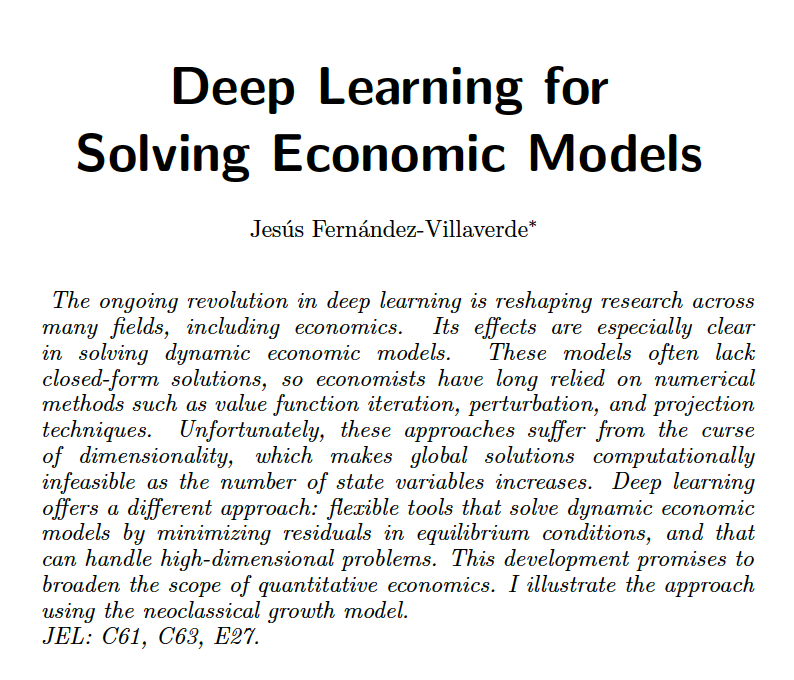
I am very happy that my survey paper, "Deep Learning for Solving Economic Models," is forthcoming in the Journal of Economic Literature (pending final replication checks, which should be quick).
The paper benefited greatly from the editor, David Romer, five referees, and many friends who read earlier versions. I believe the result is a solid introduction to the field, though in 48 pages, there is only so much one can do. So, I created a companion webpage:
https://t.co/zZpOLFXpDk
where you can find the paper, the code, and some slide decks with my teaching material. My plan is to expand the slides over time, adding new material and updating them as new results appear. I will probably do a thorough revision once the spring semester is over.
Those who follow my feed know that I think deep learning is the most fundamental change to computational economics in the last 40 years. I am by now convinced it is more important than the development of Markov chain Monte Carlo methods in the early 1990s or the introduction of projection and perturbation methods in the 1980s. To find a comparable shift, one would probably need to go back to Richard Bellman's invention of value function iteration in 1957.
More pointedly, we need to redesign the Ph.D. in economics. Not at the margin. From the ground up. Economists can either fully embrace the deep learning revolution or become irrelevant, as has already happened, I would dare say, to some fields in academia that refused to accept reality.
Finally, let me apologize to everyone working in this area whom I could not cite. Space was a binding constraint.
And yes, this post was written with the considerable help of AI. There is nothing I am prouder of than the fact that AI is now an integral part of every step I take in my professional life.
𝗝𝗼𝗵𝗻 𝗦𝘁𝘂𝗮𝗿𝘁 𝗠𝗶𝗹𝗹
For those looking to read works by John S. Mill, you can download his 𝘊𝘰𝘭𝘭𝘦𝘤𝘵𝘦𝘥 𝘞𝘰𝘳𝘬𝘴 here for free: https://t.co/DSju7svPMs
For researchers, this is a great resource.