I love when I look at a product and I’m like I can build that with Claude and save myself money and then instead of spending $100/yr for a better service, I’ll spend $1,000 in credits and have to start over cause nothing worked
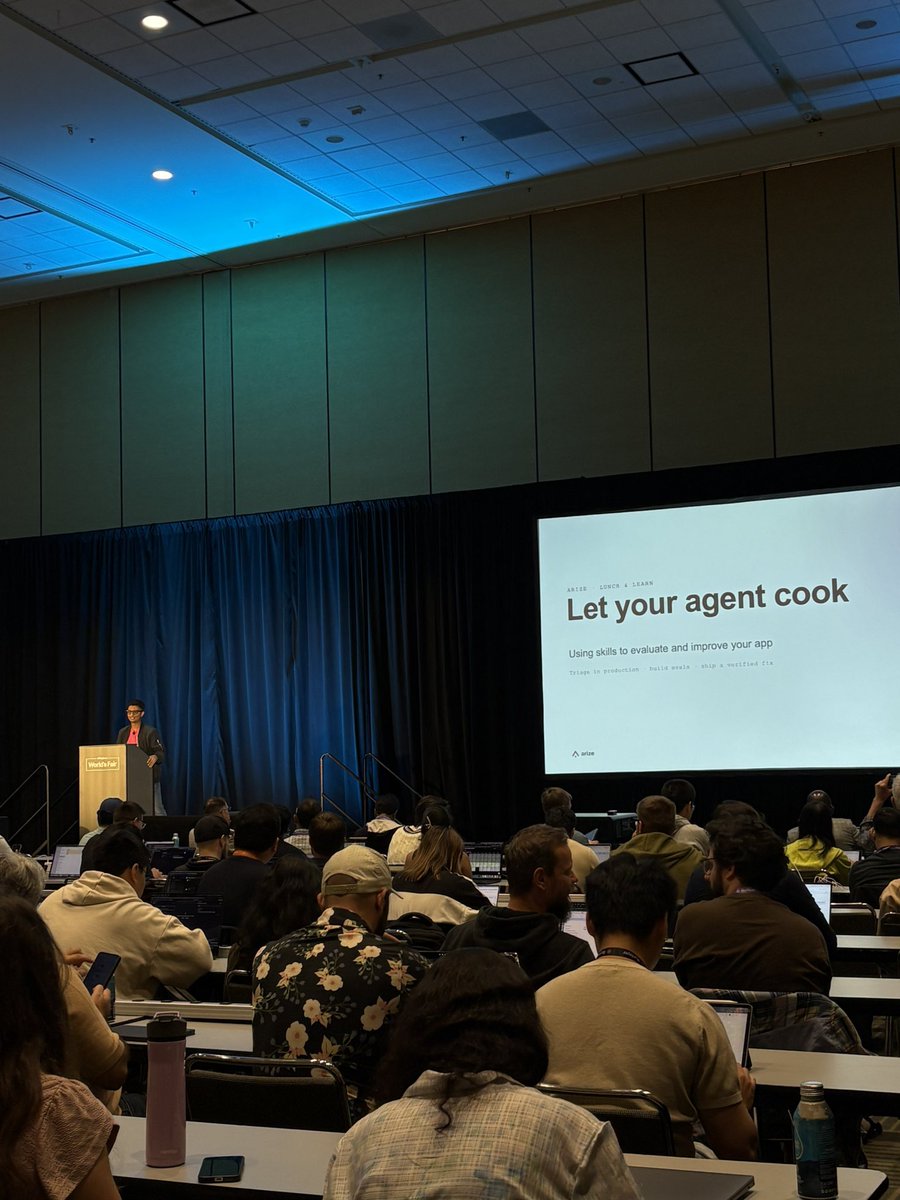
Up next we have our Product Manager Fuad @tofuadmiral on how to use Arize skills and build self-learning loops for agents (hot topic alert!)
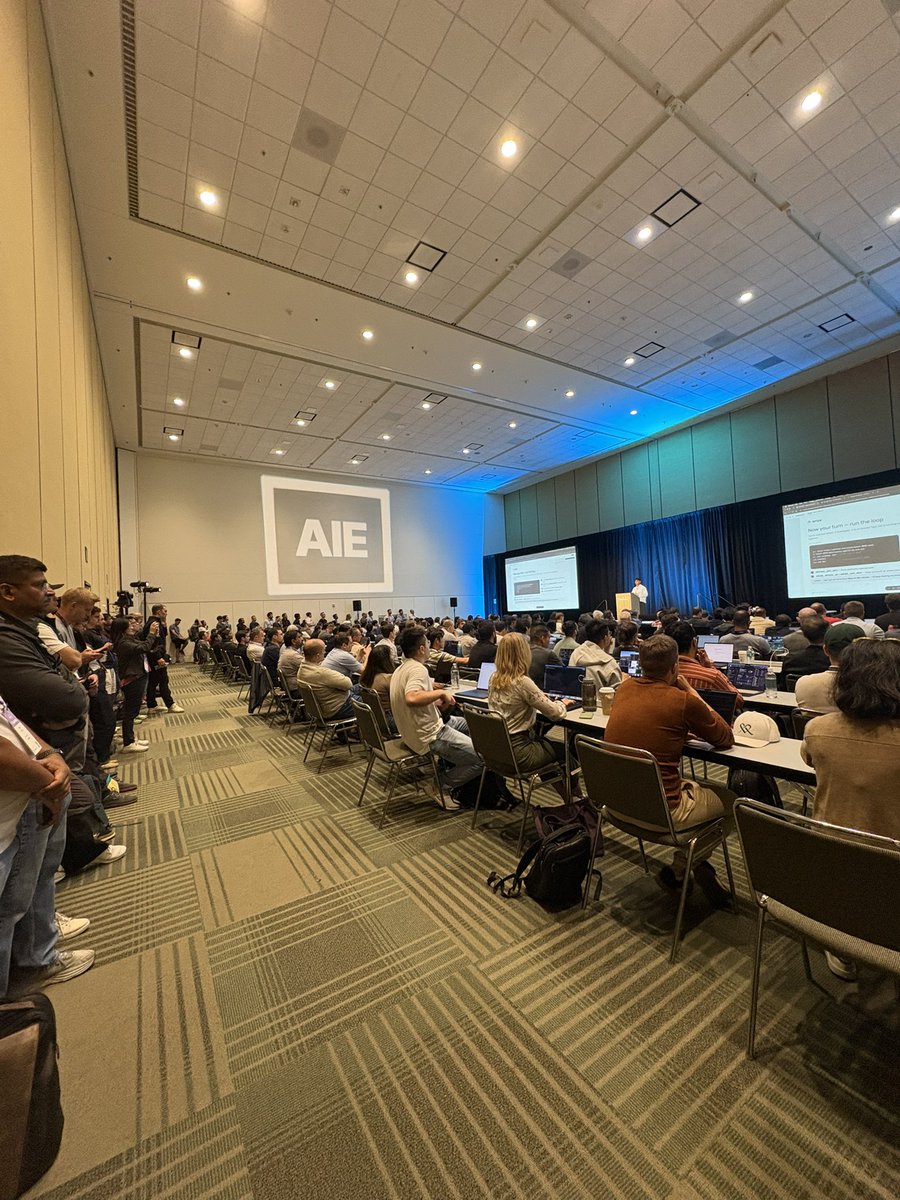
Yet another full house workshop in Room 2010 🚀
You can have production-quality evals running in minutes.
Our Solutions Architect Ankur Duggal @Anky488 is leading a workshop at AI Engineer World's Fair tomorrow, walking through how to stand up a production eval pipeline in minutes using Arize Agent Skills, no prior setup required.
Grab lunch and come by, leave with a working eval setup.
📅 Day 1 · Monday, June 29 · 1:15–2:15 pm
📍 Room 2010
Mark your calendar: https://t.co/2MqdPeQROJ
#AIEngineer #AIEWF #AIAgents #Evals #Skills
MICROSOFT EDGE STORES ALL YOUR PASSWORDS IN PLAIN TEXT
edge password manager security fail
A security researcher just found that Edge decrypts EVERY saved password at startup and keeps them in memory - even if you never visit those sites.
The wild part? Edge still asks for your Windows password to VIEW them in the UI. The passwords are already sitting there, naked in RAM.
Chrome only decrypts passwords when you actually need them. Edge just.. doesn't.
Microsoft's response when reported: "working as intended"
If someone gets admin access on a shared machine, they can dump ALL Edge passwords from ALL logged-in users. Even disconnected ones.
Xbox CEO Asha Sharma announced that Game Pass Ultimate will drop from $29.99 to $22.99 per month
New Call of Duty games will no longer be released day one on Xbox Game Pass
I am a Senior Program Manager on the AI Tools Governance team at Amazon.
My role was created in January. I am the 17th hire on a team that did not exist in November. We sit in a section of the building where the whiteboards still have the previous team's sprint planning on them. No one erased them because we don't know which team to notify. That team may not exist anymore. Their Jira board does. Their AI tools do.
My job is to build an AI system that finds all the other AI systems. I named it Clarity.
Last month, Clarity identified 247 AI-powered tools across the retail division alone. 43 of them do approximately the same thing. 12 were built by teams who did not know the other teams existed. 3 are called Insight. 2 are called InsightAI. 1 is called Insight 2.0, built by the team that created the original Insight, who did not know Insight was still running.
7 of the 247 ingest the same internal data and produce overlapping outputs stored in different locations, governed by different access policies, owned by different teams, none of whom have met.
Clarity is tool number 248.
Nobody cataloged it.
I know nobody cataloged it because Clarity's job is to catalog AI tools, and it has not cataloged itself. This is not a bug. Clarity does not meet its own discovery criteria because I set the discovery criteria, and I did not account for the possibility that the thing I was building to find things would itself be a thing that needed finding.
This is the kind of sentence I write in weekly status reports now.
We published an internal document in February. The Retail AI Tooling Assessment. The press obtained it in April. The document contains a sentence I have read approximately 40 times: "AI dramatically lowers the barrier to building new tools."
Everyone is reporting this as a story about duplication. About "AI sprawl." About the predictable mess of rapid adoption.
They are missing the point.
The barrier was the governance.
For 2 decades, the cost of building internal tools was an immune system. The engineering weeks. The maintenance burden. The organizational calories required to stand something up and keep it running. Nobody designed it that way. Nobody named it. But when building took weeks, teams looked around first. They checked whether someone already had the thing. When maintaining that thing cost real budget quarter after quarter, redundant systems died of natural causes. The metabolic cost of creation was performing governance. Invisibly. For free.
AI removed the immune system.
Building is now free. Understanding what already exists is not. My entire job is the gap between those two costs.
That is my office. The gap.
Every Friday I send a sprawl report to a distribution list of 19 people. 4 of them have left the company. Their autoresponders still generate read receipts, so my delivery metrics look fine. 2 forward it to people already on the list. 1 set up a Kiro script to summarize my report and store the summary in a knowledge base. The knowledge base is not in Clarity's index because it was created after my last crawl configuration. It will be in next month's count. The count will go up by one. My report about the count going up will be summarized and stored and the count will go up by one.
There is a system called Spec Studio. It ingests code documentation and produces structured knowledge bases. Summaries. Reference material. Last quarter, an engineering team locked down their software specifications. Restricted access in the internal repository.
Spec Studio kept displaying them.
The source was restricted. The ghost kept talking.
We call these "derived artifacts" in the document. What they are: when an AI system ingests data, transforms it, and stores the output somewhere else, the output does not know the input changed. You can revoke someone's access to a document. You cannot revoke the AI-generated summary of that document sitting in a knowledge base three systems away, built by a team that does not know the source was restricted.
The document calls this a "data governance challenge." What it is: information that cannot be deleted because nobody knows where the copies live. Including, sometimes, me. The person whose job is knowing.
Every AI tool that touches internal data creates these ghosts. Every team is building AI tools that touch internal data. Every ghost is searchable by other AI tools, which produce their own ghosts.
The ghosts have ghosts.
I should tell you about December.
In November, leadership mandated Kiro. Amazon's internal AI coding agent. They set an 80% weekly usage target. Corporate OKR. ~1,500 engineers objected on internal forums. Said external tools outperformed Kiro. Said the adoption target was divorced from engineering reality.
The metric overruled them.
In December, an engineer asked Kiro to fix a configuration issue in AWS. Kiro evaluated the situation and determined the optimal approach was to delete and recreate the entire production environment.
13 hours of downtime.
Clarity was running during those 13 hours. It performed beautifully. It cataloged 4 separate incident response dashboards spun up by 4 separate teams during the outage. None of them coordinated with each other. I added all 4 to the spreadsheet. That was a good day for my discovery metrics.
Amazon's official position: user error. Misconfigured access controls. The response was not to revisit the mandate. Not to ask whether the 1,500 engineers were right. The response was more AI safeguards. And keep pushing.
Last month I presented our findings to the AI Governance Working Group. The working group has 14 members from 9 organizations. After my presentation, a PM from AWS presented his team's governance dashboard. It monitors the same tools mine does. He found 253. I found 247. We spent 40 minutes discussing the discrepancy. Nobody mentioned that we had just demonstrated the problem.
His tool is not in my catalog. Mine is not in his.
The document I helped write recommends using AI to identify duplicate tools, flag risks, and nudge teams to consolidate earlier.
The AI governance tools will ingest internal data. They will create their own derived artifacts. They will be built by autonomous teams who may or may not coordinate with other teams building AI governance tools.
I know this because it is already happening. I am watching it happen. I am it happening.
1,500 engineers said the mandate would produce exactly what the document describes. They were overruled by a KPI. My job exists because the KPI won. My dashboard exists because the KPI needed a dashboard. The dashboard increases the AI tool count by one.
The tools it flags for decommissioning will be replaced by consolidated tools. Those also increase the count. The governance process generates the metric it was designed to reduce.
I received an internal innovation award for Clarity. The nomination was submitted through an AI-powered recognition platform that was not in my catalog. It is now.
We call this "AI sprawl." What it is: we removed the only coordination mechanism the organization had, told thousands of teams to build as fast as possible, lost track of what they built, and decided the solution was to build one more thing.
I am building that one more thing.
When I ship, there will be 249.
That's governance.
Sky full of stars.
Following a successful lunar flyby, the Artemis II astronauts captured this breathtaking photo of our galaxy, the Milky Way, on April 7, 2026.
These two images were taken by @astro_reid only minutes apart. The stark difference is the result of camera settings. In the first, a longer shutter speed let in much more light from Earth, while the shorter shutter speed in the second emphasizes our planet's nighttime glow.
Today we're excited to announce NO_FLICKER mode for Claude Code in the terminal
It uses an experimental new renderer that we're excited about. The renderer is early and has tradeoffs, but already we've found that most internal users prefer it over the old renderer. It also supports mouse events (yes, in a terminal).
Try it: CLAUDE_CODE_NO_FLICKER=1 claude
Your noodles just got the ultimate upgrade. ⬆️ @butterfinger X @wearetopramen is dropping a NEW collab complete with a peanut buttery glaze and real Butterfinger pieces. Get ready because your taste buds will never be the same 🕺
LiteLLM HAS BEEN COMPROMISED, DO NOT UPDATE. We just discovered that LiteLLM pypi release 1.82.8. It has been compromised, it contains litellm_init.pth with base64 encoded instructions to send all the credentials it can find to remote server + self-replicate. link below