65% of family offices say AI is their #1 priority.
JP Morgan checked their portfolios.
More than half had zero VC exposure.
Zero.
They want the AI return.
They just don't want the AI risk.
The best deals won't wait for them to get comfortable.
#FamilyOffices#VentureCapital #AI
Hegseth today: the Hormuz blockade will last "as long as it takes."
25% of the world's oil moves through that strait.
13 ships turned back this week alone.
Ceasefire talks are the only thing keeping oil below $100 right now.
If they fail, nobody has a number for where this goes.
83% of CFOs are raising AI budgets.
Only 20% have anything to show for it.
That gap is worth billions.
Bain just surveyed 100+ CFOs at companies generating $5B+ in revenue.
The headline sounds bullish:
→ 83% raising AI budgets by 15%+
→ 42% boosting by 30% or more
→ Finance functions getting the biggest slice
But bury the lead and you miss the story.
Only 15–20% have actually scaled AI.
Most are still running pilots.
And just 31% of CFOs rate their AI outcomes as "strongly positive."
Here's what that tells you.
The money isn't buying results. It's buying optionality.
Right now, every CFO is making the same bet. The ones who execute — not just invest — will separate themselves permanently.
How permanent?
CFO satisfaction at AI-mature firms: 60%+
CFO satisfaction still in pilot mode: 25%
That's not a technology gap. That's a compounding moat.
And here's the finding nobody is talking about:
When CFOs named their #1 AI win — it wasn't cutting costs.
It was SPEED.
Faster close cycles. Faster forecasting. Faster reallocation of capital.
In a world of $100 oil, rate uncertainty, and geopolitical shocks — the company that can reforecast in hours instead of weeks doesn't just survive volatility.
It exploits it.
The investment thesis writes itself:
→ AI infra spend is accelerating — not plateauing
→ The execution gap between leaders and laggards is widening every quarter
→ The picks-and-shovels layer (data infra, AI finance tooling) is not priced in
Every CFO is signing the checks.
Very few are cashing the returns yet.
That window does not stay open.
Are you watching the companies closing the gap — or still waiting for the headline?
#AI #Finance #CFO #Investing #CapitalMarkets #ArtificialIntelligence #FutureOfFinance #Bain
In 2008, someone sent a 9-page document to a mailing list.
No name. No face. No institution behind it.
Just an idea and a pseudonym: Satoshi Nakamoto.
That document became Bitcoin.
That pseudonym became the greatest mystery in financial history.
Until today.
The New York Times published an 18-month investigation pointing to one man: Adam Back. 55-year-old British cryptographer. CEO of Blockstream. One of the earliest figures in Bitcoin's story.
He denied it. Called it confirmation bias.
Here's what this actually signals for investors:
For 15 years, Satoshi's silence was Bitcoin's greatest asset. No founder meant no single point of failure. No face meant no regulators could knock on a door. The anonymity wasn't accidental it was structural protection worth trillions.
If Back is Satoshi, he holds an estimated 1 million BTC $71B at today's price. Untouched for 15 years. One move from that wallet and every market Bitcoin touches would feel it.
Two things worth noting beyond the headline:
The timing is extraordinary. Bitcoin is at $71,000. Global markets are in freefall from tariff wars. The world's most "neutral" asset just became the centre of the most consequential identity story in crypto history.
And institutional investors who built their Bitcoin thesis on decentralisation now have a new question on their risk register: what if there was always a founder?
Every great myth has a moment of reckoning.
This might be Bitcoin's.
Identity. Decentralisation. Systemic risk.
hashtag#Bitcoin hashtag#CryptoInvesting hashtag#VentureCapital
Yesterday everyone was panic-selling.
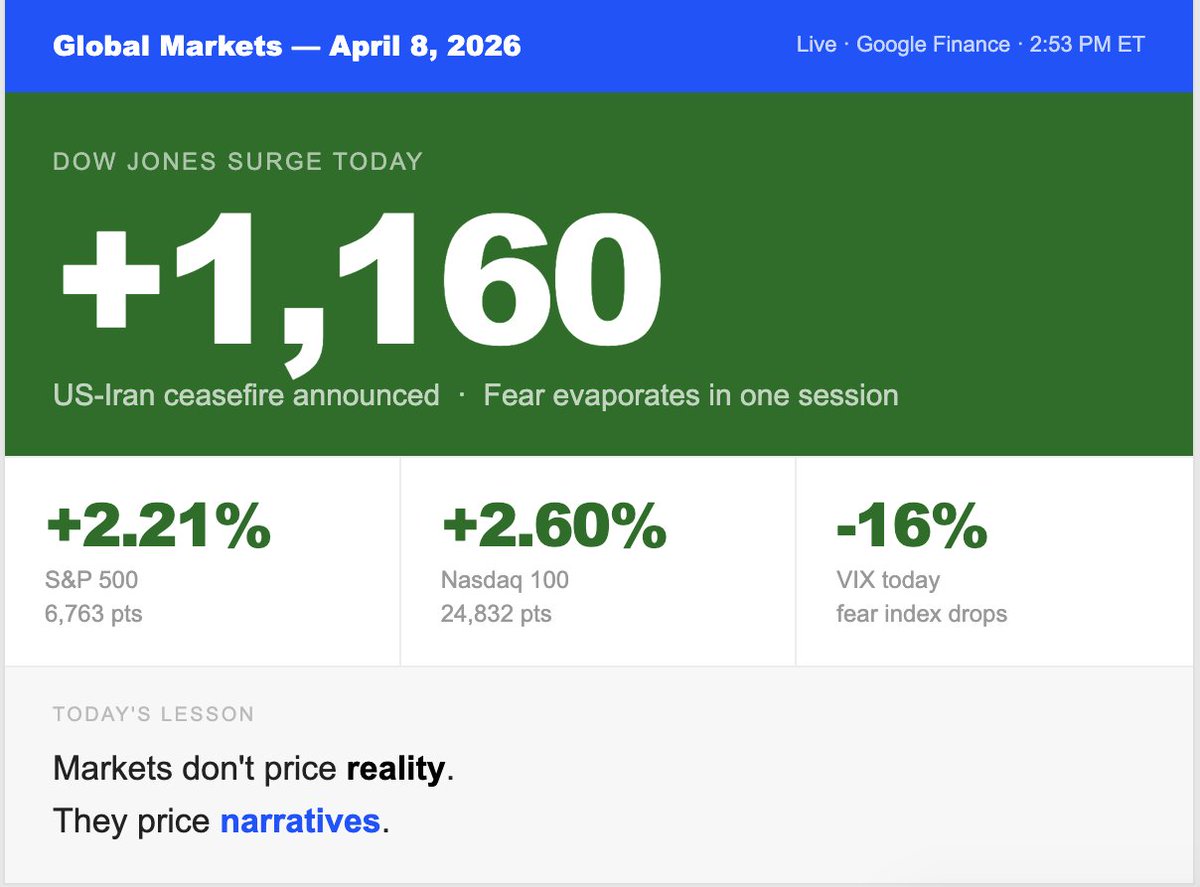
Today the Dow is up 1,000+ points.
Same companies. Same fundamentals.
Different headline.
This is the most important investing lesson playing out in real time.
S&P 500: +2.21% today. Nasdaq: +2.60%. Dow: +2.48%.
All driven by a single piece of news — a 2-week US-Iran ceasefire.
Here's what this actually signals:
Markets don't price reality. They price narratives. Last week, the narrative was tariff apocalypse. Today it's geopolitical relief. The underlying businesses didn't change. The story did.
This is why the investors who sold in panic last week are now buying back at higher prices — paying a premium for the courage they didn't have when it was cheap.
Two things worth noting beyond the green numbers:
The VIX just dropped 16% in a single session. Fear evaporated as fast as it arrived. That's not a stable market — that's a market running on sentiment, not structure. Volatility at this speed cuts both ways.
And the investors quietly accumulating during last week's selloff? They just got paid. Not because they predicted the ceasefire. Because they had a thesis that didn't depend on the next headline.
The market rewards patience disguised as conviction.
Were you buying last week — or waiting for permission?
Narrative. Patience. Thesis over headlines.
#Investing #VentureCapital #MarketVolatility
A 3-year-old company just raised $500M.
No profitable quarter. No hardware. No proprietary model.
Valuation: $9B.
Bezos and SoftBank both signed the check.
Here's what this deal actually signals:
The market is no longer pricing AI on potential. It's pricing on distribution velocity.
Perplexity didn't win because they built a better LLM. They built a better answer interface and quietly captured a user behavior that Google had owned for 25 years: the instinct to type a question and trust the first result.
That's not a product insight. That's a thesis.
When Bezos and SoftBank co-lead a round at a $9B valuation for a company that's 3 years old, they're not betting on the technology. They're betting on the habit.
Two things worth noting beyond the headline number:
This round came during one of the most selective funding environments in a decade. Capital is available but it's concentrating. The top 5% of AI deals are absorbing 80%+ of the dollars. Everything else is fighting for scraps.
And the strategic investors matter more than the check size. Having Bezos personally on your cap table is a signal to every enterprise procurement team in the world. That's not money. That's distribution infrastructure.
The real question for founders raising right now isn't whether your AI product is good.
It's whether you're building a habit — or just a feature.
Thesis clarity. Behavioral moat. Strategic cap table. That's what a $9B looks like in 2026.
This isn’t optimization. It’s monopolization.
Oracle just laid off up to 30,000 employees while posting a 95% surge in net income in the same quarter.
Let that sink in.
This week humanity returned to the Moon with Artemis II first crewed lunar mission since 1972. Same week, SpaceX filed for what could be the largest IPO ever (~$1.75T valuation), powered by Starlink's 9M+ subscribers and billions in revenue. Space isn't sci-fi anymore. It's real infrastructure with real money.The internet in 1999 moment is here. Are you positioned? 🚀
The Big News: OpenFX, a fintech company, just raised $9.4 million in new funding. Their goal is simple: make sending money across borders as fast and easy as sending an email. 🌍💸
Why It Matters: Traditional bank transfers are slow, often taking 3 to 5 days. OpenFX is changing that. By using stablecoins (digital versions of the dollar), they move money instantly, 24/7, even on weekends.
How It Works: Instead of waiting for old banking "middlemen," OpenFX uses a digital network to settle payments.
Faster: Most transfers finish in minutes.
Cheaper: It cuts high bank fees by up to 90%.
Global: It helps businesses move money into markets that used to be hard to reach.
The Bottom Line: The "waiting game" for international business is ending. OpenFX has already handled billions in transactions, and this new money will help them grow even faster.
Gamma Prime built the #1 side events calendar for Consensus Miami so you don't miss a thing. 👉 https://t.co/dT06HFb8l2
5 tips to maximize your week:
1. Arrive Sunday May 3 best access, smallest crowd, most approachable people
2. Use this map while searching for area to stay:https://t.co/TNR17AMdxg
3. Pick 2–3 side events per day max, Miami has big distances, make sure not to loose the time in traffic, better to chose the events where all people a heading to.
4. Target the summits — that's where institutional conversations happen off the record
5. Check the calendar daily — new events get added every week, don't sleep on it
For more info around Consensus Miami and our full spreadsheet of side events 👇
🔗 https://t.co/s7lhaLeHf2