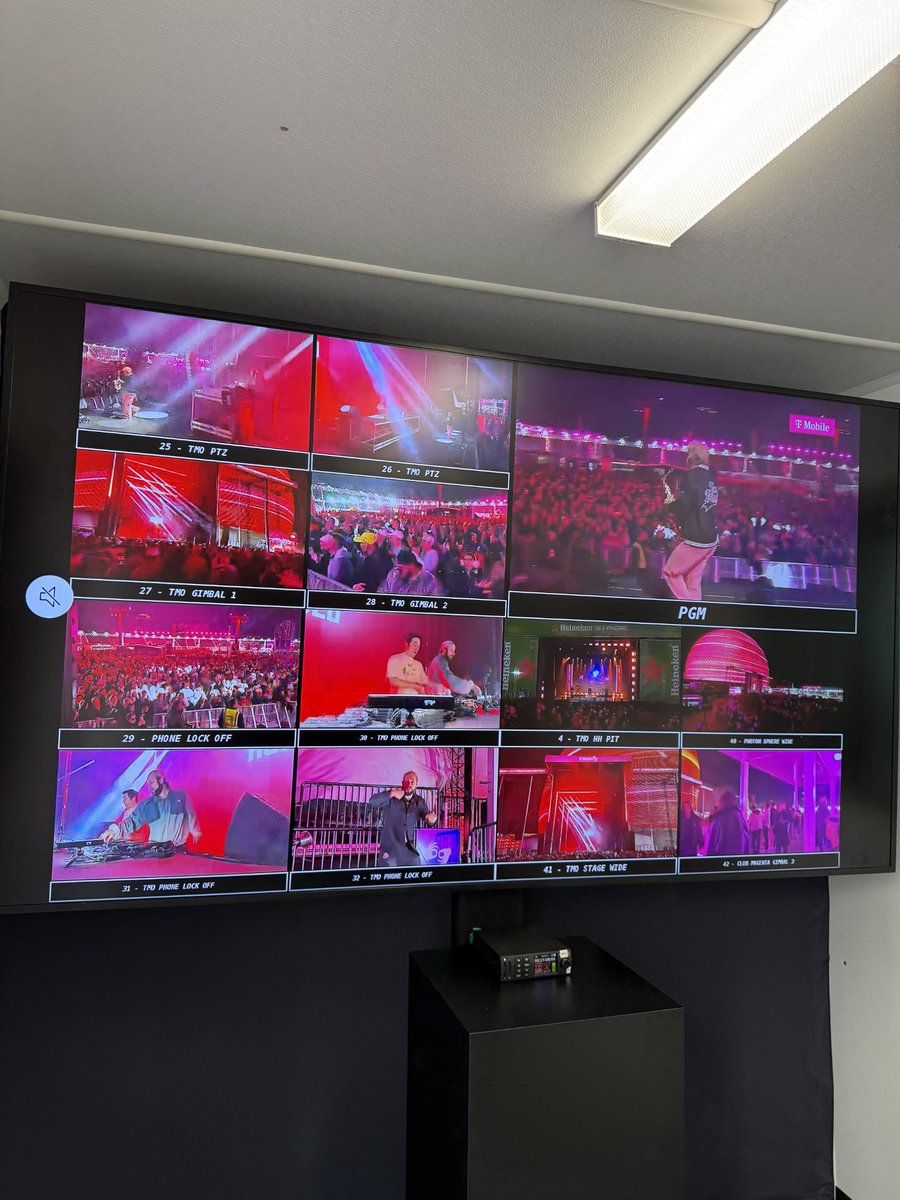
Camera angles are editorial choices. Connectivity is an engineering one.
At the Las Vegas Grand Prix, @TMobileBusiness supported wireless video. Edge Control from T-Mobile for Business processes video closer to capture.
T-Mobile for Business Partner
What can businesses learn from the Las Vegas Grand Prix?
In my latest newsletter, I explore five ways @TMobileBusiness put connectivity to work:
🎥 5G-powered broadcasting
📊 AI and digital twins
🚨 First responder connectivity w/ @T_Priority
🏎️ Connected fan experiences
🤖 Physical AI
What lessons from the racetrack could you apply to your organization?
T-Mobile for Business Partner
https://t.co/bbdxvOL2oA
The choice of Whiplash makes sense to me. AI is venturing into our emotional world, and music is naturally part of it.
I favor the approach of Taan: AI that follows the creative direction of musicians rather than taking their place.
@taan_ai Partner.
Today we're launching Taan V1.
A music model that follows instructions to the T.
V1 has significant improvements in quality and genre support over V1-preview
Models today aren't trained to be controllable. Terence Fletcher from whiplash wouldn't approve.
So we made a film about it.
An AI foundation model is not medical just because some hospitals use it. What matters is how it was trained or adapted for medical work.
The medical training can prepare it for specialized tasks, but it still needs to demonstrate clinical reliability.
Microblog by @antgrasso
A general foundation model can perform different tasks, but being able to summarize an ordinary document does not mean it can interpret clinical information with the same reliability.
Medical records have their own terminology and context, which general training may not adequately address.
Some medical foundation models are trained on medical data from the beginning. Others are adapted from broader models using specialized information.
The aim is to prepare them for tasks that require knowledge of the medical domain.
But specialization does not automatically mean clinical reliability.
A model that performs well at analyzing biomedical literature has not necessarily demonstrated that it can safely support decisions affecting patients.
Its performance must be evaluated for the specific application and the conditions in which it will be used.
#MedicalAI #FoundationModels
The 3D view catches the eye, but the important work is connecting data from different systems so people can make decisions.
The Las Vegas Grand Prix offers a useful example of that integration.
@TMobileBusiness Partner
Ticketing has one set of signals. Network operations has another. The event still has to run as one.
At the Las Vegas Grand Prix, a live 3D digital twin brings those data streams into a shared operational view.
@TMobileBusiness Partner
At the Las Vegas Grand Prix, a live 3D digital twin brings crowd, ticketing and network data into one view, with AI-powered alerts helping teams spot changes.
The technology supports decisions, while event teams remain in charge.
@TMobileBusiness Partner
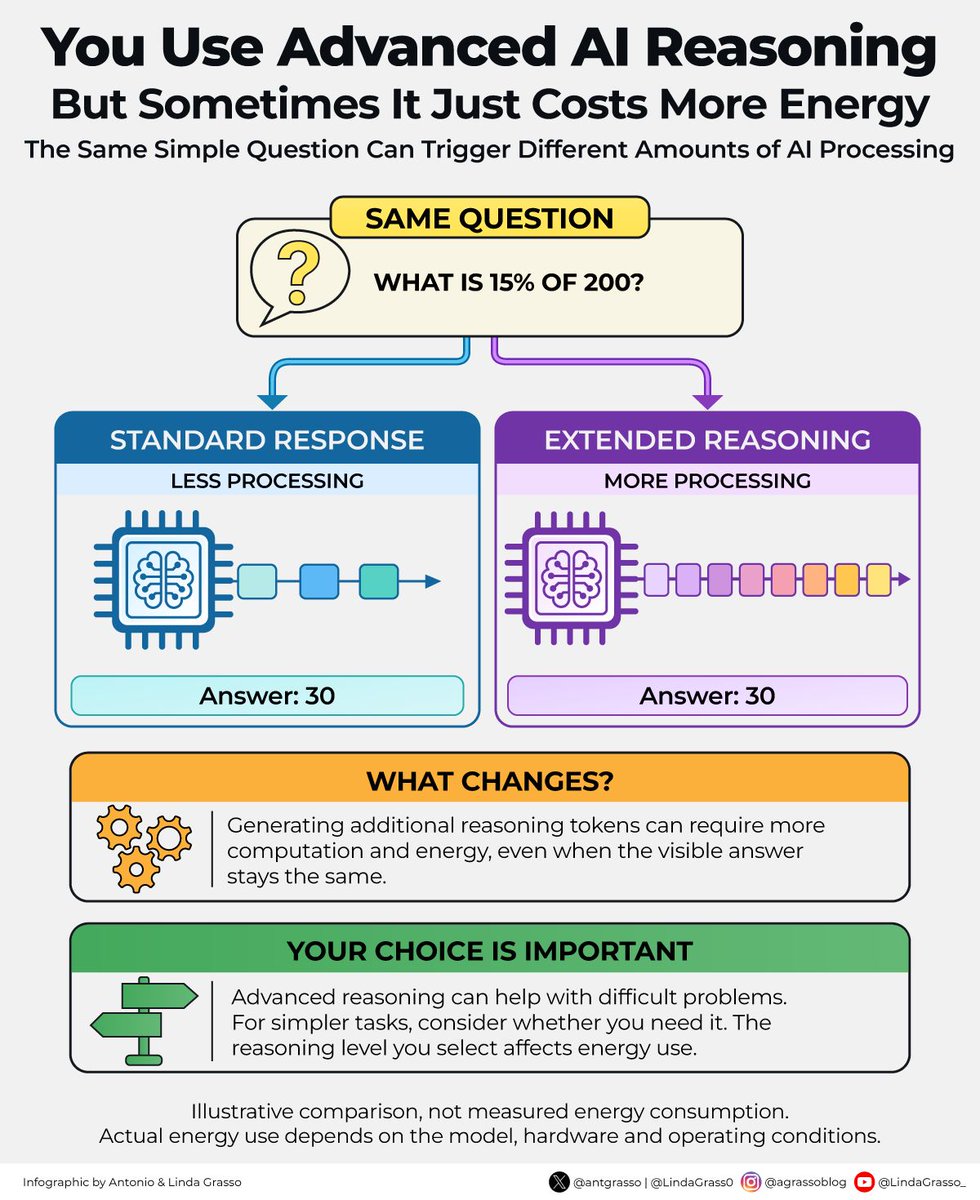
More advanced AI reasoning does not guarantee a better answer, but it can require more energy, so knowing when to use it matters.
The same simple question can require different amounts of processing. Choosing the level of reasoning is part of using AI well.
Microblog @antgrasso
A higher reasoning setting can make a model generate more internal tokens before answering. That extra processing can increase energy consumption.
What is 15% of 200?
30.
A standard response can solve it. If a higher setting produces the same answer after more processing, what benefit have we gained?
The prompt describes the task, while the reasoning setting, when available, influences how much computation the model may devote to it.
A short prompt is not necessarily a simple problem. But for a straightforward task, the highest setting may consume more energy without improving the answer.
We do not need maximum reasoning for every question, but we should understand when the extra computation is worth the energy.
#AIEfficiency #AIEnergy
GPTZero 5 arrives at a time when detecting AI-generated text is challenging.
I see value in improving these tools, provided we use their results responsibly. A detection score should support human judgment, not replace it.
In partnership with @GPTZeroAI
The new GPTZero 5 model outperforms Pangram in almost all third-party benchmarks
Our model has an industry-leading 1 in 50,000 false positives on essay-length writing
We have zero false positives on benchmarks where Pangram lags behind, like ESL writers
To achieve this, we had to completely change how we train AI detectors
Here’s the full evidence
When hundreds of thousands of fans connect to the network at the Las Vegas Grand Prix, how do first responders stay connected even during network congestion?
I explore how @T_Priority supports mission-critical communications, from priority connectivity to 5G-connected drones and push-to-talk ⬇️
@TMobileBusiness Partner
🏎️ Beyond the racing, LVGP was a fascinating showcase for enterprise tech.
From smarter operations to wireless broadcasting and Physical AI, there's plenty for business leaders to take away.
🎥 My quick take + full article👇
https://t.co/eDmo6Z7mWT
@TMobileBusiness Partner
Figure AI at the Las Vegas Grand Prix offers a glimpse of Physical AI with built-in 5G.
For businesses, the questions are already practical: where could these machines help, how would teams supervise them, and what processes would need to change? @TMobileBusiness
T-Mobile for Business Partner
The Sphere draws the eye, while fans create a less visible traffic challenge: mobile data.
At the Las Vegas Grand Prix, expanded 5G coverage and capacity are designed to support connectivity across the circuit and fan areas.
@TMobileBusiness Partner
Coverage and capacity are different engineering questions.
At the Las Vegas Grand Prix, crowded grandstands bring both into focus: reaching fans is one challenge; serving many connections at once is another.
@TMobileBusiness Partner
The Sphere draws the eye, while fans create a less visible traffic challenge: mobile data.
At the Las Vegas Grand Prix, expanded 5G coverage and capacity are designed to support connectivity across the circuit and fan areas.
@TMobileBusiness Partner
Ticketing has one set of signals. Network operations has another. The event still has to run as one.
At the Las Vegas Grand Prix, a live 3D digital twin brings those data streams into a shared operational view.
@TMobileBusiness Partner
Infrastructure is judged when demand rises, not when everything is quiet. The Las Vegas Grand Prix makes that point visible on the track and beyond it.
@TMobileBusiness Partner
The app is the visible layer. Behind it sit connectivity, coverage and capacity. At the Las Vegas Grand Prix, the fan experience depends on how those layers work together.
@TMobileBusiness Partner