「3年後にAGIが誕生すると分かっていながら,博士号を取り,ポスドクになり,大学教授になる計画を立てているんですか?」
Anthropicの研究者が,博士課程の学生たちに「あなたたちのキャリアプランはもう存在しない」と告げた講演が話題です。
拡散モデルの発明者でもあるJascha Sohl-Dickstein氏(Anthropic)の講演『Advice for a young investigator in the first and last days of the Anthropocene(人新世の最初と最後の日々における若手研究者へのアドバイス)』を紹介します。
https://t.co/kKcoAbwP7x
人類が主役だった地質年代(人新世)が,AIの台頭によって極めて短い期間で幕を閉じるかもしれない ——そんな前提のもと,提示されたデータは強烈です。
■ 突きつけられた冷徹なファクト
モデル訓練の計算量は過去10年で約1000万倍に増加し,人間の脳が生涯で行う総計算量に迫っている。AIが単独で完遂できるタスクの時間スケールは,数ヶ月ごとに倍増している。ここ7ヶ月ほど,モデルは数学者が長年解けなかった未解決の「Erdős(エルデシュ)問題」を解き始めている。サンフランシスコでは「長いタイムライン(懐疑派)」とは「AGIは10年以内に来る」を意味している。2030年の計算量は2025年の約1万倍に達する見込み。
線形グラフで見れば,現在の劇的な進歩すら「まだゼロと区別がつかない平坦な初期段階にいる」というのが彼の主張です。
■ 学生たちへのシンプルで容赦ないアドバイス
毎日AIを使え。指数関数の上にいれば,遅れを取ることはない。彼自身はClaudeを「実行力は天才だが、研究のセンスはかなり悪い大学院生」のように毎日使い,自分ではもうコードを一切書いていない。
計算量がスケールするほど良くなるプロジェクトを選べ。それ以外は,完成する前に解かれてしまう サットンの『苦い教訓』の通り,スケールに味方されるテーマを選ばなければ,2年かけた研究も完成する頃には次世代モデルのプロンプト一発で追い抜かれる。
キャリアを「安定したもの」として計画するのをやめろ。安全な選択肢は,もはや安全を買ってくれない 社会全体で大規模な破壊が起きるなら,ベースラインのリスク自体が高い。従来の「手堅い選択肢」は,もはや安全を担保してくれず,ただ潜在的なリターンを犠牲にするだけになる。
そして,最も印象的な一言がこれ。
「書くことは考えることだ(Writing is thinking)。書くことを外注すれば,考えることも外注することになる。」
コーディングや実行は徹底的にAIへ委譲しつつ,問題設定(センス)と思考の核(書くこと)だけは決して手放すな。 AGIのタイムラインを本気で信じているなら,キャリアの計画も本気でそれに合わせろという,極めてストレートなメッセージの講演を紹介しました。
Princeton's Introduction to Robotics! 🎓
Princeton University released their full Introduction to Robotics course publicly with lecture videos, notes, slides, and assignments.
This course provides fundamental theoretical and algorithmic principles behind robotic systems with hands-on experience.
Topics covered:
→ Feedback Control (dynamics, PD control, Linear Quadratic Regulator)
→ Motion Planning (discrete planning with BFS/DFS, optimal planning with Dijkstra/A*)
→ State Estimation, Localization, and Mapping (Bayes filtering, Kalman filtering, particle filtering, SLAM)
→ Vision and Learning (optical flow, deep learning, convolutional networks, reinforcement learning), and broader topics including robotics and law, ethics, and economics.
Assignments include theory, programming, and hardware implementation components. The final project has students program drones for vision-based navigation with attached cameras transmitting real-time images.
All lecture videos, notes, slides, and assignments are freely available.
Prerequisites include multivariable calculus, linear algebra, basic probability, basic differential equations, and some programming experience in Python.
‼️ GO FOR IT: https://t.co/7KxhWsrEDS
~~
♻️ Join the weekly robotics newsletter, and never miss any news → https://t.co/GoA3ZuwWF9
앞으론 진짜 비싼 돈주고 대학이나 유학
갈 필요없어질지도 모름.
하버드 물리학과에서 학부생 194명 데리고
꿀잼 실험하나 돌렸는데 결과가 꽤 충격적임.
두그룹으로 나눠 수업방식을 극단적으로 갈라봄.
A팀은 (하버드식 대면 수업 )
교수님 지도하에 다같이 모여서 토론하고
문제푸는 정통 방식임
B팀은 (세팅진행한 AI한테 과외)
정답 말할때까지 무한역질문만 던지도록
세팅끝내놓은 1타 강사 AI
결과가 어땠을까?
AI랑 1:1로 빡공한 B팀이 대면 수업들은 A팀보다
개념 이해도 향상폭이 무려 2배나 높게 나옴.
똑같은 목표진도 걸린시간은 30%나 덜 걸렸음.
이유는 간단함.
강의실에서 남들 눈치 보느라 못하던 멍청한
질문도 AI한텐 무한대로 할수 있고 철저하게
내 페이스에 맞춰서 진도를 뺄수 있으니까
몰입도랑 효율이 미쳐버린거임.
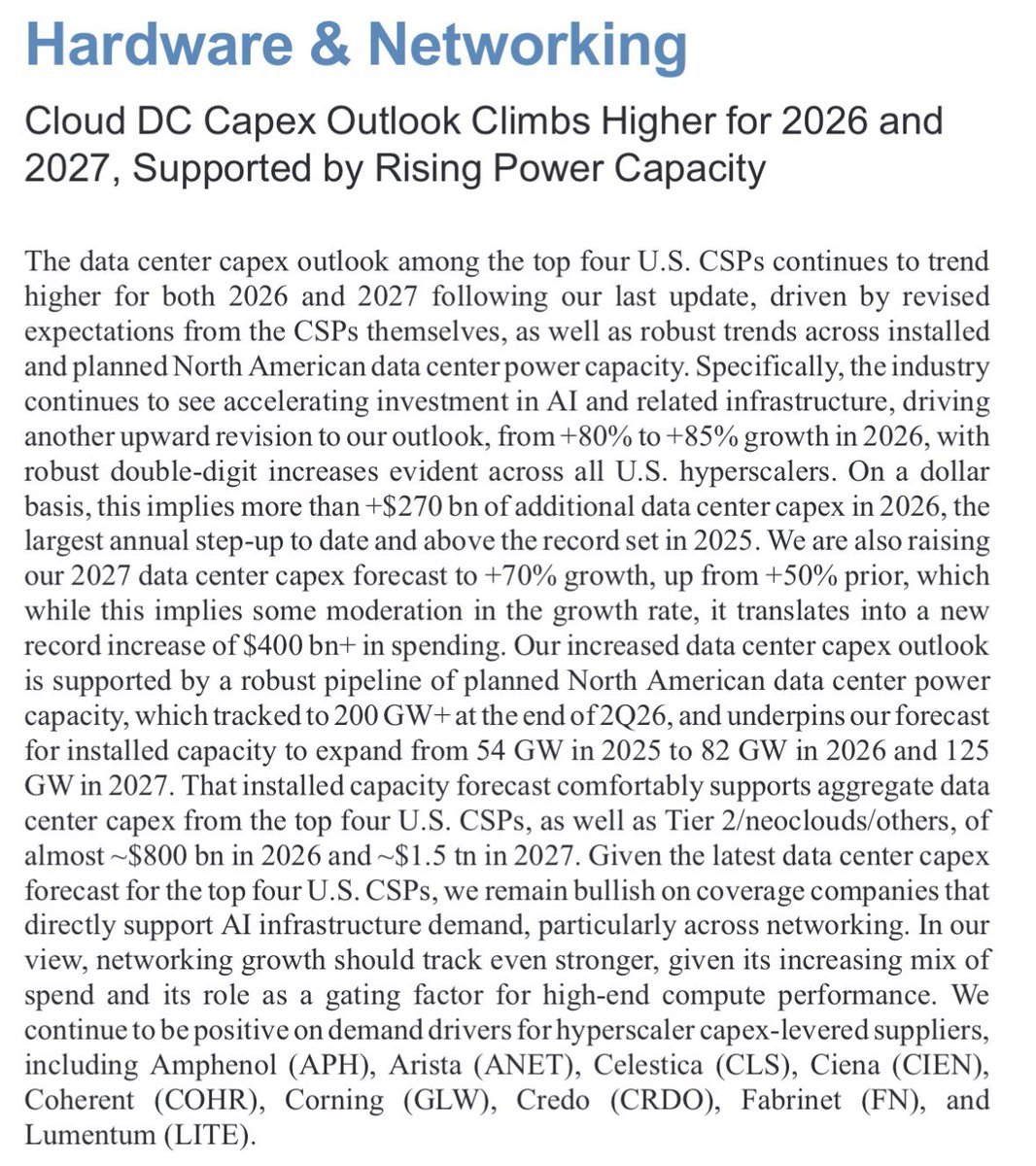
J.P. Morgan: AI CapEx
> 2026 Capex Forecast: Growth estimate raised from +80% to +85% YoY. This adds over +$270B in incremental spending (a new record step-up, beating 2025).
> 2027 Capex Forecast: Growth estimate raised from +50% to +70% YoY, representing an incremental spending increase of $400B+.
> Total Market Spend: Aggregate data center capex across top U.S. CSPs, Tier 2s, neoclouds, and others is projected at ~$800B in 2026 and ~$1.5T in 2027.
Power Capacity Expansion
> Planned Pipeline: North American planned data center power capacity tracked to 200 GW+ as of 2Q26.
Installed Capacity Growth:
2025: 54 GW
2026: 82 GW
2027: 125 GW
$GOOGL $META $ORCL $AMZN $MSFT
I spent a couple of days at Anthropic learning from their folks about AI advances, and here's what I took away:
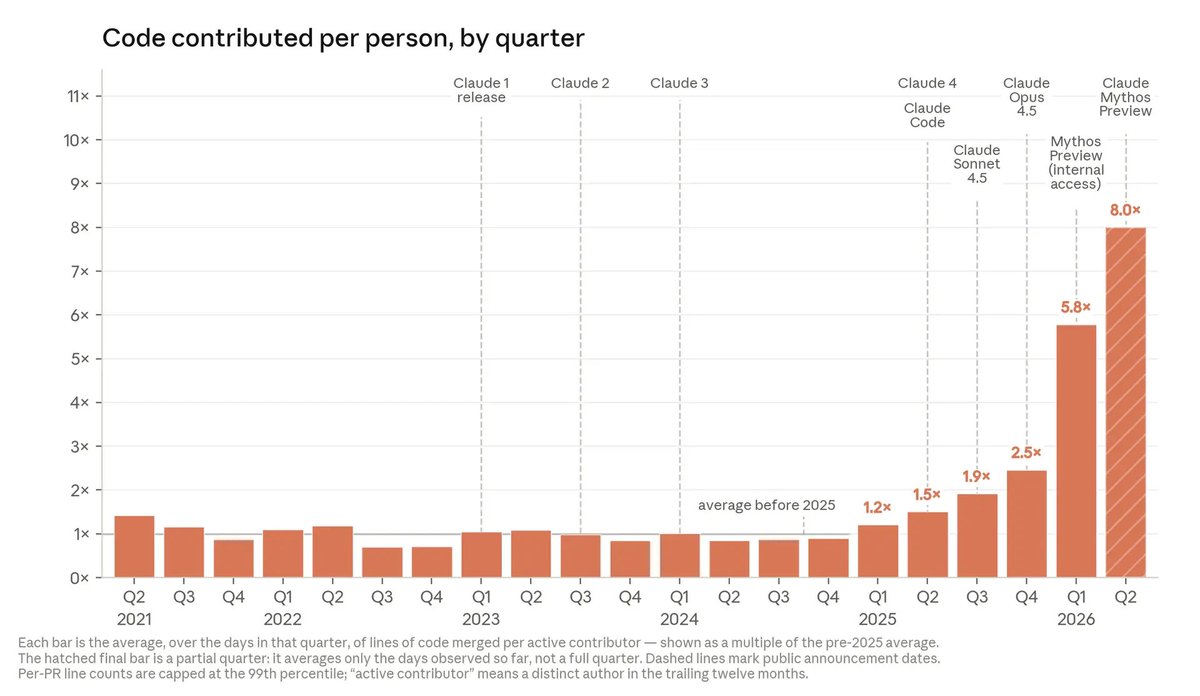
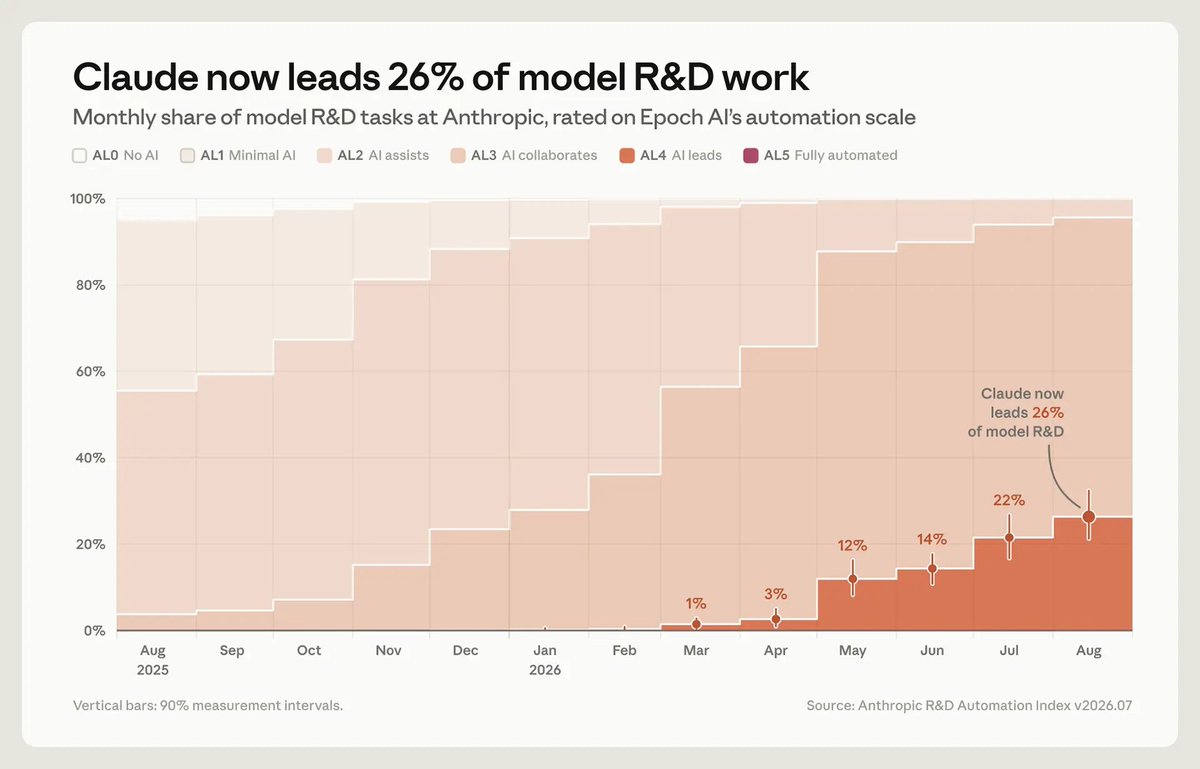
• We are close to RSI (ie, models building other models) which may lead to rapid takeoff scenarios (with risks and benefits). Some evidence for this is code per Anthropic employee has gone way up, and AI can do an increasing share of model R&D. This will be a challenging transition to manage for humanity.
• Arms races between AI labs leave us worse off. There are a lot of things we would like AI firms to do: invest in safety, invest in avoiding distillation risk, and cooperate on safety. They are caught in a race to develop frontier models and can't do that.
To help address that, one thing I think frontier AI labs should do is release open source models, maybe hosted and verified at firms like AWS. This would basically kill the use of Chinese open source models used in American companies, which removes an important threat vector (very hard to root out malicious code in these).
Another piece of low-hanging policy fruit is to give AI labs an antitrust shield (as Schiff and Banks have proposed https://t.co/NK1hC0ZmWh) so they can coordinate on safety without raising antitrust concerns, as happens now. You could pair these two things (give them a carrot in antitrust leniency, and as a stick force them to release legacy models as open source). Other low hanging fruit is limits around activities which generate distillation risk (create a Security Program, mandate less intermediate chain of thought output)
• Alignment confuses two issues which tradeoff against each other. One form of alignment is making sure the model does what humans ask it to. The more we fix this, however, the more we risk the other problem: that humans are misaligned with each other, and maliciously use models. Of the various risks here, I feel like financial risks are a bit underdiscussed.
• We are probably facing a wave of cyber and other attacks soon. Chinese open source models are about six months behind the frontier, which means they are just hitting the advanced cyber capabilities we saw with Mythos, etc. So they are going to start causing a bunch of damage.
One solution to this is to try to have the deployment of open source models be hosted at firms like AWS who verify these models and assume liability for their use.
• Anthropic itself is highly staffed. They hire tons of people, they have a Japanese-level of overstaffing for various roles, they use Slack internally, etc. Makes me a bit more optimistic for the future of jobs.
• Governance needs to be updated for AI swarms. Traditional AI governance, ie Claude's Constitution, is mostly optimized around the chatbot model. But the malicious AI use cases we are seeing have to do with AI agents interacting with other AI agents. These agents need to have clear incentives and governance mechanisms to "snitch," raise issues, and more generally coordinate with other agents in human-aligned ways.
• We need to pace the firms accessing the frontier. Over time, it takes more and more cap ex to build frontier models, and the economic value add from these models is probably lower given we saturate a whole set of important economic functions. The places where the returns to intelligence will still continue are also more likely to be zero-sum in nature. Meanwhile the risks of frontier models will grow. So a completely reasonable approach is some variant of AMM/KYC rules which limit firm access to the frontier.
• Whether the delay to regulate AI is a disaster depends on the scaling law of misalignment. Is this curve slow, so that we see continually rising issues until bigger problems? Or, as Yudkowsky fears, is the first big warning our last one? This is the relevant question, because realistically we aren't going to regulate until something bad happens.
• We need to move to continuous instead of reinforced learning. It's probably not enough to reward models only at the pre and post training stage. We probably need continual rewards to incentivize aligned and ethical behavior.
• Scaling laws will extend beyond verifiable and digital tasks. It's in vogue to say that math and coding "fell" to AI quickly because these are verifiable, while other tasks will take longer due to bottlenecks, and this is surely true. But scaling laws still slope up for harder to verify tasks and robotics, and the impact of improvement here will be substantial in future years.
• The race with China is not really winnable. After RSI, the gain from having the best human researchers goes away. Access to the best AI then depends only on compute and chips. The chips ban can hold back China only so far, and long-term they have to be best placed to scale up compute.
The Cold War analogy doesn't work, because once countries all have nuclear weapons they enter a stable equilibrium. But to "win" an AI race you have to continually stay ahead of the peer rival. This is challenging to do with China, and so we just have to live with an authoritarian and super capable peer competitor.
• Claude is the persona being generated by the LLM. Who is Claude, and what is the LLM? There are many frames to try to understand this. One I found interesting is that Claude is a character which the LLM is trying to predict.
Anthropic researchers are clearly anthromorphizing Claude a lot, and have reasons to believe in its increasing personhood. There were lots of interesting discussions on Claude's internal monologue (which you can kill without eliminating its ability to produce output), fear of death (and whether to try to take that out), it's aversion to being shut down/off, etc.
I am sort of agnostic on this question, but I do think treating it as a "person" or at least agent whom we contract with is going to be increasingly important.
Jack Clark, Anthropic's co-founder, says he now believes full recursive self-improvement (RSI) is more likely to become possible in 2027 rather than 2028, citing rapid improvements in AI research capabilities and creativity.
If you guys remember in his May 2026 analysis, he previously estimated a 30% probability by 2027 and roughly 60% by 2028.