@marcfriedrich@CDU@spdde@bundeskanzler@_FriedrichMerz Damit sich das Volk nach der „Rettung” also nach dem digitalen Euro sehnt, braucht die aktuelle politische Führung in der EU zunächst eine ordentliche Wirtschafts- und Bankenkrise.
To grasp the mind-boggling scale of the universe, consider the Laniakea Supercluster—a vast "web" of cosmic structure that forms our larger galactic neighborhood.This immense superstructure, named from Hawaiian for "immense heaven" or "open skies," contains roughly 100,000 galaxies (with estimates sometimes ranging up to 100,000–150,000). It spans about 500 million light-years across (roughly 520 million ly in diameter in many visualizations, or about 160 megaparsecs), and its total mass is on the order of 10¹⁷ solar masses—equivalent to around 100,000 times the mass of our entire Milky Way https://t.co/jUbDLOo1sk its heart lies the Great Attractor, a gravitational focal point pulling galaxies (including ours) toward it along flowing streams of matter.Our home—the Milky Way, with its roughly 300 billion stars (including our Sun and solar system)—is just one ordinary galaxy among those 100,000. In famous visualizations of Laniakea, it appears as a tiny red dot (or sometimes blue in variants) perched right on the outskirts or fringe of this enormous structure, far from the denser central regions.This perspective dramatically illustrates our place in the cosmos: even a galaxy containing hundreds of billions of stars is reduced to a single, barely noticeable speck in a sprawling network of filaments, clusters, and voids that make up just one supercluster—itself a minor feature in the still-vaster observable universe.
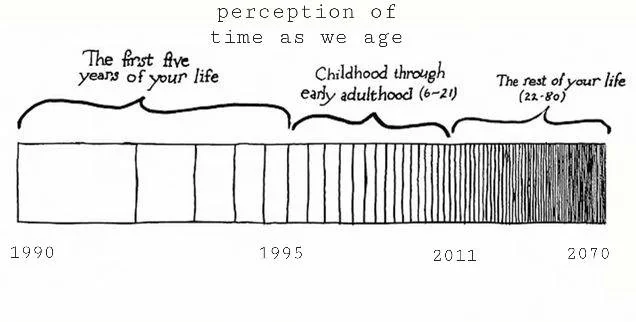
When you’re 5 years old, a year is 20% of your life. And when you’re 50 years old, a year is 2% of your life. This is an explanation given why time speeds up as you age. It's called Janet's law. It states you’ve experienced roughly half of your perceived by life by 20 years old. Or to put it another way: A summer holiday for a 5 year old feels as long as the 10 years from 40 to 50 years old.
But Janet's law can be broken with high agency.
You have agency over the speed time. You're not a passive victim. A better explanation of why time speeds up as you age is because you have fewer new experiences as an adult, so your brain deletes the memories. If you take agency over your life, do new things and create memory dividends, time slows down.
If you live your life on autopilot, you may die at 80, but feel like you died at 20 years old.
If you take agency over your life, you may diet at 80, but feel like you died at 200 years old.
This is a photo of Elon Musk's son at a meeting where his father met with the Indian Prime Minister, Narendra Modi. Notice that this child of the richest man in the world carries no phone, no iPad, or any other electronic gadget that entertains, while stealing children's attention span. Instead, the then-eight-year-old boy was reading Secrets of Mental Math by Arthur T. Benjamin and Michael Shermer, while his brother held another book.
That is the secret between the Rich Dad and the Poor Dad. The wealthiest man in the world is teaching his children mathematics and numbers, while your child has a phone, iPad and still plays video games on another device after watching Netflix.
Steve Jobs, the creator of the iPad and iPhone, did not let his own children use both devices. He instead gave them books and even paid them to read. Please fact-check me. Yet, you overload your children with digital devices.
Mark Zuckerberg is famous for not having a television in his house. Not even one. His reason is that it will distract his wife, his children, and him from reading.
Notice what all three of these tech billionaire founders had in common. Their children are readers.
If you don't teach your children to love learning, they will grow up to become adults who are not earning. Children who lead grow to become adults who lead. The expansion of the mind in childhood results in an increase in your wealth in adulthood, if you can apply what your books supply.
And by the way, notice how simply the children are dressed. It just reminds me of how simply Alhaji Aliko Dangote's children were absorbed when I met them last year after spending time with him.
Think about this and consider making a positive change in your child's life.
Reno Omokri
Gospeller. Deep Thinker. #TableShaker. #1 Bestselling author of Facts Versus Fiction: The True Story of the Jonathan Years. Hodophile. Hollywood Magazine Humanitarian of the Year, 2019. Business Insider Influencer of the Year 2022. 21st Most Talked About Person in Africa, 2024.
@great_martis@helpmeuber1111 Furthermore, Germany, France, the Netherlands, Finland and Austria have only achieved a short-lived economic boom through credit.
This is, without exaggerating, one of the most extraordinary things a US Treasury Secretary ever said.
It should be mandatory viewing for all citizens of US "allies", Europeans first and foremost.
What Bessent is saying is that the US will now treat US allies' wealth as an American "sovereign wealth fund" (his words), "directing" them, "largely at the [US] president's discretion", how to use their money in order to build American factories and reshore American industries.
Even the Fox News host can't believe it, calling it "offshore appropriation", another word for theft.
That's exactly what it is: straight up unabashed colonial plunder.
That's the pattern we see emerge: unable to extract wealth or win wars against an increasingly strong Global South, the US has turned inward to feast on its own "allies" - who can't resist precisely because they depend on their exploiter for military "protection". They're as defenseless against American wealth extraction as any 19th-century colony was against its colonial "protector."
That's exactly what I wrote in my latest article on "Europe's colonial moment": https://t.co/QwO6zB1Trz
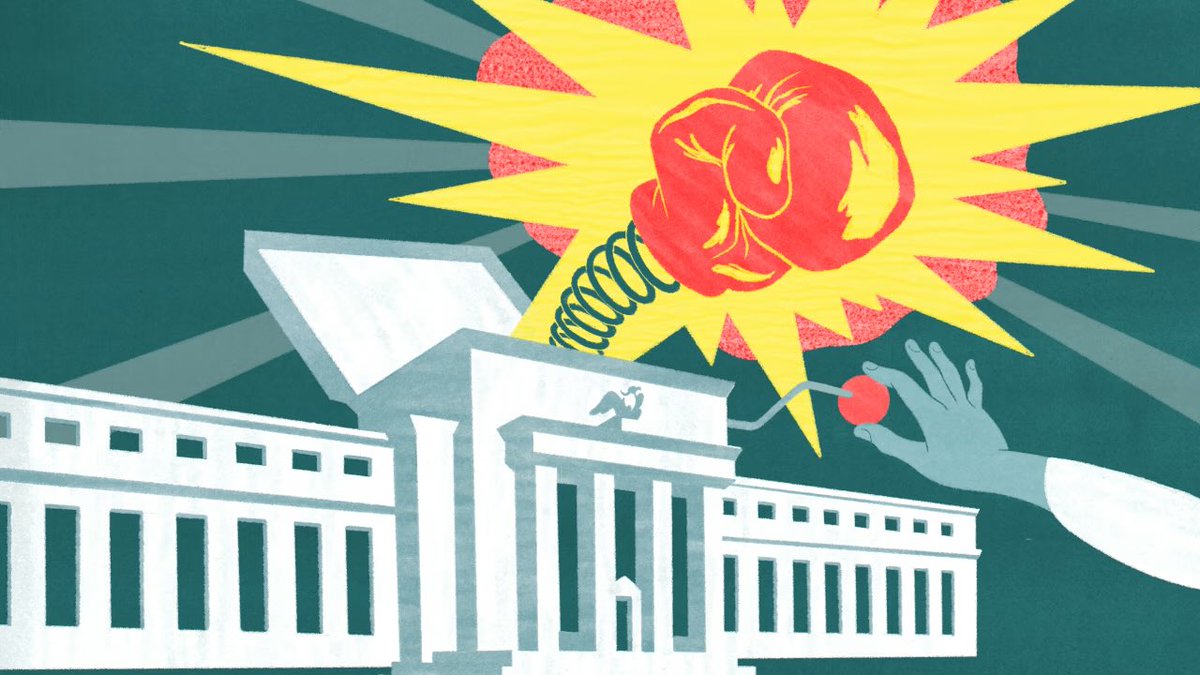
(1 of 2) The Strategic Silence: How the Fed Is Using High Rates as a Geopolitical Weapon
⸻
I. The Illusion of Domestic Inertia
At first glance, Jerome Powell’s refusal to cut interest rates even as the U.S. economy flashes broad-based disinflationary signals appears stubborn or even negligent. Real GDP growth has decelerated, consumer confidence is teetering, and various segments of the U.S. labor market (temporary work, credit-sensitive sectors) are softening. Historically, these would be fertile conditions for at least one symbolic rate cut. Yet Powell remains still. This inaction isn’t indecision its strategy.
To the informed observer, this suggests the Federal Reserve is not operating within the domestic economic playbook, but under a broader, more covert doctrine of strategic economic warfare. Keeping interest rates elevated may be less about taming domestic inflation (which has cooled meaningfully in real terms) and more about projecting financial pressure outward onto America’s adversaries through the global dollar system.
⸻
II. Interest Rates as a Weapon in the Arsenal of Power
This isn’t a new play. During the Reagan-Volcker era in the 1980s, interest rates were jacked up to 20%, not only to kill inflation but also to weaponize capital flow attraction. Emerging markets reliant on dollar-denominated debt were crushed under the weight of a soaring dollar and tightening global liquidity. Mexico defaulted. Brazil flirted with collapse. The USSR watched its economic model destabilize from afar.
This tool, what geoeconomic scholars call “currency statecraft” reappears today in subtler form. The high Fed Funds rate, in conjunction with a structurally tight balance sheet and swap line selectivity, operates as a form of monetary siege warfare. Nations like China, Turkey, and parts of the Global South now face the double bind of capital outflows into higher-yielding U.S. assets and rising costs to roll dollar-denominated debt, which weakens their ability to counter U.S. interests abroad.
⸻
III. The “Silent Sanction” Doctrine: Pressure Without Declaration
We’re witnessing a form of silent sanctions. Unlike OFAC restrictions or SWIFT bans, this form of pressure does not require executive orders or Congressional consent. The Fed merely needs to do… nothing. Every month Powell holds rates high while liquidity tightens globally, he indirectly raises the operating cost of America’s adversaries.
This matters profoundly in 2025. China’s stimulus attempts are failing to take hold, capital flight is a risk, and commodity importers are hurting. Meanwhile, Iran is under acute financial strain as war risk premiums inflate oil costs but also isolate its financial system further. Russia, too, must navigate dwindling reserves and a ruble facing structural depreciation. A high Fed Funds rate tightens the noose across this axis without firing a shot.
⸻
IV. eSLR and Shadow QE: A Hidden Domestic Outlet for Treasuries
At home, there’s an added layer. The recent news of potential easing in the enhanced Supplementary Leverage Ratio (eSLR) for banks is a stealth way to unclog the Treasury market without cutting rates. This would allow major banks to absorb more Treasuries without breaching leverage constraints effectively creating quiet demand for U.S. debt in a world where foreign buyers have been fading.
This dual approach, external pressure via high rates, internal absorption via regulatory tweaks creates a powerful system. The Fed avoids the optics of monetizing the debt while still engineering sufficient demand through balance sheet re-leverage. This is not unlike the 2013–2014 “taper diplomacy” era, where policy tightening disproportionately damaged emerging markets while reinforcing the dollar’s dominance.
(2 of 2) V. Historical Parallels: From Plaza Accord to Powell Doctrine
There’s precedent in the mid-1980s. After the dollar surged due to high rates and a global scramble for U.S. assets, the resulting imbalance forced the U.S. to orchestrate the Plaza Accord to deliberately weaken the dollar and stabilize allies. Today, the inverse logic applies. Rather than a strong-dollar correction, the Powell Doctrine appears to intentionally sustain dollar strength to exhaust geopolitical rivals.
But this doctrine is risky. In the late 1990s, during the Asian Financial Crisis, U.S. monetary policy tightened just as leverage and dollar-linked exposure peaked abroad. The results were catastrophic for regional economies and triggered contagion across global markets. It was a case study in the limits of rate-based diplomacy one where short-term hegemony produced long-term instability.
⸻
VI. The Domestic Cost of War: Will the U.S. Economy Be the Collateral?
This raises the critical question: Is Powell sacrificing domestic economic vitality for foreign policy objectives? In many ways, yes. Small businesses are getting squeezed by credit costs. Housing affordability is collapsing. The yield curve remains deeply distorted. And yet the Fed’s silence persists. Powell may be executing what amounts to a covert wartime economic policy, designed not for economic expansion but for international attrition.
The logic is grim but strategic: Even if the U.S. economy slows while adversaries face even worse financial stress that impairs their military or technological aggression, it’s a worthwhile trade in the eyes of national security planners. The cost of stagnation at home becomes the price of containment abroad.
⸻
VII. Strategic Forecast: What to Watch Next
If this framework is correct, we should expect the following:
1.Continued delay of rate cuts despite disinflation.
2.Regulatory tweaks like eSLR relief to ease domestic Treasury absorption.
3.Elevated real rates in U.S. markets to sustain capital inflows.
4.Pain in EM and BRICS-aligned economies manifesting in FX stress, capital controls, or commodity volatility.
5.A delayed but aggressive easing response only once key adversaries have been economically neutralized or neutralized themselves through internal collapse.
This would frame the next 6–12 months not as a monetary policy cycle but as a geopolitical chess match with interest rates as the queen.