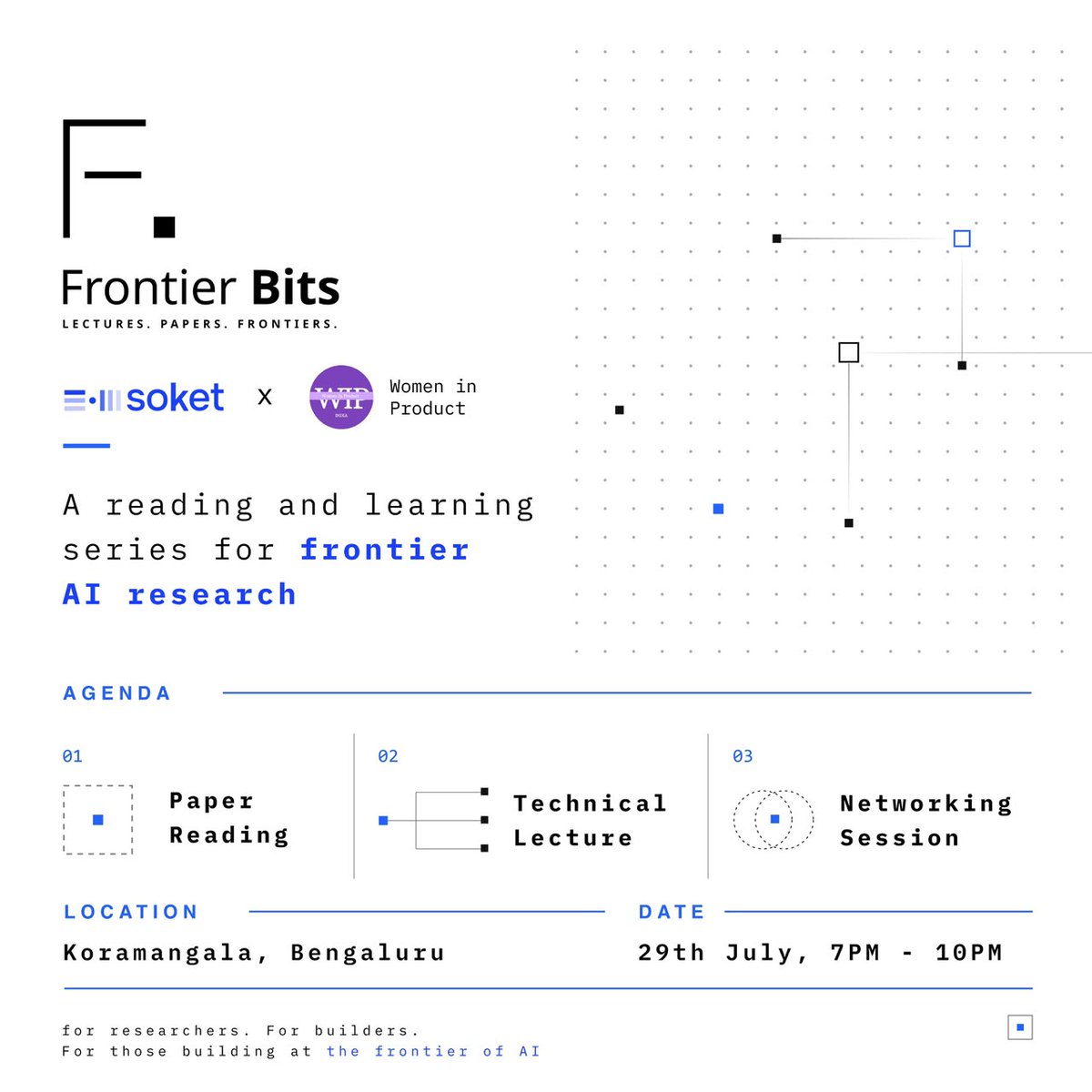
A few months ago we opened our internal paper readings & technical discussions to the community. That’s how Frontier Bits started.
Details: 29 July, 7–10 PM, Koramangala.
OPD deep dive + NVIDIA Megatron lecture + networking
@wipindia
Limited seats → https://t.co/JkLXAjEmMP
India’s entry to LLM models race are out.
@SarvamAI , @soketlabs and @GnaniAi are chosen by MIETY.
Target is to build a sovereign AI model for India that competes with other global models.
👏🏼👏🏼👏🏼
https://t.co/whRBwKPGg8
AI / ML Engineer in 2026, please learn:
One ML stack deeply:- PyTorch or JAX, not just .fit(), but GPU memory, kernels, mixed precision, profiling, and why your model OOMs at 3am.
Data:- Where it comes from, how it lies, how it drifts, how labels break, how leakage sneaks in, and why 80% of model failures are upstream.
Statistics:- Bias vs variance, confidence intervals, calibration, distribution shift, and why “95% accuracy” is often meaningless.
Loss functions:- What you are actually optimizing, how it shapes behavior, and how bad losses silently create bad products.
Evaluation:- Real-world metrics, not Kaggle ones. Offline vs online. Regression tests for models. When numbers lie.
Training:- Distributed GPUs, gradient accumulation, checkpointing, reproducibility, and how to not lose a 3-day run to one crash.
LLMs: Tokenization, attention, context limits, KV cache, LoRA vs fine-tuning vs RAG, and where hallucinations are born.
Inference:- Batching, quantization, vLLM, streaming, cold starts, GPU vs. CPU, and why serving is harder than training.
Retrieval:- Embeddings, chunking, hybrid search, reranking, grounding, and why most RAG systems fail quietly.
Pipelines:- Feature stores, offline vs. online data, backfills, late events, schema evolution, and broken joins.
Monitoring:- Drift, outliers, token spend, latency, hallucination rate, and silent quality decay.
Optimization:- Distillation, pruning, caching, prompt compression, and how to make models affordable.
Agents:- Tool calling, memory, retries, failure modes, and why autonomous systems are chaos engines.
Security:- Prompt injection, data exfiltration, training data leaks, and tool misuse.
Deployment:- Model versioning, shadow runs, canaries, rollbacks, and killing bad models fast.
Distributed systems:- Queues, retries, idempotency, backpressure, and partial failures. ML is just distributed systems with gradients.
Documentation:- Model cards, data contracts, eval reports, and written tradeoffs.
Pick one stack. Build real systems. Break them. Fix them.
If I missed something, Add in the comment section.
What we fear doing most is usually what we most need to do.
A person’s success in life can usually be measured by the number of uncomfortable conversations he or she is willing to have.
Resolve to do one thing every day that you fear.
-The 4 Hour Workweek
So you've got a (trained) graph neural network, giving you node latents. What kinds of tasks can you then solve with them? Here's a concise and abstract summary. :)
Inspiration from @thomaskipf's slide deck on GNNs.
TikZ code coming soon.
In Introduction to On-Device AI you’ll learn key steps for on-device deployment: neural network graph capture, on-device compilation, hardware acceleration, and validating on-device numerical correctness.
Enroll for free: https://t.co/1MP5ndtg1J
Jensen Huang: "Greatness does not come from intelligence. Greatness comes from character, and character isn't isn't formed out of smart people: it's formed out of people who have suffered."
https://t.co/atLrZkB85p
**Cooperative GNNs** with @benfinkelshtein@hxyscott@ismaililkanc
In message-passing GNNs, each node is updated based on messages from its neighborhood. In Co-GNNs, every node can choose to either ‘listen’, ‘broadcast’, ‘listen&broadcast’, or ‘isolate’
Had great fun working on this project with an amazing team! 😎
I think this work can be seen as an attempt to connect what we know about information propagation in GNNs to LLMs. 🕸️ 🤖 With interesting practical implications!
Excited to see where this direction can take us!🚀