🚫🕶️ I've been building an XR app for a real-world ad blocker using Snap @Spectacles. It uses Gemini to detect and block ads in the environment.
It’s still early and experimental, but it’s exciting to imagine a future where you control the physical content you see.
@VeroniqueBasle@Lucius_Gellius - Hebergement local ça consiste à installer un serveur sur sa machine.(ex: WAMP ou Laragon), mais tu seras le seul à y avoir accès.
- Hebergement web, ça nécessite de payer généralement un petit abonnement pour que le suite soit accessible depuis une url(https://t.co/jbmfMKVegR)
@VeroniqueBasle@Lucius_Gellius Je l'ai hébergé sur un vieux serveur, j'ai commenté deux parties de codes qui généré des erreurs sûrement lié à la version de PHP, je ne sais pas si tout fonctionne mais tu peux voir le contenu ici : https://t.co/BW2ry68Cjr
@VeroniqueBasle@Lucius_Gellius Le projet étant simple, il suffit de:
- Télécharger le projet : https://t.co/fIAJw70lKb
Puis deux solutions, si tu souhaites le mettre en ligne, dans ces cas là va falloir prendre un hebergement puis de déposer tous les fichiers.
Sinon héberger en local sur ton PC
I wanted this feature in @rectorphp since day one. Now with upcoming v2, it's time to ship it 😊
* What if Rector could find out, what package version we use? 🔥
* Then load the sets that make sense 🔥
* So we don't have to maintain config anymore 🔥
Starting with Twig. Next up is PHPUnit and Doctrine
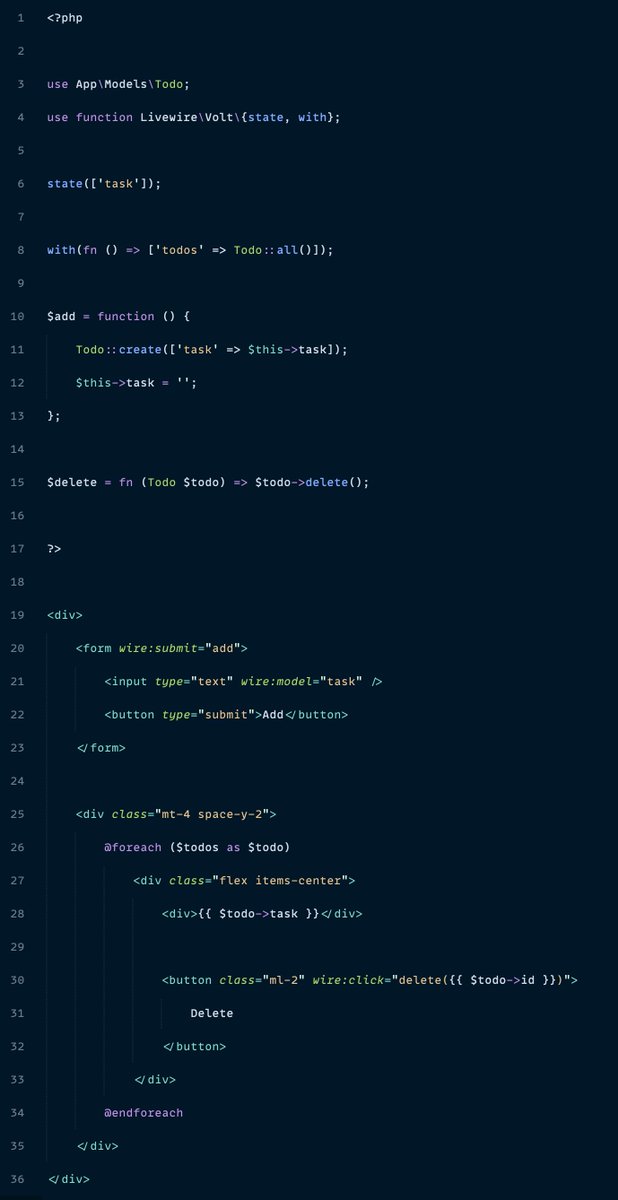
The todo application. 😅
But, seriously, here's the thing...
When Laravel and Rails developers say "full stack", they mean something totally different than when Next or Remix (React Router?) developers say "full stack".
In Laravel and Rails, it means there are built-in, opinionated solutions to things like validation, interacting with a database, authenticating users, scheduling background work, sending an email.
In Next and Remix, it seems to mean that there is simply the bare ability to run code on the server at all and an advertisement for Clerk. 🙃
From my perspective, Next and others are really, really great at the GET part of web development. Get data from some backend, show it on the page quickly. 👌
They are not mature for POST, PUT, and DELETE, especially when things start getting non-trivial.
And, I don't think this is really unique to Next or a single framework. It's something that seems to pervade current JavaScript as a whole - note the current proliferation of "starter kits" that try to bring some sanity to the full-stack story.
I think this has had actual consequences in the JavaScript ecosystem...
Rails and Laravel were built with the express purpose of allowing a single developer to build the next GitHub... or the next AirBnb... or the next Shopify. Prototyped from beginning to end.
That's what I'm passionate about. Empowering a single developer or small team to build something amazing.
I built the 1.0 of Laravel Forge, Envoyer, Vapor, Spark, and the backend of Nova by myself.
$40M in revenue over 10 years from my home office. That's an empowering tool for a solo founder.
I don't see a full-stack story in JavaScript yet that would allow me to realistically sit down and build something like Forge or Vapor from start to finish. Maybe I'm missing it. 🤷♂️
The MVP start-ups I do see fully built on current JS meta frameworks are much thinner. The stereotypical API call to an AI service. Not much meat on the bones.
Laravel / Rails have been building their modern front end story with Hotwire, Livewire, Inertia, and more... Next and others are building their modern back end story.
Smart people on both sides working on these problems, so I'm confident we'll both get to where we want to go. 💪
Nous organisons un meet en partenariat avec @openfacto ouvert à toutes les communautés associatives ou collectifs sur l'OSINT . Merci de vous inscrire pour faciliter l'organisation
https://t.co/3r8uIs1b2l