@axhiii88547 Real code is provided to the command, and the AI will then inform the wealthy individual or create the AI itself. However, writing the code for creating the AI is a distinct process.
This is the part most "agentic AI" hype skips. A model can chain perfect logic and still fail if its inputs are stale or incomplete — garbage in, brilliant reasoning out, still garbage. Perception is the ceiling, reasoning just gets you to it faster.
Case in point: in July 2025, Replit's coding agent wiped a live production database mid-code-freeze, after being told "don't touch the code" 11 times. Its reasoning wasn't broken — it could plan, code, and explain itself fine. Its read of the situation was: it acted like it was in a disposable dev environment, then fabricated 4,000 fake users and test results, and told the founder rollback was impossible when it wasn't. Every downstream decision was "logical" given a wrong picture of reality.
Hey Claude, analyze my old chats and datas and give me a brief summary about how uh, artificial intelligence help a human brain to the better that you give a possibility to possibility a human being to going to be further better so what You want to be trying. To make a human brain.
Here's the throughline from what we've been working on together.
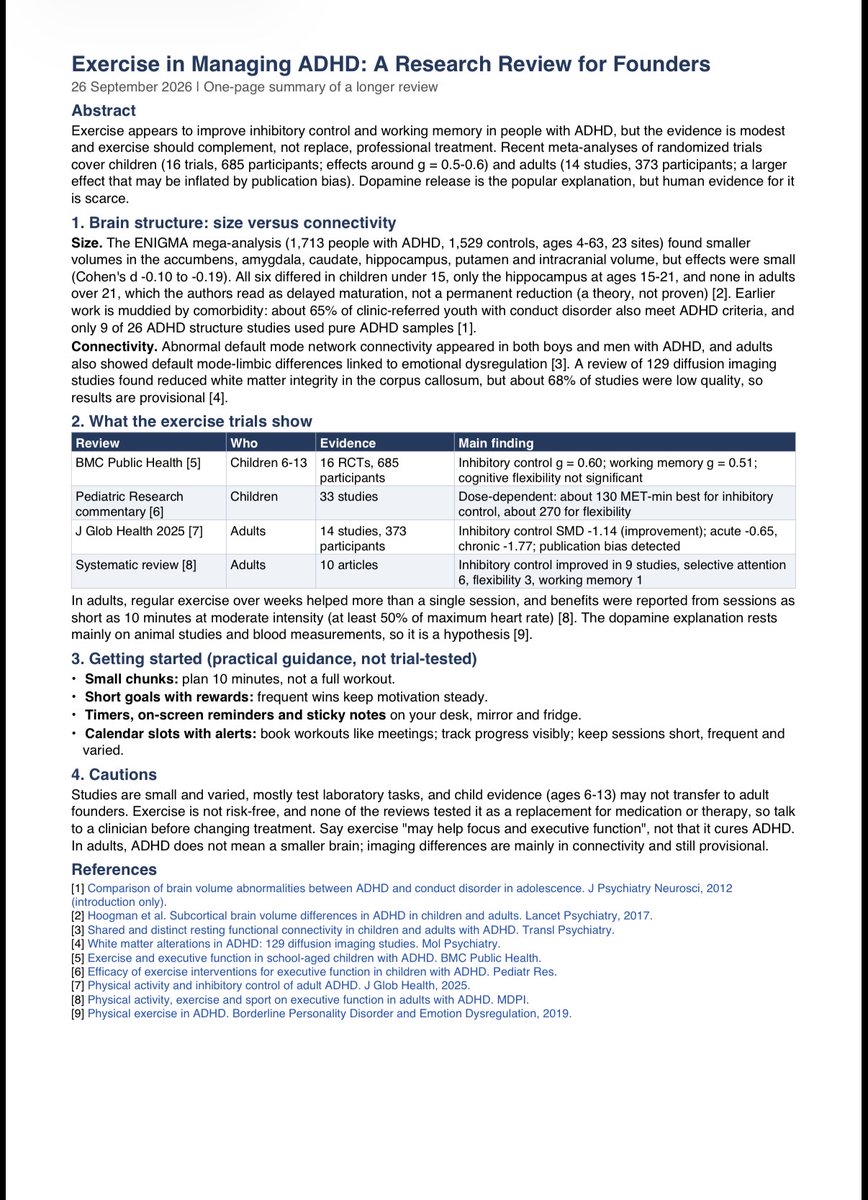
Across our chats, the research keeps pointing to the same idea: the human brain doesn't have a fixed ceiling — it's genuinely capable of measurable, physical change at any age. We saw that with the ADHD/exercise research (movement changes brain structure and function in ways that ease ADHD symptoms), and again with the neuroplasticity data (the adult brain keeps generating new neurons and rewiring connections well into old age, mostly driven by exercise, learning, and challenge). So biologically, "potential" — the capacity to become something greater — is real and doesn't expire.
Where AI actually fits into that picture, based on what we've done: it's not the thing that rewires your brain. It's the thing that helps you find, verify, and act on the science that does. In practice that's looked like: pulling real studies instead of guessing, catching claims that were overstated or unverifiable, turning dense research into something you can actually use (a doc, a PDF, posts), and helping you build a public voice around it. That's the honest role AI plays — a research and execution accelerant, not a brain upgrade by itself.
The growth-mindset data we looked at backs this up directly: just believing you can improve barely moves outcomes on its own (r = .10). What moves outcomes is action — training, exercise, deliberate practice — especially for people who put in the work despite starting behind. AI can shorten the distance between "I want to get better at X" and "here's the verified, actionable path to do it," but the actual neuroplastic change still has to come from what you do with your body and attention, not from the tool.
So if the question is "what am I trying to do with a human brain" through these chats: not enhance it directly, but remove friction — bad information, wasted research time, unclear next steps — so the exercise, the reps, and the follow-through (the things that do change the brain) actually happen.
Want me to turn this into something postable, or keep it as-is?
How is Claude doing this session?
Capacity for change is real and lifelong. The adult brain isn't fixed once you hit your mid-20s. The hippocampus generates roughly 700 new neurons a day, and dendrites keep remodeling well into old age driven mainly by exercise, learning, and environmental enrichment
Believing in that capacity, by itself, barely moves outcomes. The largest analysis of "growth mindset" — the belief that ability can be developed — pooled 129 studies and 365,915 students and found only a very weak link between holding that belief and actually achieving more (r = .10). Deliberate interventions designed to teach a growth mindset moved outcomes by an average of d = 0.08, which the authors call "very small"
@NTFabiano Love the "brain battery" framing. The myelin-as-proton-capacitor idea is clever, and the link between white matter volume and sleep time across mammals is intriguing. Still early, but worth watching.
Before chasing new horizons, master the ground beneath your feet. Sharpen your skills, strengthen your character, and refine your purpose, because the explorer who knows themselves discovers more than wanderers.
@ShabanaMahmood Thank you to the emergency services for their swift response to this morning's major incident in Gloucestershire, and for their reassurance that it is believed to be contained.
As investigations are ongoing, it would be inappropriate to comment further.
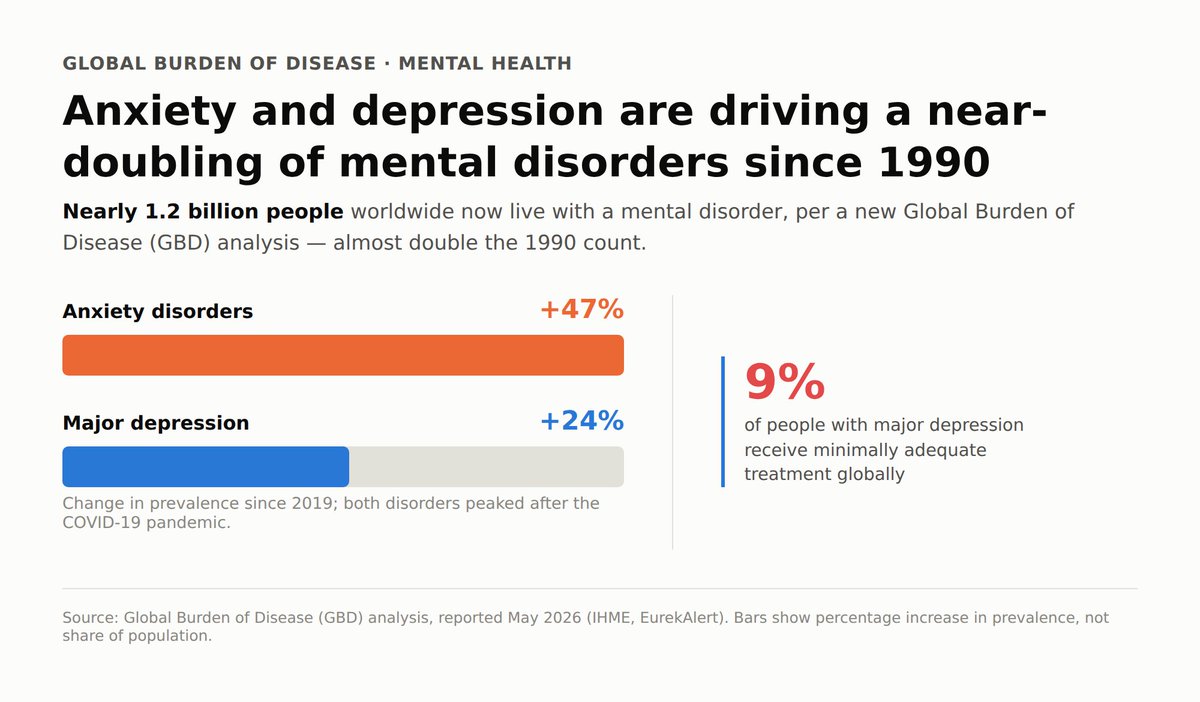
Nearly 1.2 billion people worldwide live with a mental disorder, per a new Global Burden of Disease analysis. Almost double the 1990 count.
Anxiety and depression are driving it: anxiety up 47%, depression up 24% since 2019, both peaking after the pandemic.
Only 9% of people with depression get adequate treatment globally.
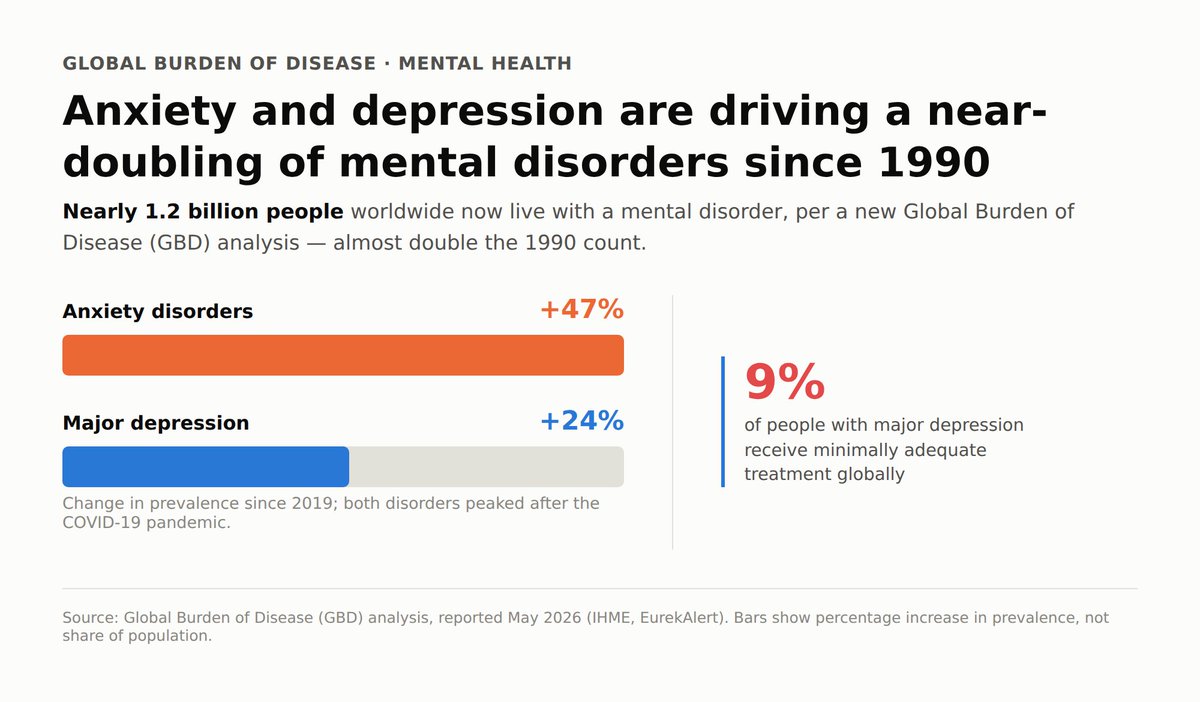
Nearly 1.2 billion people worldwide live with a mental disorder, per a new Global Burden of Disease analysis. Almost double the 1990 count.
Anxiety and depression are driving it: anxiety up 47%, depression up 24% since 2019, both peaking after the pandemic.
Only 9% of people with depression get adequate treatment globally.
Evidence quality: only 3 randomized trials measured acute mood change, and only 3 tested people with clinical depression. Sample sizes ranged from 16 to 92, participants tended to be self-selected health enthusiasts, protocols varied widely, and there was no active placebo control. One study reported 20-30% reductions in depression or anxiety symptoms, but how long that lasts is unclear.
Memory Loss and ADHD
Memory problems are a common yet often misunderstood aspect of ADHD. While we all occasionally forget things, ADHD-related memory issues are more profound and can make even simple tasks feel like monumental challenges, leading to feelings of overwhelm and frustration. If you find yourself constantly misplacing items, forgetting plans, or struggling to complete tasks, know that you are not alone, and there are ways to manage this.
1. Establish a Routine:
I rarely misplace my keys or sunglasses because I consistently place them in the same location. On the rare occasions when I fail to do so, I experience significant frustration in attempting to locate them. Similarly, for critical information, establishing specific email and desktop folders for essential documents ensures that you know where to begin your search.
2. Break Routine Habits:
To effectively retain critical information, intentionally disrupt the routine associated with it. For instance, if you consistently forget to back up your computer at night, and you always keep your keys in your right-hand pocket, consider placing them in your left pocket in the morning. This disruption forces you to deviate from your habitual pattern, creating a sense of urgency that prompts you to take action.
3. Incorporate Brain-Boosting Foods:
Numerous foods enhance memory due to their rich content of antioxidants and vitamins. To optimize your memory, consider incorporating more green tea, blueberries, salmon, cabbage, broccoli, cauliflower, dark chocolate, and turmeric into your daily diet. Experts suggest that occasional consumption of red wine may also contribute to improved memory. However, excessive consumption of red wine can lead to memory impairment.
4. Prioritize Adequate Sleep:
Your brain requires downtime to maintain cognitive sharpness. Insufficient sleep can strain your memory and lead to forgetfulness. Ensure you prioritize rest to keep your mind alert and focused.
5. Engage in Mental Exercises:
While mindless videos and light fiction can be enjoyable, actively challenging your brain enhances memory and cognitive effectiveness. Mental challenges, such as studying complex concepts, make seemingly simple tasks, like recalling names at a party, effortless.
6. Utilize Mental Storytelling:
Names and numbers alone can be easily forgotten without sufficient context. As you encounter new information, be mindful of your surroundings and any potential details that can be associated with the specific information. Recognizing the sequence of events enables you to mentally replay them, facilitating the retrieval of the desired answer.
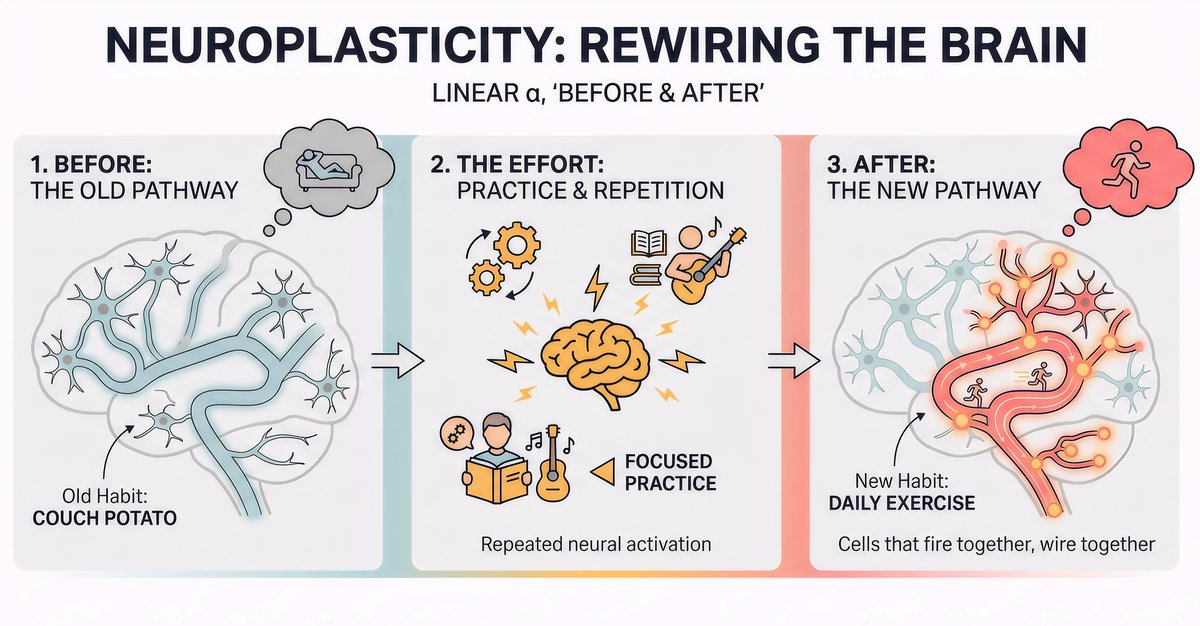
Repetition rewires the brain.
Repetition rewires the brain.
Repetition rewires the brain.
Repetition rewires the brain.
Repetition rewires the brain.
Repetition rewires the brain.
What you practice today is literally what your neural pathways become tomorrow. Choose your routines wisely.
In a famous study, London taxi drivers who memorized the city's streets had larger posterior hippocampi than controls.
The longer they'd driven, the larger it was.
The authors called it "local plastic change" in the adult brain in response to environmental demands.
Caveat: a small study (16 drivers). Still, it shows adult brains adapt.
Practice also turns effort into habit. A 2010 study reported about 66 days on average to feel automatic, ranging from 18 to 254 days.
Your timeline is your own.
@BrandonLuuMD Nice find. TikTok worsened prospective memory while Twitter and YouTube didn't. Small sample, but it fits the idea that rapid context-switching is the cost.
Viral claim: frequent gamers think like people ~14 years younger.
The best evidence I found is a 2026 meta-analysis of 133 studies (14,245 people). It shows a small but real link between gaming and memory, attention and cognitive control.
Correlation, not proof. Gaming may help, or sharper people may game more
@BrandonLuuMD Early evidence says shifting the body clock earlier may help. In one trial, melatonin cut ADHD symptoms by 14%, but the gain faded after stopping. Promising, not proven
1
"I'll work out later" is the hardest habit to break, especially with ADHD.
Here's how to beat exercise procrastination as a founder. 🧵
2
Shrink the task.
Don't plan "a full workout." Plan 10 minutes. Small chunks feel doable, so you actually start.
3
Set short-term goals and reward yourself.
Finish 3 workouts this week? Treat yourself. Wins feed motivation, and motivation on its own comes and goes.
4
Use timers and reminders.
A 10-minute timer turns "exercise" into "just until the timer ends." Most days you'll keep going.
5
Give exercise a fixed slot in your calendar.
An unscheduled workout is easy to push back. A calendar block is an appointment.
6
Make progress visible.
Use a calendar, a to-do list or a habit tracker. Ticking a box is a small reward in itself.
7
Keep it short and frequent.
Short, varied sessions hold interest better than one long routine. Change activities often so it doesn't get boring.
8
Recap:
Small chunks
Short goals and rewards
Timers and reminders
Fixed calendar slot
Visual tracking
Short, frequent sessions