Did you know?
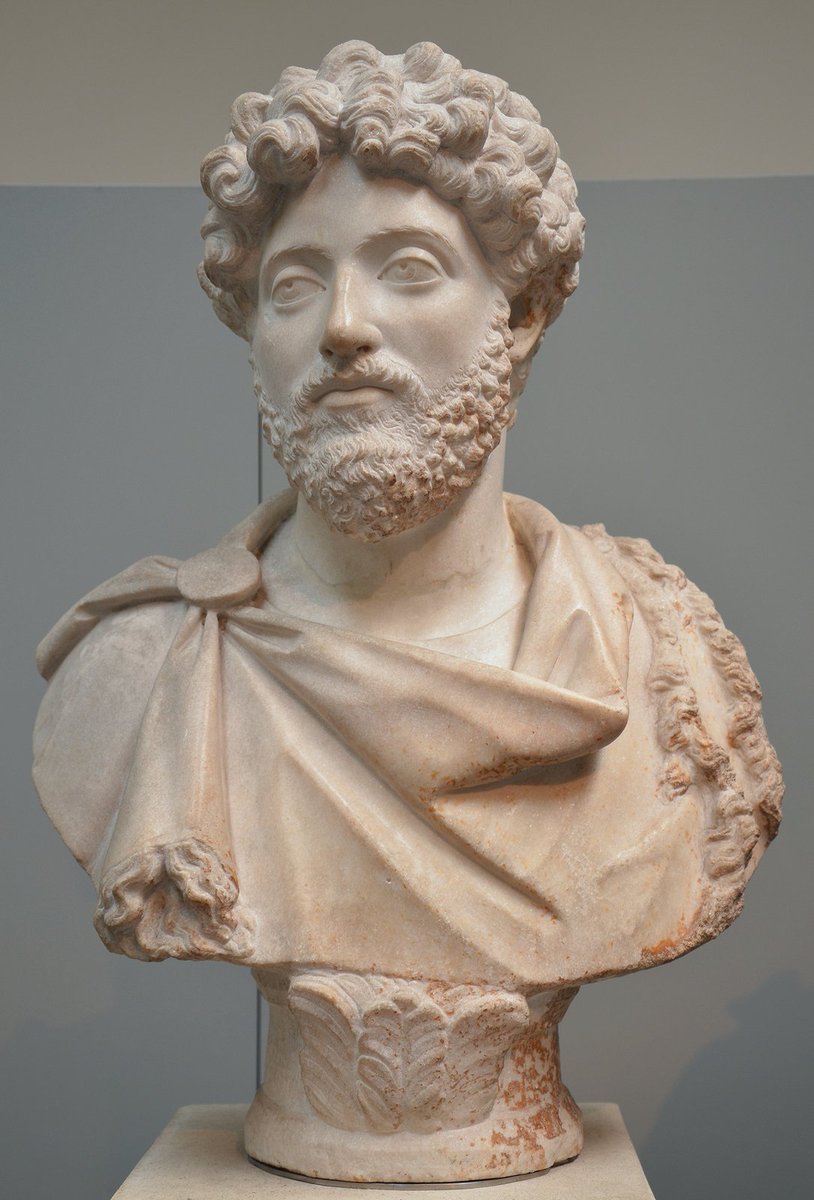
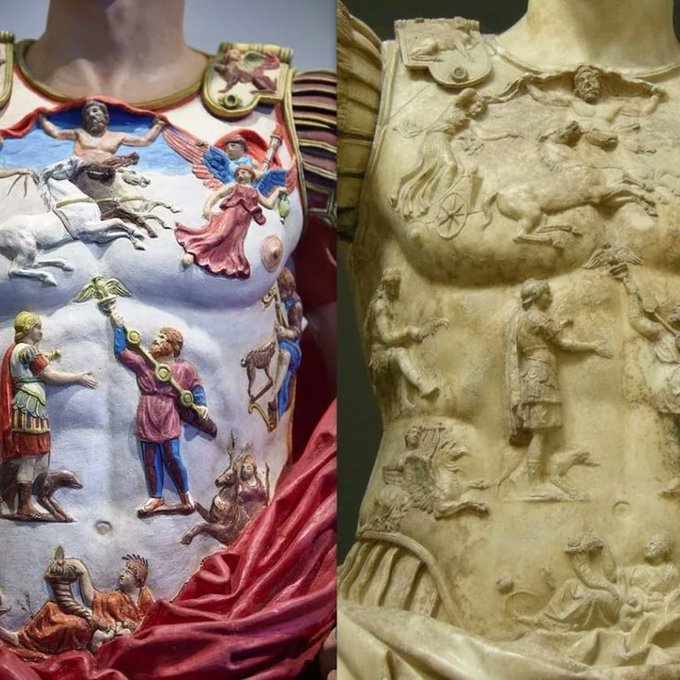
Ancient Roman statues weren't white as we see them today, but were actually colorful.
Roman artists used a wide range of pigments, painting media, and surface applications to embellish their marble sculptures.
In the 19th century, archaeologists unearthed better-preserved items that had traces of color.
But these were mostly ignored — and often actively scrubbed off — until as late as the 1960s.
It was only then that scholars began to confirm that the white sculptures we all associated with ancient Greece and Rome were actually painted with multiple colors (a practice known as polychromy). The paint had deteriorated and faded over time, but evidence of it remained.
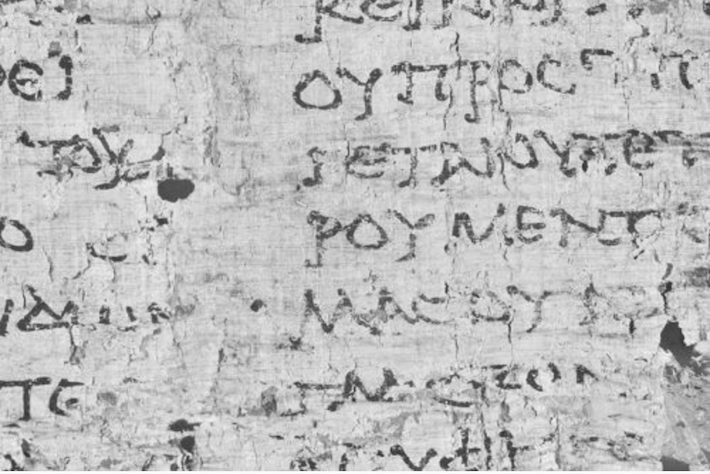
Researchers have deciphered text on charred papyrus recovered from Herculaneum, a Roman town destroyed by the eruption of Mount Vesuvius in A.D. 79, from Philodemus of Gadara (110–30 B.C.) about the burial of the 4th-century Greek philosopher Plato.
https://t.co/4oqRDeOLcb
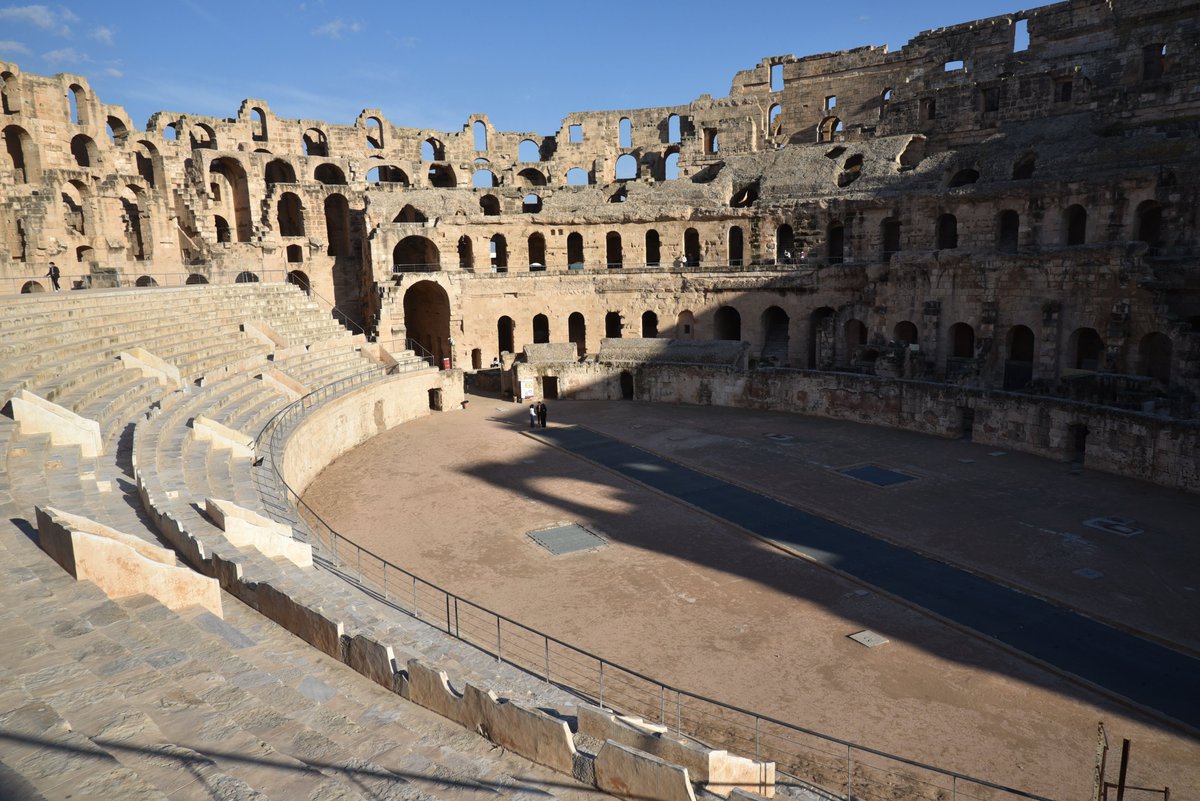
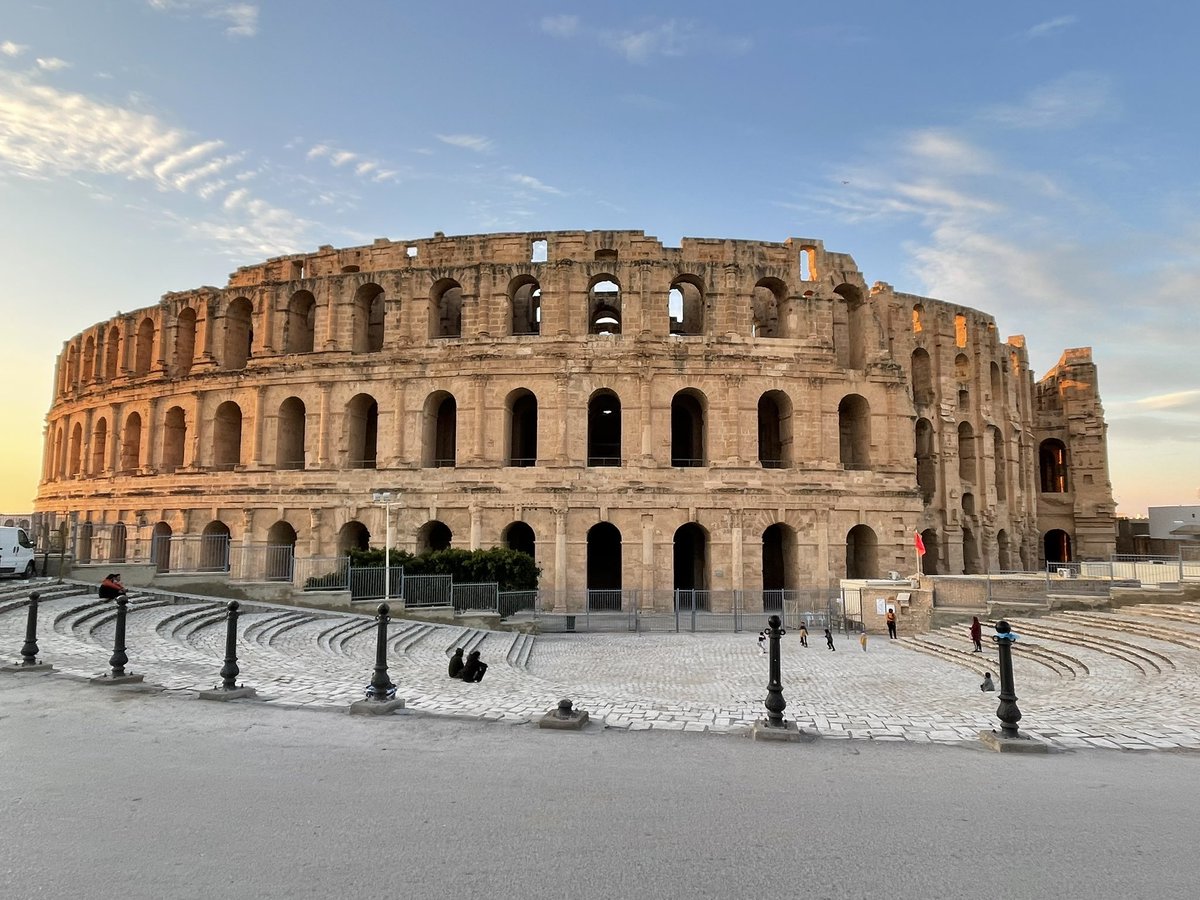
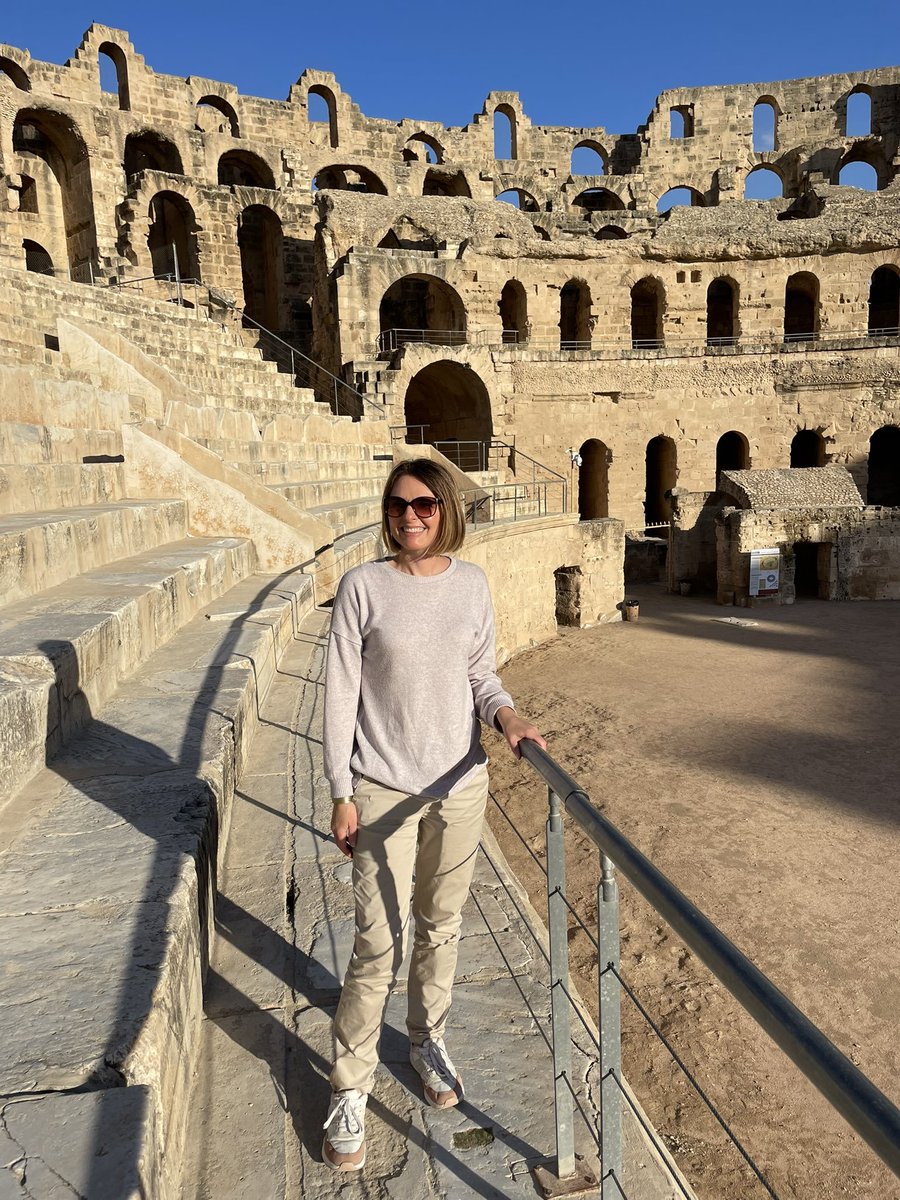
Revisiting the impressive Amphitheatre of El Jem, the largest amphitheatre in North Africa. It could hold up to 35,000 spectators. It is dated to the 3rd century AD and illustrates the grandeur and extent of Imperial Rome. #Tunisia
Hace unos meses trabajé en uno de los proyectos más exigentes a los que me he enfrentado: la recreación virtual en 3D de tres ciudades romanas muy diferentes para una exposición que estaba preparando el @museudelleida. ¿Me acompañáis a descubrirlas? ¡Dentro hilo! 🧵
Designer fashion on the Roman frontier!
This expensive lady’s leather sandal is stamped with the maker’s name ‘Lucius Aebutius Thales’. It was made in Gaul (modern-day France) almost 2,000 years ago.
Perhaps Lucius was a ‘must-have’ designer brand, the Louboutin of his day! 😉
The shoe is affectionately known as ‘Lepidina’s Slipper’. It was found in the period III (c. AD 90 - 105) commanding officer’s residence at Vindolanda fort, home of fort prefect Flavius Cerialis, and his wife Sulpicia Lepidina.
Chesterholm Museum. Photo my own.
#RomanFortThursday
#Archaeology
This gigantic hand was found near the Temple of Hercules on the Amman Citadel in Jordan (ancient Philadelphia). It belonged to a colossal statue of Hercules from the 2nd century AD. The statue is estimated to have stood over 13 metres high, making it one of the largest statues from Graeco-Roman times.
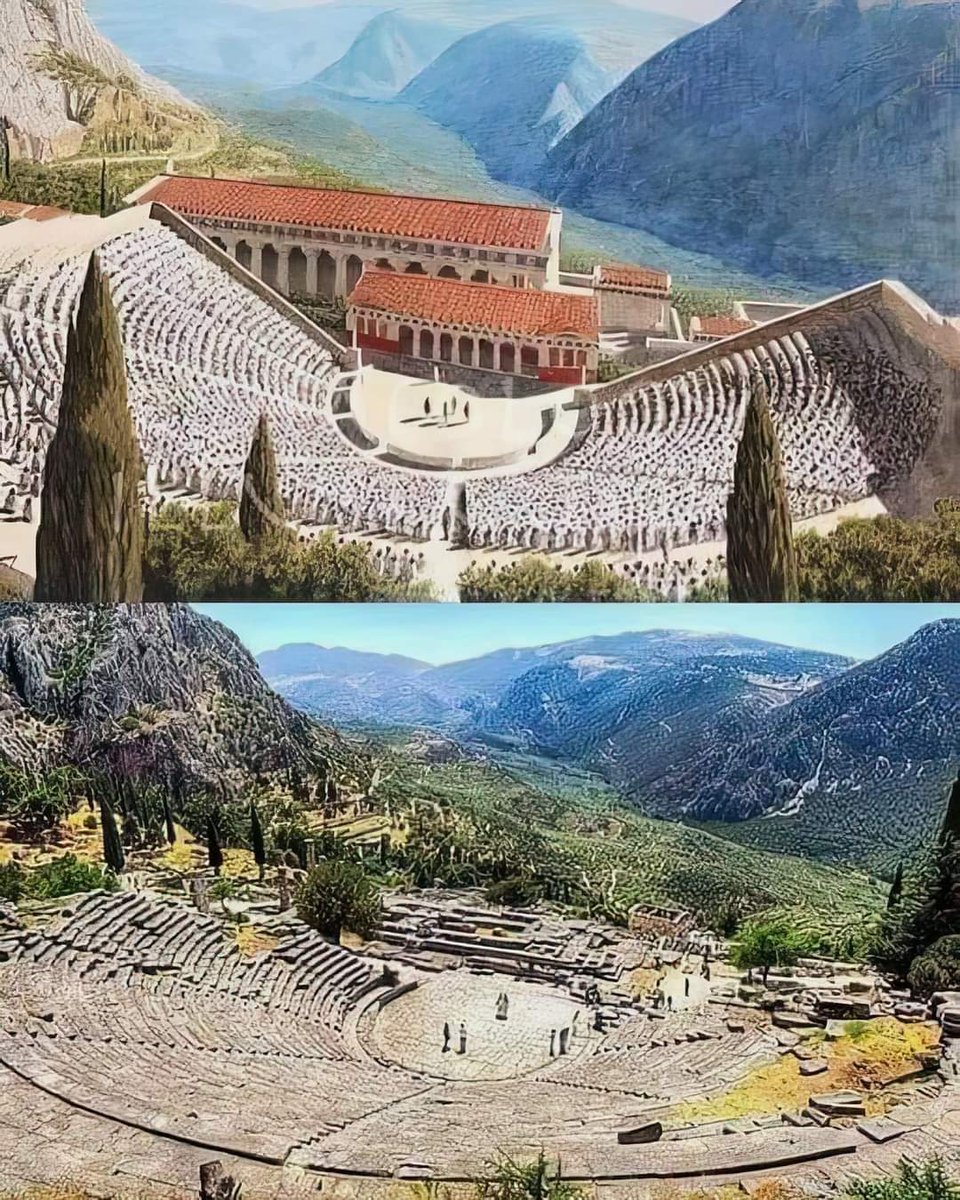
Then vs Now :
Ancient Theatre of Delphi, Greece; has been built on same hill as Temple of Apollo, but it is located further above it. Its situation gave audiences a great view of entire sanctuary and above 'Olive Tree Valley'. Dating back to 4th Century BC, theatre was constructed using limestone of Mount Parnassus.
The 35 rows of theatre could seat nearly 5000 people, who in ancient times enjoyed plays, poetry readings and musical events during the various festivals that took place periodically at Delphi. The lower tiers of seats were constructed in Hellenistic and Roman periods. Theatre went through many reformations. However, it has kept its basic structures: stone seats, a round-shaped stage and an orchestra.
Today, it hosts many ancient plays and other cultural events, mostly in summer.
- Subscribe for Weekly Newsletter -
https://t.co/QSjn4yGpeh
#archaeohistories
Papyrus of Ahmose or Mathematical Rhind (1650 BC); an oldest Manuscript written in Algebra and Trigonometry.
"Rhind Mathematical Papyrus" : Papyrus is probably a mathematics textbook, used by scribes to learn to solve particular mathematical problems by writing down appropriate examples. Eighty-four problems are included in text covering tables of divisions, multiplication and handling of fractions; and geometry, including volumes and areas. The scribe, Ahmose, dated it in year 33 of Apophis, the penultimate king of the Hyksos 15th Dynasty. The other side of the papyrus mentions 'year 11' without a king's name, but with a reference to the capture of the city of Heliopolis.
The Rhind Mathematical Papyrus , is named after Alexander Henry Rhind, a Scottish antiquarian, who purchased the papyrus in 1858 AD, in Luxor, Egypt; it was apparently found during illegal excavations in or near the Ramesseum. Papyrus written by scribe Ahmes (Ahmose) around 1650 BC, Second Intermediate Period. It was copied from a now lost text from reign of king Amenemhat III (12th dynasty) 1500 years prior to Ahmose’s birth. Written in the Hieratic Script. His papyrus is one of the best known examples of advanced Egyptian mathematics; mathematician-priests of the Nile valley knew no peers. It was found during illegal excavations in or near Ramesseum. It has been housed in British Museum since 1865 AD, along with Egyptian Mathematical Leather Roll, also owned by Henry Rhind there are a few small fragments held by Brooklyn Museum in New York. It is one of two well-known Mathematical Papyri along with Moscow Mathematical Papyrus. This Egyptian manuscript began to be transliterated and mathematically translated in late 19th Century AD.
In 2008, mathematical translation aspect is incomplete in several respects. The document is dated to Year 33 of the Hyksos king Apophis and also contains a separate later Year 11 on its verso likely from his successor, Khamudi.
The first part of the Rhind papyrus consists of reference tables and a collection of 20 arithmetic and 20 algebraic problems. The problems start out with simple fractional expressions, followed by completion (sekhem) problems and more involved linear equations. Along with multiplication of fractions.
The second part of the Rhind papyrus consists of geometry problems and gives a general expression for computing 2/3 of 1/n, where n is odd. Peet referred to these problems as "mensuration problems". Problems 41 - 46 show how to find the volume of both cylindrical and rectangular based granaries. In problem 41 the scribe computes the volume of a cylindrical granary. Given the diameter (d) and the height (h), the volume V is given by: V = [(1 - 1 / 9)d]2h. In modern mathematical notation given is 2/(3n) = 1/(2n) + 1/(6n), (and using d = 2r) this clearly equals V = (8 / 9)2d2h = 256 / 81r2h The quotient 256/81 approximates the value of p as being 3.1605.
The third part of the Rhind papyrus consists of a collection of 24 problems. Problem 61 consists of 2 parts.
Manuscript shows that Egyptians used first-order equations and solved them in several ways. They also know quadratic equations and solve them. They also know numerical and geometric sequences and know quadratic equations like two :
X2 + y2 = 100,
Y = 3/4 x, where x = 8, y = 6,
This equation is origin of Pythagoras theorem, a2 = b 2 + c 2, and Egyptians used to call unknown number (koom).
Pythagoras developed his mathematical theories after travelling to Egypt and learning from Egyptian priests, and this has been proven in books of Greek historians and scholars such as Farpharius of Sour, Herodotus and Thales. Egyptians had Algebra, Trigonometry and Geometry about 2000 years before birth of Pythagoras and about 3000 years prior to al-Khwarizmi being born.
(H: 32cm; L: 198.5cm; D: 4.50cm)
British Museum
- Subscribe for Weekly Newsletter -
https://t.co/QSjn4yGpeh
#archaeohistories
Tombstones of two #Roman auxilliary cavalrymen from the 1st century AD
Dannicus (recruited from Switzerland) and Genialis (from the Netherlands) who both died in Britain
Illuminated in colour, as the originals may have been, in the excellent @CoriniumMuseum#RomanFortThursday
Okay this looks like bullying.
"Hey careful, don't step on my tiles Dave, they're drying."
"This tile" *steps
"DAVE"
"Not step on it?" *steps again
"STOP IT"
"Oh this tile!" *steps again.
"Come on, why Dave, why?"
"Hey Fido, don't step on that tile"
"Woof?" *dog steps
"Noooooo"
Magna-ificent!
A wonderful find to share with you today from the new excavation of Milecastle 46 at our Roman Magna site.
This is a delicate equal arm steelyard beam, part of a Roman scale. Read more about it. 👇#RomanMagna#Hadrianswall
https://t.co/jbFI3m36OM
A wonderful example of Roman technology and engineering - a bronze water piston pump!
Excavated at one of the bathhouses in Pompeii and around 2,000 years old, it helped supply fresh water for Roman bathers to enjoy.
🏛️@museiincomune#Classics#Roman#Archaeology#History
A 3,000 year old doodle from ancient Egypt of a cat serving a mouse!
Drawn on a shard of pottery, was it simply done for fun or as a piece of witty social commentary by a disgruntled worker? Dated 19th - 20th Dynasty.
🏛️@brooklynmuseum#Ancient#Egypt#History#Art#Animal








![archeohistories's tweet photo. Papyrus of Ahmose or Mathematical Rhind (1650 BC); an oldest Manuscript written in Algebra and Trigonometry.
"Rhind Mathematical Papyrus" : Papyrus is probably a mathematics textbook, used by scribes to learn to solve particular mathematical problems by writing down appropriate examples. Eighty-four problems are included in text covering tables of divisions, multiplication and handling of fractions; and geometry, including volumes and areas. The scribe, Ahmose, dated it in year 33 of Apophis, the penultimate king of the Hyksos 15th Dynasty. The other side of the papyrus mentions 'year 11' without a king's name, but with a reference to the capture of the city of Heliopolis.
The Rhind Mathematical Papyrus , is named after Alexander Henry Rhind, a Scottish antiquarian, who purchased the papyrus in 1858 AD, in Luxor, Egypt; it was apparently found during illegal excavations in or near the Ramesseum. Papyrus written by scribe Ahmes (Ahmose) around 1650 BC, Second Intermediate Period. It was copied from a now lost text from reign of king Amenemhat III (12th dynasty) 1500 years prior to Ahmose’s birth. Written in the Hieratic Script. His papyrus is one of the best known examples of advanced Egyptian mathematics; mathematician-priests of the Nile valley knew no peers. It was found during illegal excavations in or near Ramesseum. It has been housed in British Museum since 1865 AD, along with Egyptian Mathematical Leather Roll, also owned by Henry Rhind there are a few small fragments held by Brooklyn Museum in New York. It is one of two well-known Mathematical Papyri along with Moscow Mathematical Papyrus. This Egyptian manuscript began to be transliterated and mathematically translated in late 19th Century AD.
In 2008, mathematical translation aspect is incomplete in several respects. The document is dated to Year 33 of the Hyksos king Apophis and also contains a separate later Year 11 on its verso likely from his successor, Khamudi.
The first part of the Rhind papyrus consists of reference tables and a collection of 20 arithmetic and 20 algebraic problems. The problems start out with simple fractional expressions, followed by completion (sekhem) problems and more involved linear equations. Along with multiplication of fractions.
The second part of the Rhind papyrus consists of geometry problems and gives a general expression for computing 2/3 of 1/n, where n is odd. Peet referred to these problems as "mensuration problems". Problems 41 - 46 show how to find the volume of both cylindrical and rectangular based granaries. In problem 41 the scribe computes the volume of a cylindrical granary. Given the diameter (d) and the height (h), the volume V is given by: V = [(1 - 1 / 9)d]2h. In modern mathematical notation given is 2/(3n) = 1/(2n) + 1/(6n), (and using d = 2r) this clearly equals V = (8 / 9)2d2h = 256 / 81r2h The quotient 256/81 approximates the value of p as being 3.1605.
The third part of the Rhind papyrus consists of a collection of 24 problems. Problem 61 consists of 2 parts.
Manuscript shows that Egyptians used first-order equations and solved them in several ways. They also know quadratic equations and solve them. They also know numerical and geometric sequences and know quadratic equations like two :
X2 + y2 = 100,
Y = 3/4 x, where x = 8, y = 6,
This equation is origin of Pythagoras theorem, a2 = b 2 + c 2, and Egyptians used to call unknown number (koom).
Pythagoras developed his mathematical theories after travelling to Egypt and learning from Egyptian priests, and this has been proven in books of Greek historians and scholars such as Farpharius of Sour, Herodotus and Thales. Egyptians had Algebra, Trigonometry and Geometry about 2000 years before birth of Pythagoras and about 3000 years prior to al-Khwarizmi being born.
(H: 32cm; L: 198.5cm; D: 4.50cm)
British Museum
- Subscribe for Weekly Newsletter -
https://t.co/QSjn4yGpeh
#archaeohistories](https://pbs.twimg.com/media/F-54-tfa8AA7dm0.jpg)


