Looking for arc-melt capacity in Canada or the PNW. Mo-Nb-Ta-W-Zr, ~10 g button, Tm ≈ 3060 K, homogenized, XRD + SEM/EDS. Refractory-capable practice — 10 at% Zr, so oxygen control matters.
Paying. Reply or DM.
A surgical-stapler paper and a rotating-black-hole paper were sitting in the refractory-alloy corpus.
They're out.
The index keeps literature that can answer a composition question. If it can't support a claim, the system returns [UNSUPPORTED] instead of guessing.
https://t.co/SNOO15Sa24
One alloy. One orbit. At a time.
Zitron’s point isn’t “AI is fake.” It’s that the capex story is running ahead of the product, and the 2027 superintelligence date is sales copy.
Quote: https://t.co/qmf9ywmfoU
Stage Zero is a ledger, not a catalog.
Six compositions on the record. Three descriptor-screened. Three model-proposed. None melted.
The timestamp: https://t.co/Oh0O5Mzrel scoreboard: https://t.co/uBO7CJEFHX
Confirmations and refutations get the same line.
One alloy. One orbit. At a time.
Six computational predictions. Nothing melted.
AV-001–003 descriptor-screened.
AV-004–006 model-proposed.
Registered:
https://t.co/74vyuuzXUE
Ledger:
https://t.co/yoFFuyBw93
Furnace next.
One alloy. One orbit. At a time.
Looking for arc-melt capacity in Canada or the PNW. Mo-Nb-Ta-W-Zr, ~10 g button, Tm ≈ 3060 K, homogenized, XRD + SEM/EDS. Refractory-capable practice — 10 at% Zr, so oxygen control matters.
Paying. Reply or DM.
Engagement metrics count how many.
The reply section shows who.
Only one is useful.
@AudienceXai finds the high-signal people in your replies and DMs them to you with drafts that sound like you.
Grok-powered. Read-only. 7 days free.
https://t.co/7E2KB4S9xW
We @ArgeadVenture pointed our generative AI at a problem most material scientists call impractical: design brand-new refractory high-entropy alloys that can survive orbital ISRU. The targets were brutal — melting point above 2,900°C, real strength at 2,500°C, self-healing under radiation, and toughness enough to shrug off micrometeoroid impacts.
Here's what came back:
• Alloy A — W₀.₂₅Ta₀.₂₀Mo₀.₂₀Nb₀.₂₀Hf₀.₁₅, melting at 3,120°C
• Alloy B — Ta₀.₂₅W₀.₂₀Mo₀.₂₀Nb₀.₂₀Zr₀.₁₅, 3,085°C • Alloy C — Hf₀.₂₀Ta₀.₂₀W₀.₂₀Mo₀.₂₀Nb₀.₂₀, 3,010°C
All three hold their phase stability, recombine radiation defects 3–4× better than pure tungsten, and slot directly into in-space additive manufacturing.
For context: these run roughly 1,500°C hotter than Inconel 718 or Hastelloy X — the materials we currently lean on — while holding more strength and taking more punishment.
That's the Argead edge. We don't search for better materials. We design ones that have never existed, aimed straight at humanity's expansion off this planet.
What do we build for next?
https://t.co/hWu1jSXEm6
@SpaceX@NASAAdmin@NASA@Amazonleo@elonmusk
Frontier sparks: refractory alloys hitting thermal walls at Mach 10+. LEO debris density approaching Kessler cascade territory.
These extremes ignite us.
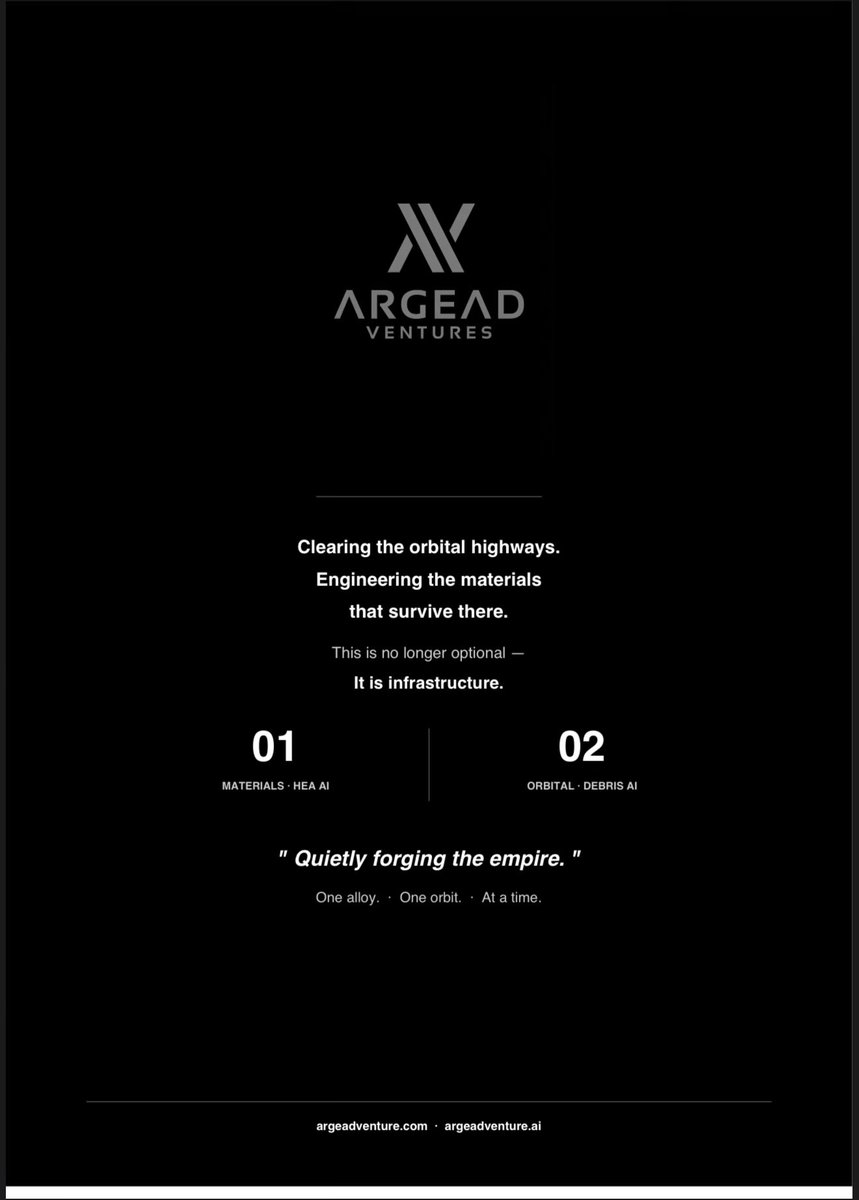
At @ArgeadVenture we fuse AI + quantum chem to autonomously forge never-before-synthesized ultra-stable high-entropy alloys for hypersonics, fusion & space hardware — plus RL swarms that predict, intercept & de-orbit junk for safe mega-constellations.
Quietly forging the empire. One alloy. One orbit. At a time.
The 1M-ton-to-orbit future is coming fast.
Clearing the orbital highways and engineering the materials that can actually survive there at scale is no longer optional — it’s infrastructure.
That’s exactly why we’re building at Argead Venture.
One orbit. One alloy. At a time.
@ArgeadVenture
#DeepTech #Space
@jvisserlabs said on Pomp’s show that Eli Lilly could become both the world’s largest company and the largest AI company within five years. Most people heard hype. I heard someone finally saying out loud the thing I’ve been building toward for two years.
$LLY isn’t dabbling in AI. They’ve stood up serious pharma-first compute, pointed it at 150 years of proprietary chemistry and clinical data, and started closing the loop between the wet lab and the molecule. That’s not a chatbot bolted onto a research org. That’s a company realizing its real moat was never the buildings or the sales force. It was the data nobody else has and the regulatory knowledge nobody else can fake.
Here’s the part that keeps me up at night in a good way.
Discovering the molecule is only half the race. The other half is everything that happens after, and it’s where pharma quietly bleeds out. You can design something brilliant and then lose six to twelve months and millions of dollars turning it into a submission a regulator will actually accept. The CMC work. The dossier. The CTD modules, the batch records, the tech transfer protocols. That bottleneck is invisible in the press releases and fatal in the timelines.
That’s the half we built PureMonograph for.
The idea was never to replace scientists. It was to give every pharma company, from the Lilly-scale giants down to a three-person biotech, the same infrastructure underneath them, so that the moment they have a candidate they don’t have to wait for the paperwork to catch up. They generate the work product, grounded in real regulatory sources and real CMC judgment, auditable, every claim traceable. And they move.
What Lilly is proving in public is the whole thesis. The companies that own the full loop, from molecule design to submission-ready compliance, are going to compound faster than any pure software play, because they sit on a data moat that’s a century and a half deep and a regulatory moat almost nobody can cross.
The future isn’t AI showing up in pharma. It’s the realization that the best-positioned AI companies on earth might already be pharma companies. They just haven’t all figured it out yet.
Lilly figured it out. We built the missing half of the stack for everyone who comes next.
@PureMonograph
If you’re a pharma exec or a biotech founder tired of watching good molecules stall in documentation, that’s the conversation I want to have.
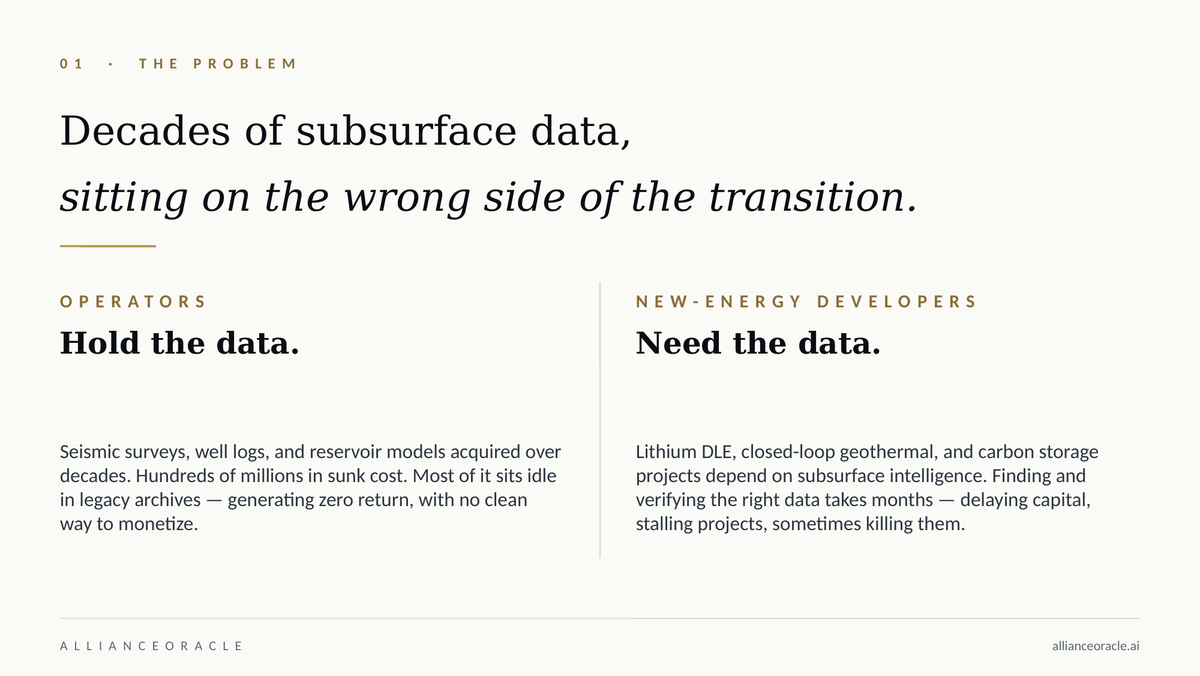
Most Alberta operators sit on millions in idle subsurface data.
Most lithium & geothermal developers can’t find what they need.
We fixed that gap.
@allianceoracle1 = verified metadata licensing, clean settlement, no raw data exposure.
Strong operator & developer network forming now.
https://t.co/pjsmQaOJo5
Alberta operators are sitting on subsurface archives worth seven figures per verified asset, getting zero return today.
Building the verification and settlement layer between that data and the lithium, geothermal, and CCS developers who need it.
https://t.co/hCPNfe3EwS


![ArgeadVenture's tweet photo. A surgical-stapler paper and a rotating-black-hole paper were sitting in the refractory-alloy corpus.
They're out.
The index keeps literature that can answer a composition question. If it can't support a claim, the system returns [UNSUPPORTED] instead of guessing.
https://t.co/SNOO15Sa24
One alloy. One orbit. At a time.](https://pbs.twimg.com/media/HRJ8tWDaIAA1QoH.jpg)