KAST Turns Freelancers Into Global Finance Experts Without Extra Effort
Freelancers face a daily battle. Clients in different countries, payments in different currencies, banks that charge high fees and take days to clear transactions. KAST solves these problems while quietly teaching users how the international money system actually works.
The Technology That Removes Borders
KAST gives freelancers a US bank account number and routing number without needing US residency. A designer in Indonesia can invoice a New York agency and receive payment by ACH within hours. A writer in Kenya can hold dollars in their KAST wallet, protecting against local currency volatility. A developer in Argentina can spend those dollars instantly with a Visa card accepted at over 150 million merchants worldwide.
Behind this simplicity is a secure infrastructure. KAST partners with Fireblocks and BitGo for institutional grade custody, works with licensed financial institutions for compliance, and uses real time fraud monitoring. The freelancer never sees the complexity. They only see money that arrives fast, converts automatically, and spends easily.
The Unintentional Education
Every feature teaches a lesson. When a freelancer receives an ACH payment for the first time, they learn that the American banking system is faster and cheaper than international wires. When they withdraw stablecoins to a personal wallet, they learn about self custody and blockchain transaction fees. When they check their KAST Earn balance growing at up to 10 percent APY, they learn about yield and passive income.
No tutorials required. No certificates needed. Just real work, real payments, and real learning. KAST Academy exists in the help center for deeper questions, but most users absorb knowledge simply by using the product day after day.
Freelancers are the future of work. They move across borders, serve global clients, and need financial tools that keep up. KAST provides those tools and, in the process, builds a generation of financially literate independent workers. That is technology serving education. And that is the quiet power of KAST.
@KASTxyz
The @bulktrade pre deposit wave is getting ridiculous 🔥
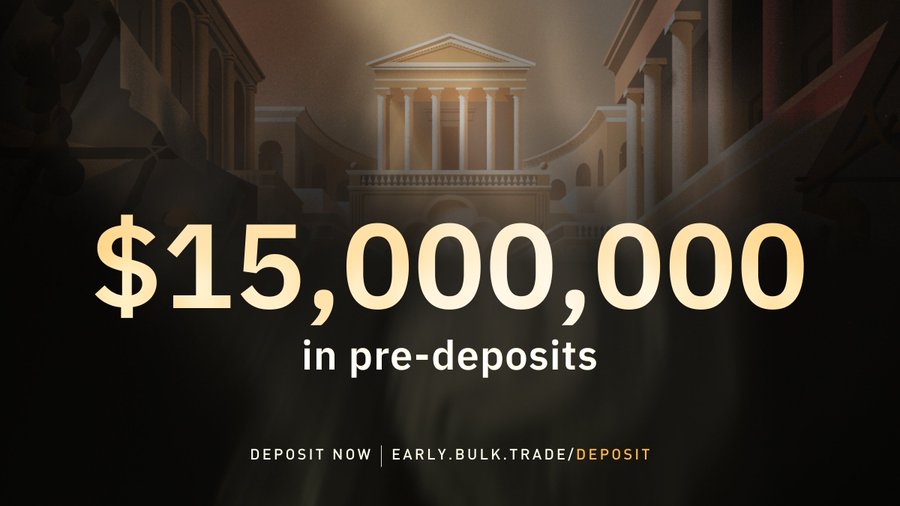
They just hit $15,000,000 deposited in Season 1 and it’s only been a few days. The momentum is actually insane.
First AURA drop is coming in just 2 days (this Saturday). 1 million AURA allocated every single week until mainnet, with pre depositors getting the biggest slice based on how much USDC you hold and how long you hold it.
You deposit now → it becomes your margin at launch → you start stacking points immediately. Withdraw anytime if you want. Referral codes are also live so you can bring friends and multiply your bag.
This is the cleanest pre mainnet farm on Solana right now.
Join here: https://t.co/vCqVBA8OGi
gBULK 🚀
@bulktrade
Why KAST Is the First Financial App That Teaches Without Boring You?
Education in finance usually comes in two flavors. The first is a thick booklet nobody reads. The second is a YouTube rabbit hole that starts with "what is a stablecoin" and ends six hours later with advanced DeFi strategies. KAST offers a third way. Learning through living.
The Technology Is the Teacher
KAST is built on a simple idea. Let people use real money tools, and they will naturally understand how those tools work. The app gives you a US account, a card, and the ability to hold stablecoins. That is it. But within that simplicity lies a curriculum.
When you receive your first ACH payment, you learn that the US banking system moves money differently than your local bank. When you tap your card in another currency, you learn about foreign exchange spreads without reading a single definition. When you watch your cashback accumulate, you learn about reward economics. Every feature is a lesson waiting to happen.
No Tests, No Lectures
KAST Academy exists inside the Concierge help center, but the real classroom is your transaction history. Open the app after a week of spending. Look at where your money went, what fees you paid, what cashback you earned. That data tells a story. It shows you where you spend too much, where you save, and how global money actually moves.
This is not theory. This is your financial life becoming visible and understandable. KAST just provides the lens.
For the Curious and the Cautious
If you are new to crypto, KAST feels safe because it works like a normal bank. If you are experienced, it feels powerful because it connects to blockchain networks. Either way, you learn something every time you open the app. That is the quiet innovation. Not a new feature. A new way to understand.
@KASTxyz
Hey degens, the @bulktrade train is moving crazy fast right now 🔥
Season 1 just dropped and predeposits are officially open. In the first 24 hours alone they pulled in $7,500,000 in Solana USDC the aura is actually flowing.
You deposit USDC (can withdraw anytime), it becomes your margin once mainnet hits, and you start stacking AURA points every single week until launch. 1 million AURA allocated weekly, with pre depositors and referrers getting the lion’s share. First retroactive drop already went out to stakers, BulkSOL holders, Exponent/Loopscale/Project0 users, and testnet traders.
Referral codes are live in the dashboard too 1 AURA for every $100 your referrals deposit. Easy multiplier.
This is the real pre mainnet move. No more waiting around.
Go deposit here: https://t.co/vCqVBA8OGi
Who’s already AURAmaxxing with me?
gBULK 🚀
@bulktrade@rizzy_sol
New puzzle on Gradient is out
This time, this puzzle has 81 pieces
How to join?
- go to https://t.co/iQCGaQejFs
- set your name same with discord username in discord
- top 10 will get quiz mastermind role
i finished solving it in 11m 34, come and try to beat me
@Gradient_HQ@davidz9@HexxRL@yuangao@gradientintern
KAST Brings Banking to the Unbanked and Knowledge to Everyone
There are 1.4 billion adults in the world without a bank account. Millions more have accounts but cannot use them across borders. KAST was not built for Wall Street. It was built for these people.
Technology That Reaches Where Banks Cannot
KAST gives any user a US bank account number and routing number without requiring US residency. A freelancer in Nigeria can receive ACH payments from American clients. A family in the Philippines can hold dollars to protect against local inflation. A student in Vietnam can pay for online courses with a Visa card accepted globally.
The technology stack is intentionally invisible. KAST partners with Fireblocks and BitGo for enterprise security, works with licensed institutions for regulatory compliance, and uses real time fraud monitoring. The user never sees any of this. They only see money that moves instantly, fees that are transparent, and a card that works everywhere.
For someone who has never had a bank account, this is revolutionary. For someone who has been rejected by traditional banks, this is liberating. KAST does not ask for credit history, minimum balances, or local addresses. It only asks for a smartphone and an internet connection.
Education That Grows From Need
When you have never used a bank, learning financial concepts happens through necessity. KAST embeds that learning directly into the experience. A user who receives their first ACH payment learns what routing numbers mean. A user who sends money to family in another country learns about exchange rates. A user who checks their cashback total learns about rewards and spending habits.
The KAST Academy, housed within the Concierge help center, provides clear articles on account setup, security, card usage, and payments. But the most powerful lessons come from the community. Testimonials from users who have replaced their local banks entirely become real world case studies. Someone in Dubai who stopped using traditional cards teaches others by example. A traveler who used KAST across six countries creates a roadmap for digital nomads.
Beyond Financial Inclusion
True financial inclusion is not just about access. It is about understanding. Giving someone a bank account without teaching them how to use it safely is incomplete. KAST solves this by making education a natural outcome of using the product.
For the underbanked, KAST offers a new start. For the curious, it offers a new education. One app serving both purposes. That is the quiet power of KAST. Not just a tool for moving money, but a teacher for moving through the modern financial world.
@KASTxyz
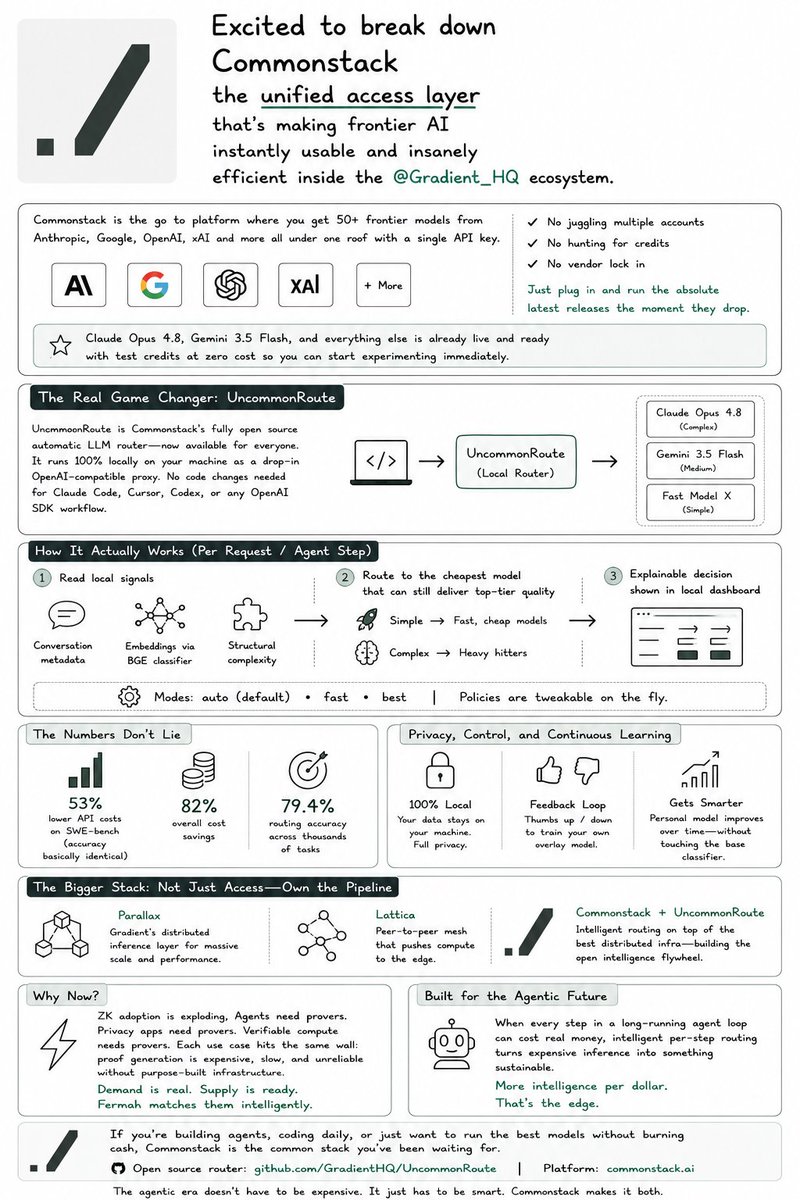
Excited to break down Commonstack the unified access layer that’s making frontier AI instantly usable and insanely efficient inside the @Gradient_HQ ecosystem.
Commonstack is the go to platform where you get 50+ frontier models from Anthropic, Google, OpenAI, xAI and more all under one roof with a single API key. No juggling multiple accounts, no hunting for credits, no vendor lock in. Just plug in and run the absolute latest releases the moment they drop. Claude Opus 4.8, Gemini 3.5 Flash, and everything else is already live and ready with test credits at zero cost so you can start experimenting immediately.
But the real game changer is UncommonRoute their fully open source automatic LLM router that’s now available for everyone. It runs 100 percent locally on your machine as a drop in OpenAI compatible proxy. No code changes needed for Claude Code, Cursor, Codex, or any OpenAI SDK workflow.
Here’s how the tech actually works: for every single request or agent step, UncommonRoute looks at three local signals conversation metadata, embeddings via a lightweight BGE classifier, and structural complexity then instantly routes the prompt to the cheapest model that can still deliver top tier quality. Simple tasks go to fast cheap models, complex reasoning or coding jumps to the heavy hitters. The decision is explainable, visible in a clean local dashboard, and you can tweak policies on the fly with modes like auto, fast, or best.
The numbers are wild. On real benchmarks like SWE bench it delivers 53 percent lower API costs while keeping accuracy basically identical. Overall it’s hitting 82 percent cost savings and 79.4 percent routing accuracy across thousands of tasks. And because everything stays local you keep full privacy, full control, and you can even give thumbs up or thumbs down feedback to train a personal overlay model that gets smarter over time without touching the base classifier.
This is exactly the kind of stack the agentic future needs. When every step in a long running agent loop can cost real money, intelligent per step routing turns expensive inference into something sustainable. Pair it with Gradient’s Parallax distributed inference layer and Lattica’s peer to peer mesh and you’re not just accessing models you’re owning the entire pipeline from edge to global scale.
Hexx and the Gradient crew have been pushing this hard because it’s the practical bridge between frontier closed models and the fully open decentralized infrastructure they’re building. Inference costs are skyrocketing with agentic adoption, yet Commonstack + UncommonRoute flips the script and gives you more intelligence per dollar than ever before.
If you’re building agents, coding daily, or just want to run the best models without burning cash, Commonstack is the common stack you’ve been waiting for. Open source router is live on GitHub right now, the platform is at https://t.co/tjxEdT9DS3 with signup credits ready, and the whole thing slots perfectly into the open intelligence flywheel @Gradient_HQ is accelerating.
The agentic era doesn’t have to be expensive. It just has to be smart. Commonstack makes it both.
@Gradient_HQ@davidz9@HexxRL@yuangao@gradientintern
Hey degens, the @bulktrade train is moving crazy fast right now 🔥
Season 1 just dropped and predeposits are officially open. In the first 24 hours alone they pulled in $7,500,000 in Solana USDC the aura is actually flowing.
You deposit USDC (can withdraw anytime), it becomes your margin once mainnet hits, and you start stacking AURA points every single week until launch. 1 million AURA allocated weekly, with pre depositors and referrers getting the lion’s share. First retroactive drop already went out to stakers, BulkSOL holders, Exponent/Loopscale/Project0 users, and testnet traders.
Referral codes are live in the dashboard too 1 AURA for every $100 your referrals deposit. Easy multiplier.
This is the real pre mainnet move. No more waiting around.
Go deposit here: https://t.co/vCqVBA8OGi
Who’s already AURAmaxxing with me?
gBULK 🚀
@bulktrade@rizzy_sol
The Day I Learned More About Money Than in 20 Years
Last month, I opened a KAST account out of curiosity. I had heard about stablecoins but never touched one. I had a bank account that charged me 40 dollars every time I sent money abroad. I had a credit card that gave me 1 percent cashback on "select categories" I never seemed to hit.
Seven days later, I understood more about global finance than in two decades of banking.
Here is what happened. KAST gave me a US account number. Not a virtual pretend one. A real routing number that an American client used to pay me by ACH. The money arrived in hours, not days. I learned that ACH exists. I learned why wire transfers are faster but more expensive. I learned that you do not need to live in America to access its banking system. That was day one.
On day two, I deposited some USDC into my KAST wallet. I had never touched a stablecoin before. The app showed me my dollar balance and my crypto balance side by side. I learned that USDC is always worth one dollar. I learned that moving it costs almost nothing. I learned that "on chain" just means moving money without a bank in the middle. That took about three minutes.
On day three, I used the KAST card to buy coffee. The app converted my stablecoins to local currency automatically at checkout. A notification popped up with the exchange rate. I learned that most cards hide their conversion fees. KAST shows them openly. That built trust.
By day seven, I had earned cashback on groceries, sent money to a friend in another country instantly, and read through KAST Academy articles about two factor authentication and fraud protection. None of it felt like studying. It felt like using a good product. But I had accidentally learned how modern money works.
KAST does not advertise itself as a school. It advertises itself as a global money app. But for anyone willing to tap and explore, the education is already built in. No textbooks. No exams. Just a wallet that teaches you as you spend. That is the quiet revolution.
@KASTxyz
KAST Teaches Global Finance One Transaction at a Time
Most people learn about international money movement the hard way. They send a wire transfer that takes a week. They pay a hidden fee. They watch their currency lose value. KAST offers a different path. A hands on education built into every feature.
The Technology Behind the Lesson
KAST provides a US bank account number and routing number to users anywhere in the world. No American address required. This single feature unlocks a cascade of learning opportunities. A freelancer who receives an ACH payment learns how the US clearing system works. A small business owner who sends a FedWire transfer learns about settlement times and priority fees. A traveler who loads stablecoins onto a KAST card learns about the relationship between crypto and fiat.
The platform partners with Fireblocks and BitGo for security, but users never need to know that. They only experience the result. Money moves fast. Fees are transparent. The card works everywhere Visa is accepted. This friction free design is intentional. When technology works smoothly, users can focus on understanding how money behaves, not on fighting the interface.
Education Through Categories
KAST organizes its features into natural learning modules. Store teaches about dollar based savings and cross border receiving. Earn introduces yield, risk, and APY. Move demonstrates instant settlement and remittance costs. Spend shows currency conversion, merchant networks, and cashback mechanics.
Each module is simple enough for a beginner but deep enough to build lasting knowledge. A user who spends a month with KAST understands concepts that would take a semester to teach in a classroom. They know why stablecoins matter. They know how banks profit from wire fees. They know the difference between a good yield and a risky one.
The Quiet Academy
KAST Academy lives inside the Concierge help center. It is not a separate app or a paid course. It is just there when users need it. Articles cover account setup, verification, card activation, payments, and rewards. The tone is clear and helpful, not technical or intimidating.
What makes this educational model effective is timing. Users search for help exactly when they encounter a problem. That moment of frustration is actually the best time to learn. KAST captures that moment with accurate, concise answers. Over time, users internalize the knowledge without feeling like they studied.
For millions of people who feel left behind by traditional banking and confused by crypto, KAST offers a middle path. A working product that teaches as it serves. That is not just fintech. That is edtech disguised as a wallet.
@KASTxyz
One Model, Anywhere: How Gradient Ends Vendor Lock in for AI
Today’s AI industry runs on captivity. Train a model on AWS? It stays on AWS. Fine tune with OpenAI’s fine tuning API? Good luck moving those weights elsewhere. Every cloud provider builds walls. Gradient was designed to be the opposite: a network where models move freely, and no one owns your intelligence.
The Standard Model Format
Gradient does not invent a new model format. It uses a simple, open specification: a manifest file (JSON) that points to content addressed parameter shards, plus metadata about precision, architecture, and sharding scheme. The manifest can reference GGUF, Safetensors, PyTorch bin files, or any other format. A model on Gradient is just a description of where to find its parts. This means any model you can download from Hugging Face can run on Gradient with zero conversion.
Export Is a First Class Feature
Most platforms make export painful if they allow it at all. Gradient treats export as a core protocol operation. A node holding a model shard must serve it to any peer that requests it (in exchange for a small bandwidth fee). The network implements a BitTorrent like swarming protocol for model distribution. If you want to move your model off Gradient, you simply download the shards from the swarm. No export button. No approval process. Just the protocol.
Private Models with Public Hashing
You can host private models on Gradient without revealing their weights. The model manifest uses hashes of encrypted shards. Nodes store encrypted blobs but cannot decrypt them without a key you control. Your application sends the decryption key alongside each inference request (over an encrypted channel). The node runs inference inside a secure enclave or simply decrypts in memory temporarily. The model never leaves the network in plaintext, but you retain full control. And you can still export the encrypted blobs anytime.
Cross Network Compatibility
Because the model format is open, a second decentralized AI network could adopt the same specification. Models hosted on Gradient could then run on that competing network without re uploading. This creates competitive pressure. If Gradient’s fees rise too high, developers can point their applications to another network that speaks the same model format. The barrier to switching is near zero. That is the opposite of vendor lock in.
Checkpoint Portability for Fine Tuning
When you fine tune a model on Gradient’s Echo framework, the output is not a proprietary blob. Echo produces standard PyTorch checkpoint files, split into shards following the same manifest format. You can download those checkpoints, load them into any PyTorch environment, and continue training elsewhere. The fine tuning process itself is decentralized, but the results are completely portable. No special decoder. No reverse engineering.
The Role of the Blockchain
Some might worry that Solana settlement locks you in. It does not. Gradient’s smart contracts are open source and deployable on any blockchain. If Solana becomes undesirable, the community can fork the settlement layer to another chain. Node identities and reputation scores are portable across forks because they are rooted in cryptographic keys, not chain specific addresses. The network can migrate. The models stay.
Real World Example
A developer trains a small specialized model for medical coding using Gradient’s network. The model runs happily on Gradient for six months. Then a new, cheaper network launches. The developer downloads the model shards from Gradient’s swarm (paying minimal bandwidth fees) and uploads the same shards to the new network. The manifest file needs one line changed: the base URL for peer discovery. That is it. The application continues running, now on cheaper infrastructure. No retraining. No reformatting. No vendor permission.
Why Others Don’t Do This?
Centralized platforms do not offer this portability because portability kills their pricing power. If you can leave easily, they must compete on price and quality, not lock in. Gradient’s architecture forces competition. The protocol does not favor any single operator. It does not capture value from model hosting. It merely enables it. That is why Gradient can offer true portability: it does not need to trap you.
The End of Captive AI
Vendor lock in has been the default since the beginning of commercial AI. Gradient proves that another way is possible. Models as open, portable, content addressed blobs. Networks that compete for your business. Intelligence that you actually own. The walls are coming down.
@Gradient_HQ@davidz9@HexxRL@yuangao