A great summary of my forthcoming paper with Luca Macedoni by the J of International Econ.
Nothing to add, but I’ll say we’re working on a multi country framework to estimate global welfare response to a counterfactual change in regulations in one or multiple countries.
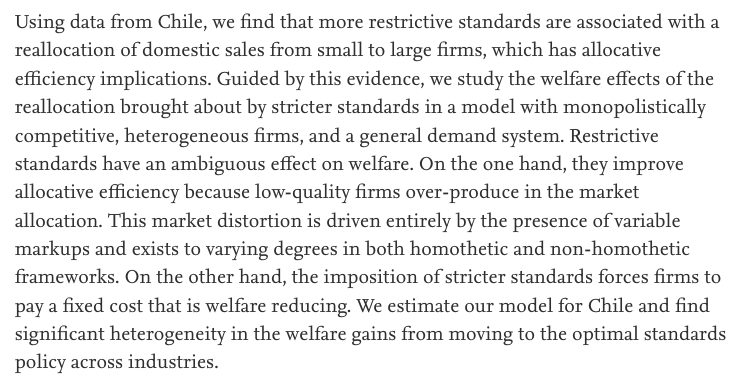
New: "Quality Heterogeneity and Misallocation: The Welfare Benefits of Raising Your Standards" by Luca Macedoni (@AarhusUni_int) & @ArielWein. Restrictive product standards can improve allocative efficiency by shifting sales from small to large firms. https://t.co/wr6DRnN6B8 1/4
This *2021* Waller speech makes for interesting reading today.
At the time, Fed doves had been pointing to trimmed mean measures of inflation to argue against overreacting to spot inflation.
Waller's point was that serially excluding 'one-off' outliers assumes no new one-offs take their place—a fallacy that, in hindsight, anticipated how the transitory framing failed.
"The moral of this little example is that one needs to be careful when selectively ignoring data series—be it used car prices, food and energy prices, or household surveys of inflation expectations. All of these series convey important information about the evolution of inflation, and one should exhibit caution in dismissing data as outliers. We must keep our eyes open to inflationary pressures, wherever they come from, with consistency and rigor and stand ready to adjust policy if we conclude that such a change is warranted."
https://t.co/DiCvOssLUZ
@max_spero_@ben_golub@pangram My guess is the judges are themselves AI. I tried to see how AI would grade my student papers and the most glaringly obvious AI written papers were the ones it gave the highest grades. I’m sure there’s a way to train it, but reasonable in these competitions AI just rewards AI.
The Journal of International Economics is pleased to announce that the Bhagwati Prize for the best paper in International Trade has been awarded to “Robots, Tasks, and Trade,” by Paulo Bastos, Bob Rijkers, and Erhan Artuc. Congratulations!
https://t.co/KzcS0MOPbx
🚨 New NBER WP 🚨
We study how new product varieties enter markets.
When consumers discover and try new products via direct-to-consumer imports, does that information remain confined to those shoppers, or can it spread and ultimately reshape what is available locally?
1/N
The 15th Washington Area International Trade Symposium (#WAITS) will take place on May 1 at @the_IDB in Washington, DC. I am pleased to chair the keynote session, featuring Laura Alfaro, who will present on trade policy in supply chains. Join us: https://t.co/fVROKDTUxI #Trade
If any good lawyer is interested, I’m glad to represent the class. I think there’s a 0% chance any jury will agree that secretly drawing in a non-uniform way is acceptable or reasonably anticipated by purchasers.
The Migration & Organizations conference is a superb annual academic meeting that unites scholars of management, economics, and sociology studying the effects of international migration
Hosted at @upenn.edu Wharton School, May 26–27
This is the definitive synthesis of the macro and the micro, of currency policy and industrial policy and much more
Great piece
https://t.co/4f0R8NAwSp
2/
Good summary. Clear the impacts have been consistent exactly with reasonable economic expectations.
But highlights hysteria that social media causes. An incentive to make noise and predict direr outcomes than if you asked most economists. A negative externality on the profession
Four theses on tariff impacts:
1. Evidence clearly shows they've added 0.5-1.0pp to inflation. Evidence consistent with them subtracting from growth. And no evidence they've done anything good for manufacturing or trade deficits (but they have raised revenue).
Nice analogy here on the static-ness of an economy with non-growing population.
Jobs and Workers Are in Balance. Nobody Is Happy About It. https://t.co/URZm69levA
@haugejostein “But if you’ve somehow managed to convince yourself that structural adjustment programmes didn’t crush economies across the region…”
Literally just assumed the result. If you don’t see how that is dangerous to academia as a profession I’m not sure what to tell you
Broadly speaking, the big stories in inflation over the past year:
1)
Shelter disinflation proceeded so favorably last year that it is now running *below* core non-housing services (unusual) and also below the pre-pandemic run rate. Shelter dis-inflation was widely expected in 2023, after new lease rents inflected much lower in late 2022. But it took a bit longer to show up, fraying nerves in early 2024.
2)
Core goods inflation picked up in 2025 and showed no signs of slowing in January 2026. Those prices rose at an annualized rate of 3% over the three months ended January. Core goods was around zero before the pandemic. Excluding the 2021-23 surge in core goods prices, core goods inflation accelerated last year to levels not previously experienced since the early 1990s.
3)
Core non-housing services inflation is moving sideways at around 3.5% YoY. It averaged 2% during the five years before the pandemic. It doesn't have to fall quite that low for the Fed to hit 2% because inflation was below 2% before the pandemic, and it doesn't have to fall that low if we get even more shelter disinflation this year, which seems possible.
But the overshoot relative to the pre-pandemic equilibrium in core goods *and* core non-housing services remains a challenge for returning to 2% inflation. One or both of these will have to get better.
🌐Global Tariff War Simulator
Simulates a tariff war using the fast computational method from my JIE 2021 paper
🔺Integrates 3 public datasets: WIOD, ICIO, ITPD
🔺Uses 8 sources for trade elasticities
🔺135 countries × 154 sectors × 2000–2022
https://t.co/i4qWy2vsx6