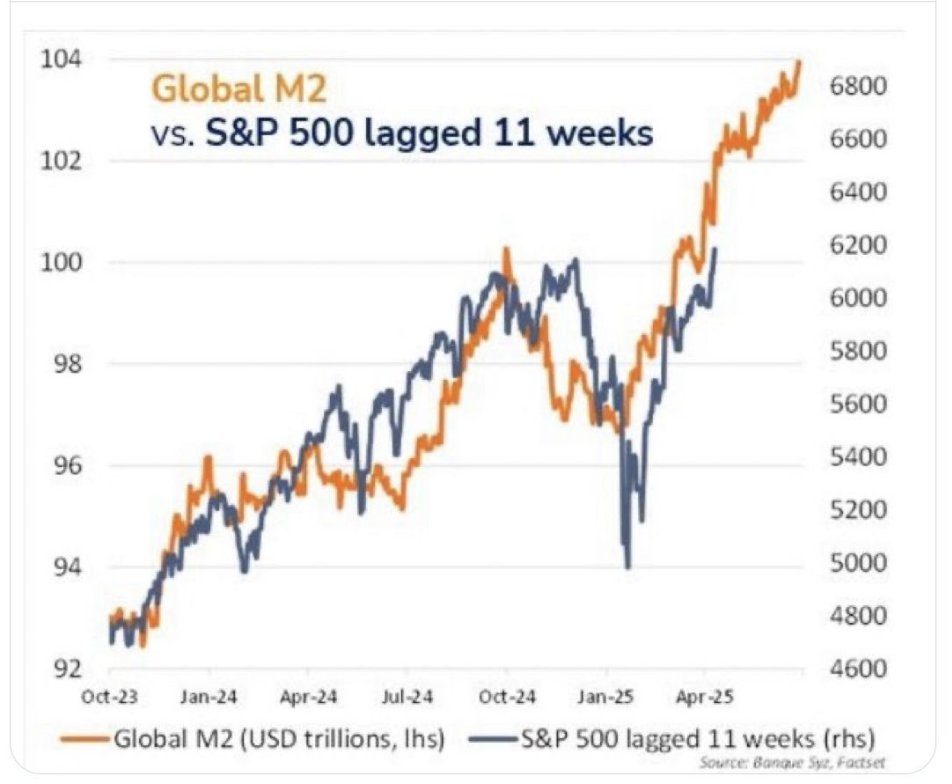
@TMTLongShort Don’t you think before the arrival of the deflationary shock, we have an inflationary one ahead? As soon as it becomes clear AI actually does improve productivity etc, there would be mother of all resource grabs, DC buildout etc ahead?
Heavily debated, secularly challenged stocks usually do not rip back the other direction unless the cause of the secular fear gets a wooden stake in the heart or it was never a real threat in the first place. The reason you think it will is because you missed it the first time it went up and now you think you have the chance to correct the mistake you made when you missed it. More likely you will make a second mistake than correct the first mistake.
@dMacro_dBS@EpsilonTheory My point was that the yield buyers are dominating the market at the moment (and thus when they get priced out due to duration rally, the spread buyers would dominate). And this could be because current yields passes the hurdle for a lot of buyer bases (life inco, retail, asiaPB)
Calls by Miran, Zervos etc for Fed to cut rates aggressively, is not too dissimilar from calls by Summer etc in 2022 for the Fed to hike >6%. They are not making these calls because it’s in the best interest of economy, but to serve their own personal agenda.
The best way of keeping Stephen Miran honest regarding Fed decisions is to feed his entire tweet history to ChatGPT and then on every data release ask it what would he have tweeted upon receiving new data/ Fed decisions etc.
Everyone is looking at this AI led rally as another incarnation of dotcom bubble and then try to channel their inner Soros and run towards the bubble before everyone else…except the price action is likely to be very different this time…
@stevehou@Citrini7 If Tariffs were a one-off definitive announcement, then the sales tax analogy works. But when it’s a moving target that may/may not go up in the future+sensitivity of Trump to any sudden price hikes one can make the argument that we “might” see predatory and gradual price rises
Think of the monetary system like a game of Musical Chairs. USD Base Money (Reserves at the Fed + Physical Cash & Coins) are the Chairs. All other USD monetary aggregates (M2, M3, Securitized Debts/Loans, USD credit extended, etc) are the people circling the chairs.
@dMacro_dBS@Iron_Mick777 Given the inflation markets are 100% pricing a transitory narrative in the US (1y1y, 2y1y swaps nudging lower vs end of Feb levels), isn’t the risk to the market pricing that the transitory nature of inflation get priced out?
@chamath Technically he said: “We have spoken…”, not “ I have spoken”. So for sake of technicality (which is core of your issue here) it is entirely possible for 10s of ppl within his firm and o have conducted interviews with 100s of CEOs etc…
What happens if your CPU gets something wrong? If it wakes up one day and decides 2+2=5?
Well, most of us will never have to worry about that. But if you work at a company the size of Google, you do, which is why this paper on "mercurial cores" is so fascinating.
What the authors report--and supposedly this is common knowledge at the hyperscalers--is that a couple cores per several thousand machines are "mercurial." Due to subtle manufacturing defects or old age, they give wrong answers for certain instructions. These can cause all sorts of impossible-to-diagnose issues. Some rare problems at Google that were traced back to bad CPUs include:
- Mutexes not working, causing application crashes
- Silent data corruption
- Garbage collectors targeting live memory, causing application crashes
- Kernel state corruption causing kernel panics
What makes CPUs go bad? It's very hard to tell. The authors posit that issues are becoming more frequent as CPUs get more complex, but there aren't solid numbers behind that. There are certainly strong relationships between frequency, temperature, voltage, and bad CPU behavior--most mercurial CPUs only cause problems under very specific conditions, but those conditions vary from CPU to CPU. Age is another source of problems, as older CPUs are more likely to exhibit problems.
Bad CPUs are an especially serious problem because they're very hard to detect. If cosmic rays flip bits in storage or on the network, that can be detected through error coding. But there's no analogy for a CPU that allows cheap online verification of its correctness. Instead, the best detection techniques involve monitoring for symptoms. If a core exhibits exceptionally high rates of process crashes or kernel panics relative to its fellows, that's a strong indication something is wrong with it. For the most critical applications, the authors propose triple modular redundancy--redoing each of its computations on three cores and majority-voting a reliable result.
More than anything, this paper is a call to action--letting everyone know that CPUs can fail. So now, if you ever find a bug you can't diagnose, you can blame the CPU! 🙂
When you study statistics, people just start talking at you like you're supposed to understand the difference between "probability" and "likelihood."
If you're confused, you're not alone: these words have an *identical* meaning in English—but an important distinction in math.
The Buzludzha Monument in Bulgaria is one of the world's strangest buildings.
It's a sort of concrete UFO in the mountains which has been totally abandoned since 1989.
And it also represents one of the strangest architectural movements in history...