The Sinauli site is extremely important because it breaks down the myths propagated by Marxist writers that swords and horses weren’t present in India during the Sindhu Saraswati civilisation timeline, and were later imports.
Sinauli site gave us ~
a) copper engraved shields and antenna swords with intact copper wired wooden hilts;
b) remains of horse driven chariots.
Sinauli site brought to limelight evidences of a 4000 year old warrior clan in ancient India, and the presence of women warriors.
51 years ago, India went to sleep as a democracy and awoke under the Emergency.
At midnight on 25 June 1975, civil liberties were suspended, the press was censored, and Opposition leaders were arrested before dawn.
Among those who resisted was a 24-year-old RSS pracharak from Gujarat - @narendramodi. Evading arrest, he worked underground, organised public readings of the Constitution, and helped circulate anti-Emergency literature through community and religious networks across Gujarat.
For 21 months, as fear was institutionalised, a young Narendra Modi remained part of the movement that kept the spirit of democratic resistance alive. Quietly, and at great personal risk.
#SamvidhanHatyaDiwas
𝐇𝐨𝐧𝐨𝐮𝐫𝐢𝐧𝐠 𝐭𝐡𝐞 𝐥𝐞𝐠𝐚𝐜𝐲 𝐨𝐟 𝐃𝐫 𝐒𝐲𝐚𝐦𝐚 𝐏𝐫𝐚𝐬𝐚𝐝 𝐌𝐨𝐨𝐤𝐞𝐫𝐣𝐞𝐞 𝐚𝐧𝐝 𝐡𝐢𝐬 𝐮𝐧𝐰𝐚𝐯𝐞𝐫𝐢𝐧𝐠 𝐯𝐢𝐬𝐢𝐨𝐧 𝐟𝐨𝐫 𝐚 𝐟𝐮𝐥𝐥𝐲 𝐮𝐧𝐢𝐟𝐢𝐞𝐝 𝐈𝐧𝐝𝐢𝐚.
From a divided past to a unified future, watch the long journey towards the integration of Jammu and Kashmir. 🎥
अदम्य साहस, शौर्य और नारी शक्ति की प्रतीक, वीरांगना रानी दुर्गावती के बलिदान दिवस पर विनम्र श्रद्धांजलि।
मातृभूमि की रक्षा और स्वाभिमान के लिए मुगलों के विरुद्ध उनके द्वारा किया गया संघर्ष युगों-युगों तक भारतीय समाज के लिए प्रेरणास्रोत बना रहेगा।
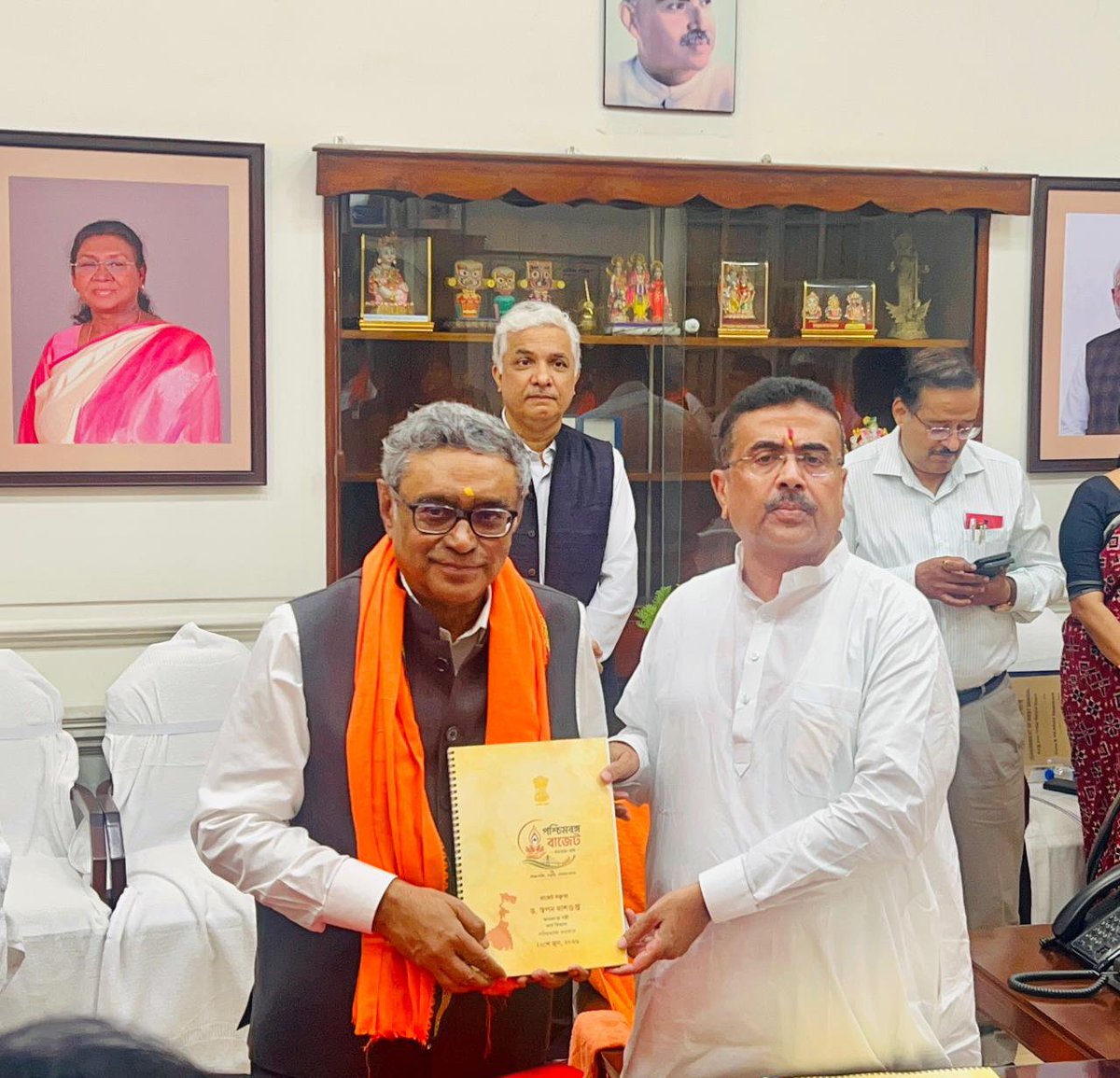
A Historic First Step Towards a Golden Bengal.
Today is a momentous day for every citizen of West Bengal. I extend my Heartfelt Congratulations and deepest gratitude to our Finance Minister, Shri Swapan Dasgupta (@swapan55), for presenting a truly visionary and landmark First Budget for our Government.
This is not just a Financial Statement; it is a master blueprint that will unequivocally propel West Bengal from the depths of the 'economic abyss we inherited', towards a Golden Future. For far too long, our immense potential was stifled. Today, we have charted a definitive roadmap to not only match the glorious past of West Bengal but to shatter every glass ceiling and limitation holding us back. We are building a progressive, unstoppable State that will stand out as the primary contributor to India’s growth story and serve as a core driver of the Viksit Bharat vision.
We are bringing in a culture of entrepreneurship, innovation and unwavering support for our citizens. Here are a few transformative highlights from today’s historic Budget:
✅ Massive Employment Push: We are fulfilling our promise by filling 1 Lakh Government vacancies this financial year, while ensuring a historic 33% reservation for Women.
✅ Empowering Nari Shakti: ₹36,000 crore has been allocated for the Annapurna Yojana, providing ₹3,000 in monthly financial assistance to eligible Women.
✅ Justice for State Govt Employees: A massive 20% hike in Dearness Allowance (DA) for our hardworking State Govt Employees and Pensioners, bringing the total DA to 38% effective October 1.
✅ World-Class Infrastructure: We are establishing a new Greenfield Airport near Kalyani and an integrated Deep-Sea Port at Dadanpatrabarh in Purba Medinipur district to supercharge our regional economy.
✅ Industrial Revival: We have reintroduced crucial incentives with a ₹5,000 crore allocation for Industries, and we will be re-examining the Urban Land Ceiling Act to attract mega private investments.
✅ Youth & Rural Welfare: Allocating ₹14,000 crore for rural jobs under the VB-G RAM G scheme, increasing work days to 125, and providing monthly allowances for Unemployed Graduates.
This budget proves our absolute commitment to restoring West Bengal's lost glory and ensuring prosperity and dignity of every Citizen. The foundation for a robust, industry-friendly and progressive West Bengal has been laid.
Together, let us march towards a glorious Viksit Bengal.
@BJP4India@BJP4Bengal
Suggest @AITCofficial to study history first!
That Sir Doctor Suhrawardy was the uncle of the Butcher Suhrawardy, and he was one who held on to freedom fighter Bina Das and handed her to the British police. He was given his ‘Sir’ title for that very reason that he had betrayed an Indian freedom fighter and saved a British governor!
Your Sir Doctor Suhrawardy was also a Muslim League supporter, and in favour of the ‘two nations’ theory, and later his daughter became a Pakistani politician. Just because he was educated doesn’t mean he was a nationalist. Even Osama bin Laden was an engineer!
Keeping all arguments aside, the name Suhrawardy should have never been used for a Kolkata road because of that name’s role in Direct Action Day riots, and removed right after independence. Any self respecting nation would have done that. But for Congress, Communists, and TMC, the words self-respect and dignity are unknown.
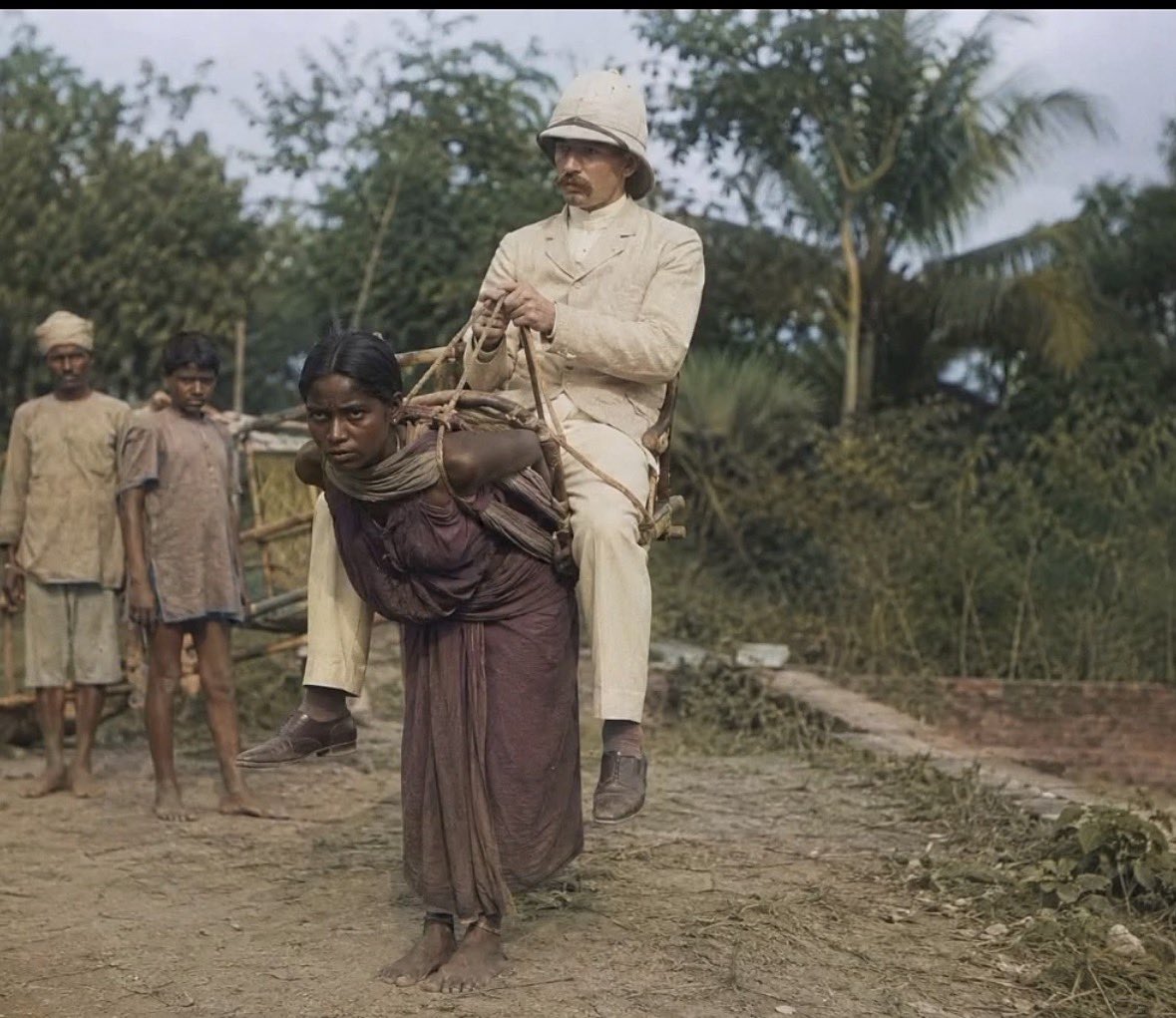
A Bengali woman carrying a British merchant on her back…
📸 This photo was taken in 1903, at the height of British colonialism in the Indian subcontinent. This isn't just a picture…
it's a slap in the face to all those who sing the praises of "Western civilization." This is the true face of colonialism, which they still try to beautify in history books.
It's slavery and the humiliation of human beings, the crushing of human dignity, simply because they don't belong to the white race! And then they ask you about terrorism…
The history of Western colonialism is full of massacres, slavery, plunder, and starvation… But they reduce terrorism to oppressed peoples struggling for their dignity! 🩸
The effects of what British colonialism did in India—the killing, starvation, plunder, and contempt for humanity—are still evident today. Millions
were killed, wealth was stolen, and generations were displaced… all under the banner of a false "enlightenment"!
I commend the historic decision taken by the Kolkata Municipal Corporation, yesterday, on the solemn occasion of Paschimbanga Divas, which would be instrumental in rectifying a historical wrong.
Suhrawardy Avenue will now be renamed as Gopal Mukherjee Road.
For decades, a major artery of our City bore the name of someone who wilfully misused state power as a weapon, orchestrating the massacre of innocent citizens for sheer political gain. By renaming it after Shri Gopal Mukherjee, the fearless soul who stepped up as a protector-in-chief to defend and save thousands of innocent lives, finally restoration of historical justice will be achieved by honouring a true guardian and savior.
It's time, West Bengal remembers, corrects and honours the Real Heroes.
@monidipadey@kmc_kolkata@punarutthana Deeply glad & satisfying!
Thank you Monidipa Ji🙏
Writing a lot & documenting akin - Our Braveheart Hindu "Shri Gopal Mukherjee". Bringing insights onto actual History.
Also, Thanks to all alike, who contributed through any means.
Amaader Hridoya kritagyatay bhore utheche.🪔
This is such good news.
Suhrawardy Avenue in Kolkata will now be known as Gopal Mukherjee Road (after the Direct Action Day Hindu saviour Gopal ‘Pantha’ Mukherjee) !
Very happy to see this notice by @kmc_kolkata 🙏
Communists will now jump in to say that this road was named after Sir Hassan Suhrawardy, a renowned doctor, and not his nephew Huseyn Shaheed Suhrawardy (the Butcher of Bengal in Direct action Day riots).
However, the thing is that the surname Suhrawardy should have never been used in the first place to name a road in Kolkata, where a Suhrawardy had organised a brutal Hindu gen0cide.
No self respecting nation would have done this. Finally, an end to this humiliating act!
Thanks to @BJP4Bengal and @SuvenduWB da 🙏
🇮🇳 Contribution of Shri Shyama Prasad Mookerjee and Hindu Mahasabha:
Among all the sons of Bengal who fought to preserve the very survival and identity of Bengalis in India around 1946-47, the figure who stood tallest and most decisive was Dr. Syama Prasad Mookerjee. Around him gathered leaders like
👉🏼Kshitish Chandra Neogy,
👉🏼Dr. Bidhan Chandra Roy,
👉🏼Nalini Ranjan Sarkar,
👉🏼Dr. Promoth Nath Banerjee,
👉🏼Debendralal Khan,
👉🏼Makhanlal Sen, and
👉🏼Atul Chandra Gupta—but it was Mookerjee who set the direction, the urgency, and the moral clarity of the movement.
Once both the Hindu Mahasabha and the Congress in Bengal, acknowledged that Bengal’s partition was essential to protect Hindu lives and interests, a massive campaign followed—76 pro-partition public meetings across Bengal.
Fifty-nine were organised by the Congress, nineteen by the Mahasabha, and five jointly.
And at every stage, Mookerjee hammered home a crucial truth:
The partition of Bengal was about saving Bengali Hindus—not about dividing India.
On 22 April 1947, speaking in New Delhi, he declared bluntly that even if the Muslim League accepted the Cabinet Mission Plan (which did not propose India’s partition), Bengali Hindus still needed a separate province for their security and future. No ambiguity. No hesitation. No political gymnastics.
The movement drew wide support—from
👉🏼Matua Mahasangha chief Pramatha Ranjan Thakur,
👉🏼B.P. Depressed Classes League secretary A.R. Das,
👉🏼former minister Prema Hari Barman, and influential zamindars like
👉🏼Maharaja Uday Chand Mahtab of Burdwan and
👉🏼Maharaja Srikrishna Nandi of Cossimbazar.
The British Indian Association also threw its weight behind Mookerjee, with leaders like
👉🏼P.N. Sinha Roy,
👉🏼Maharaja Probendra Mohan Thakur, 👉🏼Maharaja Sitangshu Kant Acharyya Chowdhury,
👉🏼Amulyadhan Adya, and
👉🏼Amarendra Narayan Roy endorsing his stand.
And Bengal’s intellectual heavyweights were no different. Giants such as
👉🏼physicist Dr. Meghnad Saha,
👉🏼linguist Dr. Suniti Kumar Chatterjee,
👉🏼historians Jadunath Sarkar,
👉🏼Dr. R.C. Majumdar, along with
👉🏼Nalinaksha Sanyal,
👉🏼Major General A.C. Chatterjee,
👉🏼Jadub Panja,
👉🏼Upendranath Banerjee,
👉🏼Dr. Shishir Kumar Banerjee,
👉🏼Subodh Chandra Mitra and
👉🏼Shailendra Kumar Ghosh all recognised the same reality:
without partition, Bengali Hindus would be left defenceless.
Through it all, Syama Prasad Mookerjee remained the driving force—the voice, the strategist, and the unflinching defender of Bengal’s people.
@BJP4Bengal@SuvenduWB@SamikBJP@BJP4Bengal Please make a greater effort to remind today’s citizens of West Bengal—many of whom remain unaware of these sacrifices and have grown to misunderstand Mookerjee because of the Congress-shaped version of history. The pattern is familiar: just as Veer Savarkar’s ordeal in the solitary cells of the Andaman Cellular Jail is often downplayed, Nehru’s comparatively privileged imprisonment as a Class A political detainee is routinely romanticised.
Some people from the Congress and Communist party are now suddenly claiming that they are the ones that voted for West Bengal partition, and Shyama Prasad Mukherjee had just one seat, so he’s irrelevant. That claim does not give the true /entire picture.
I am giving a more detailed look into what Shyama Prasad Mukherjee did to create a Hindu homeland (West Bengal) for the Hindu Bengalis.
Since the time Bengal came under Muslim League rule, increased communal riots and anti-Hindu activities in the eastern areas of Bengal showed that Hindus were under serious Islamic threat, and the Congress party was clearly not being able to handle this threat .
Understanding the seriousness of the threat, by 1939 SPM started thinking of a separate homeland for Bengali Hindus. This idea took shape from the resolution adopted in the HMS 1927 Patna meet, where demands for creating separate provinces for the Hindus of Punjab and Bengal were made.
In 1941, while census was going on, SPM made a brilliant move; he convinced common Hindus to register themselves in the census, which ensured their numbers were documented, and gave a clear picture of the Hindu majority areas in Bengal.
Owing to his powerful speeches, combined with his reasoning skills, SPM slowly got the united support of both the common people and intellectuals of Bengal (Hindus). By 1946, Muslim League was thoroughly exposed as an Islamist party, and despite giving only one seat to HMS, Bengali Hindus now turned to SPM, and finally his demands for a separate Bengali Hindu homeland took steam. After this, by careful negotiations and convincing talks, SPM performed the miracle of gaining both political support and mass support in Bengal for his movement.
Finally on 15th March 1947, SPM held a public meeting in Calcutta, and with him on stage supporting him were R. C. Majumdar, Suniti Kumar Chatterji, Lord Sinha, Makhanlal Sen, Nirmal Kumar Bose, Upendranath Mukherjee, and other stellar names. Later Jadunath Sarkar and Meghnad Saha also joined his movement for a separate Hindu homeland.
Next SPM toured entire Bengal, and created mass support in favor of a Hindu homeland for Hindu Bengalis, with help from his HMS branches across Bengal. SPM then formed a team, which included Major A. C. Chatterjee (ex- INA) among others, to draw the political map of West Bengal.
It was at this time of drawing the political map of WB that the 1941 census report came to use, and helped in the demarcation of Hindu majority areas. HMS organized a huge conference for Hindus from 4th to 6th April 1947, at Tarakeshwar in Hooghly, where the plan for creating West Bengal was officially adopted. On 5th April, in a meeting, Bengal Congress officially declared their support for the creation of West Bengal as part of India, and SPM was invited as a special speaker in that Congress meeting.
When voting was held, Congress members and 2 Communist members voted for the partition of Bengal and the creation of Hindu homeland (West Bengal).
It was a miracle that Shyama Prasad Mukherjee had performed in 1946-47, in managing to unite the political leaders (Congress and few Communists), the intellectuals (Tagore, Prafulla Ray, Majumdar, Sarkar, etc), and the common people of Bengal for a Hindu homeland.
Why the state was named as West Bengal ~
In 1947, the question arose whether the United Bengal Province would remain in India 🇮🇳 or become part of Pakistan 🇵🇰.
Three proposals were placed:
1. Bengal would remain undivided.
2. The whole of Bengal would go to Pakistan.
3. Bengal would be partitioned~ the Muslim-majority eastern part would go to Pakistan, while the Hindu-majority western part would remain in India.
Dr. Shyama Prasad Mukherjee led the movement in favour of keeping the western part of Bengal (later named as West Bengal) as a part of India. On the other hand, Huseyn Shaheed Suhrawardy proposed the plan for a United Bengal.
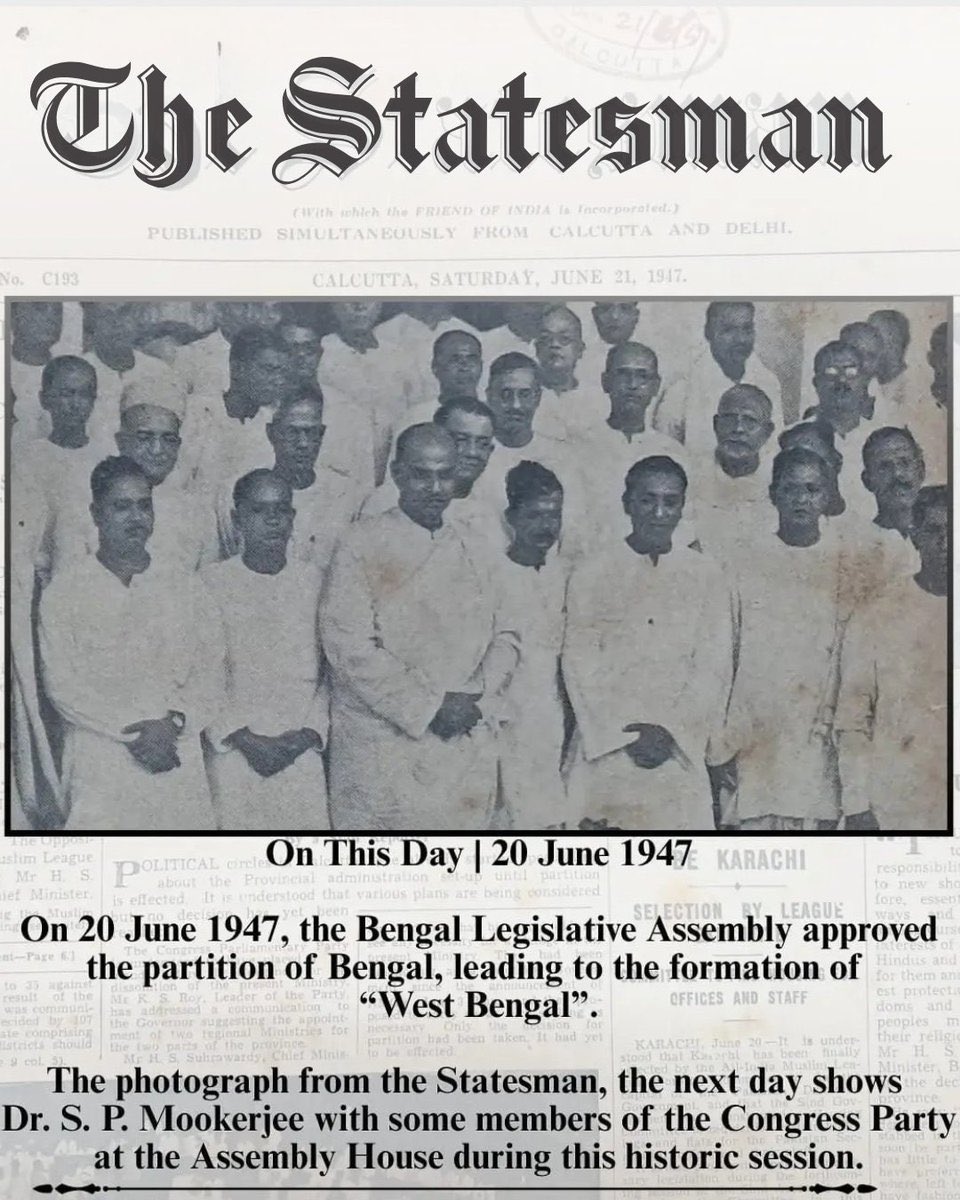
📌 In the historic vote held on 20 June 1946, the first vote was on whether Bengal should be divided or remain united, and which Constituent Assembly it would join.
Separate votes were then held.
📌 Second vote (Muslim-majority areas):
The members from East Bengal cast their votes.
Results:
106 votes in favour of keeping Bengal undivided
35 votes in favour of partition
This meant that a majority of the East Bengal members wanted the whole of Bengal to go towards Pakistan.
📌 Third vote (non-Muslim-majority areas):
The representatives of the western part voted in a separate session.
Results:
58 votes in favour of partitioning Bengal
21 votes against partition.
This meant that the representatives of the western region clearly decided in favour of dividing Bengal and becoming a part of India.
The question then arose: if the East Bengal members supported a united Bengal, while the representatives of the western part voted for partition, would Bengal be divided or not?
According to the Mountbatten Plan, if any one part of Bengal voted in favour of partition, Bengal would be divided.
Since the representatives of the western part voted 58–21 in favour of partition, the division of Bengal became certain.
Ultimately, this led to the creation of a Hindu majority western province within Bengal, which was named as ‘West Bengal,’ described here as the homeland of Bengali Hindus.
#poschimbongodibosh #westbengalday
Today on 20th June 2026, the first official Poschim Bongo Dibosh/West Bengal Day, as declared by our PM Modi ji, here’s a look back at the historic event of creation of West Bengal from an United Bengal.
Unlike Netaji Subhas Chandra Bose’s elder brother Sarat Chandra Bose, who along with Suhrawardy, tried his level best to form an ‘United Bengal’ under Pakistan and ruled by a Muslim Prime Minister; Netaji’s eldest brother Satish Chandra Bose (seen here with Netaji) supported the creation of a separate West Bengal with Hindu majority.
Satish Chandra Bose stood with Shyama Prasad Mukherjee in this regard. On 15th April 1947, Shyama Prasad Mukherjee at the historic ‘Tarakeswar Hindu Mahasammelan’ had successfully authorized the partition of Bengal, ensuring Hindu-majority areas were carved out into a separate homeland (West Bengal) within the Indian Union.
On 20th June 1947, Satish Chandra Bose was among the Hindu members of the Bose family that voted in favour of dividing Bengal, and creating a Hindu homeland for the Bengalis.
[Image was shared by Somen Sengupta ]
Not surprising. Wikipedia is completely controlled by leftist wokes and Islamists (many are Pakistanis).
In 2022, after I took up writing on Gopal Mukherjee (Gopal pantha) to spread his name, some Pakistani editors quietly deleted the Wikipedia English page on Gopal Mukherjee in 2022- 23. When I came to know of it, I wrote about it here on X, which created a lot of noise.
As revenge for highlighting the deletion of Gopal Mukherjee page and making it known, I am banned from editing on Wikipedia from 2023. They keep renewing the ban each time the ban period ends. The first time ban was by a Pakistani editor. After that each time it’s a different editor that keeps renewing the ban.
This image is today’s. After 8 months a different editor will again ban me from editing.
मातृभूमि के प्रति सर्वस्व समर्पण और स्वाभिमान की प्रतिमूर्ति रानी लक्ष्मीबाई जी ने अपने अदम्य साहस और असाधारण रणकौशल से अंग्रेजी सत्ता की नींव हिला दी थी। 1857 के स्वतंत्रता संग्राम में उनके शौर्यपूर्ण नेतृत्व ने समूचे स्वाधीनता आंदोलन को नई ऊर्जा और दिशा दी। उनकी वीरगाथा सदैव देशवासियों की प्रेरणा-शक्ति बनी रहेगी।
महान वीरांगना रानी लक्ष्मीबाई जी के बलिदान दिवस पर उन्हें नमन करता हूँ।
प्रथम स्वतंत्रता संग्राम की अमर वीरांगना, अदम्य साहस और पराक्रम की प्रतीक रानी लक्ष्मीबाई के बलिदान दिवस पर शत-शत नमन।
मातृभूमि की स्वाधीनता हेतु उनका सर्वोच्च बलिदान और अद्वितीय शौर्य भारतीय इतिहास में स्वर्णाक्षरों में अंकित है।
उनका जीवन प्रत्येक भारतीय को राष्ट्रसेवा और स्वाभिमान की निरंतर प्रेरणा देता रहेगा।
Today we remember Veera Vanchinathan who sacrificed his life for the freedom of Bharath. On 17 June 1911, Vanchinathan entered a first-class compartment at Maniyachi Junction and shot Tirunelveli Collector Ashe, who was responsible for the repression of the Swadeshi movement and the persecution of V.O. Chidambaram Pillai and Subramania Siva. Moments later, Vanchi took his own life rather than be captured.
He was only twenty-five. He had given up his career, distanced himself from family life and chosen a path from which he knew there would be no return. His method may be debated, but his courage, sacrifice and uncompromising commitment to Bharat’s freedom cannot be denied.
On his remembrance day, let us honour the martyr who placed the nation above his own life.
@monidipadey@punarutthana Yes,We need excavations in Bengal's Bhoomi to get its true History & Heritage roots back.
Also: Building Museums+Galleries, encapsulating each era & each resistance against all invasions. How Bengal's Hindus & Heritage faced destruction.
All this must be done in next few years✅










![monidipadey's tweet photo. Today on 20th June 2026, the first official Poschim Bongo Dibosh/West Bengal Day, as declared by our PM Modi ji, here’s a look back at the historic event of creation of West Bengal from an United Bengal.
Unlike Netaji Subhas Chandra Bose’s elder brother Sarat Chandra Bose, who along with Suhrawardy, tried his level best to form an ‘United Bengal’ under Pakistan and ruled by a Muslim Prime Minister; Netaji’s eldest brother Satish Chandra Bose (seen here with Netaji) supported the creation of a separate West Bengal with Hindu majority.
Satish Chandra Bose stood with Shyama Prasad Mukherjee in this regard. On 15th April 1947, Shyama Prasad Mukherjee at the historic ‘Tarakeswar Hindu Mahasammelan’ had successfully authorized the partition of Bengal, ensuring Hindu-majority areas were carved out into a separate homeland (West Bengal) within the Indian Union.
On 20th June 1947, Satish Chandra Bose was among the Hindu members of the Bose family that voted in favour of dividing Bengal, and creating a Hindu homeland for the Bengalis.
[Image was shared by Somen Sengupta ]](https://pbs.twimg.com/media/HLOggO_awAAxidu.jpg)


