Bitcoin has bottomed against gold four times in the last decade.
Every bottom was higher than the last.
2026 may be number five, and even the weakest past recovery points somewhere surprising.
@AdamBLiv breaks it down here:
@_Adrian has spent years pushing people to hold their own Bitcoin. They still buy IBIT, FBTC and treasury companies instead.
That's part of why Adrian thinks hyperbitcoinization will need banks, large custodians and some centralization.
"Most people lack the ability to maintain their own email inbox, let alone a cold wallet."
$BTC
A free open source clone shows up. What happens to a $14 billion software company?
@PunterJeff makes DocuSign the test case: 98% of revenue from software as a service, and by Jeff's math a 10 to 15% revenue drop would erase 100% of net income. The question is "when does the market figure that out?"
Bitcoin is the land. The business is what gets built on it.
"we've effectively built two apartment buildings on top of our Bitcoin balance sheet."
@PunterJeff
He says Bitcoin Core is the number one honeypot in the world, and it still hasn't broken.
@ericyakes joins @IIICapital on The Income Show to talk AI hacks, Bitcoin security, and the bull case for $BTC.
Timestamps:
0:00 - Intro
1:16 - Value Vs. Growth Investing
15:38 - The 7th Property
16:57 - Immutability Vs. Moving Fast
26:08 - Is Bitcoin Safe From AI Hacks?
29:50 - Will AI Run Out Of Bugs?
35:59 - The Bull Case For Bitcoin
45:50 - Bitcoin Treasury Companies
51:09 - Competing With Tether
1:02:46 - Closing Thoughts
Great to join @watchbmtv today 11/18/26.
Here's the segment & timestamps:
00:00 Bitcoin Pullback And Market Stress
03:03 Anthropic IPO And The AI Trade
04:53 AI, Credit, And Bitcoin Liquidity
08:00 Why Credit Managers Stay Away
10:15 SATA Vs. SATS
12:32 New Yield Opportunities
14:47 Dividend Coverage And Rating Agencies
True North Ep. 87: Everyone Is Scared. Should You Be?
Featuring @PunterJeff, @MasonFoard, @_Adrian and @nithusezni.
Timestamps:
00:00 - Intro
01:13 - Fear Is Everywhere
07:07 - Anthropic IPO And The AI Trade
20:40 - Credit Spreads And $STRC
27:01 - Buybacks Or A Higher Rate?
30:46 - Are The Buybacks A Bailout?
55:30 - Are Treasury Companies Good For $BTC?
58:33 - $BTC's Structural Catalysts
01:02:21 - Tokenization And Hyperbitcoinization
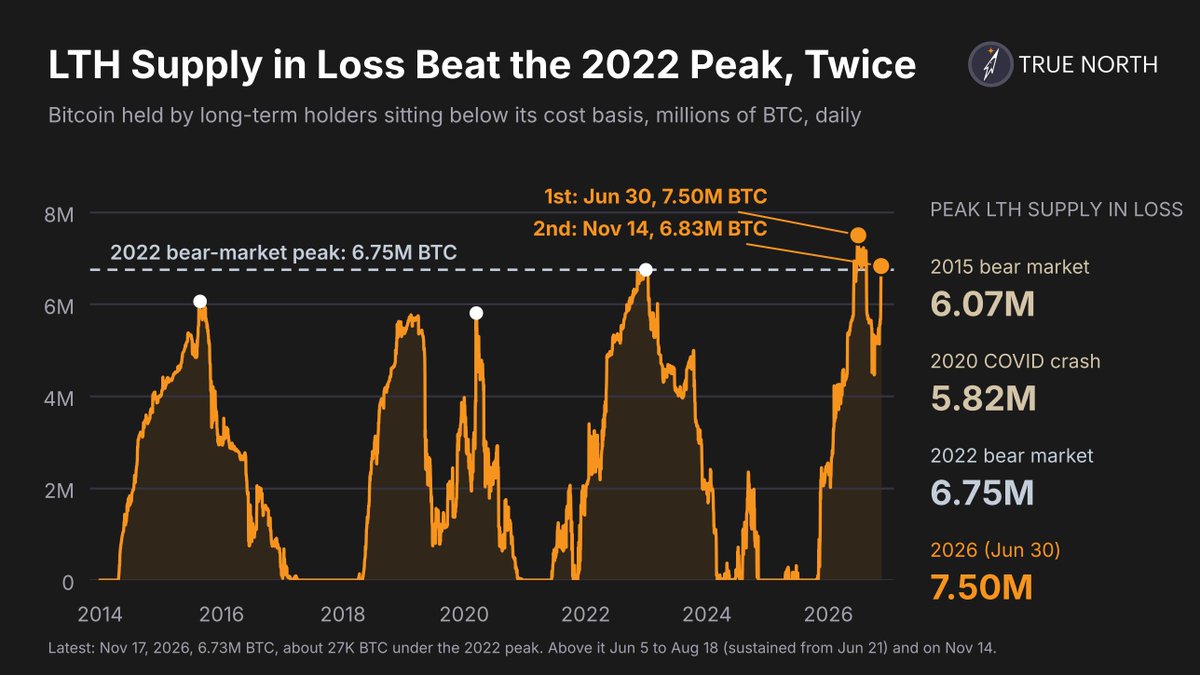
Twice this year, Bitcoin’s long-term holders have been underwater on more coins than at the bottom of the 2022 bear market.
Long Term Holder supply in loss, peak by cycle:
2015: 6.07M BTC
2020: 5.82M BTC
2022: 6.75M BTC
2026: 7.50M BTC
The first breach ran from June into August and set the all-time record on June 30th.
The second came on Nov 14th.
Today it sits at 6.73M, within 27K BTC of the 2022 peak.
Thirteen months ago, at the $124.7K all-time high, this number was zero. Every long-term holder was in profit.
Now the market’s most patient owners carry more coins at a loss than in any prior cycle.
Each previous peak in this metric landed near a generational entry:
2015 peak: ~$210
2020 peak: ~$4.8K
2022 peak: ~$16.7K
This is what maximum pressure on the strongest hands looks like:
Could demand for a giant IPO add to Bitcoin selling?
@ColeMacro connects the SpaceX comparison to Anthropic, capital rotation and leverage. It's a possible contributor, not a claim that one IPO explains the whole drop.
Beyond the Balance Sheet: Buffett and the Value of Capital Optionality
Warren Buffett understood something that I believe is essential to valuing balance sheet companies:
The ability to deploy capital when everyone else is constrained has enormous economic value.
In his 2018 Berkshire Hathaway letter, Buffett explained why he was retiring book value per share as his preferred measure of progress after nearly 30 years.
The accounting was accurate. The picture of intrinsic value was incomplete.
I believe Bitcoin balance sheet companies face a similar valuation challenge today.
mNAV captures a snapshot of the balance sheet. But intrinsic value also depends on the cost of capital, the durability of financing, contractual obligations, and the opportunities a company can pursue through volatility.
Two companies with identical Bitcoin holdings can have radically different economic futures depending on how they finance those holdings.
A strong capital structure buys something extraordinarily valuable: the freedom to choose when to act.
And sometimes the greatest returns come from having the capital, patience, and flexibility to act precisely when others cannot.
In this video, I explain how Buffett's thinking on capital optionality informs the way we approach valuation at Strive.
The balance sheet tells you what a company owns today.
Capital optionality helps determine what it can become tomorrow:
Each new Bitcoin bear market has seen a shallower crash with a faster recovery.
Cycle top → max drawdown → back to ATH:
2013: −85% → 39 months
2017: −84% → 35 months
2021: −77% → 28 months
2025: −53% so far → ?
From the bottom, it took 25 months to reclaim the old high, then 24, then just 15.
Every prior cycle bottomed 12–14 months after the top.
We’re 13 months in, at −48%.
Each recovery has come faster than the last.
Does the pattern hold again?
Bitcoin $BTC around the SpaceX $SPCX IPO:
50 days before: −19%
100 days after: +39% off the low
Heading into the Anthropic IPO, it's down 18% over the same stretch.
h/t @ColeMacro