SpaceX now has over 10,000 Starlink satellites in orbit (and growing), providing internet data service to every corner of the earth. Even ships at sea or aircraft in the sky can receive high speed internet service.
Over 2/3 of the active satellites in orbit are Starlink now. And it won't create any long term trash in orbit. The orbits are so low (480 km to 550 km) that even if SpaceX were to lose control of one, the small satellites will run out of fuel within 5 years. Then they get dragged back into the atmosphere and burn up.
Every satellite is in a lane to avoid other Starlink satellites. They all are connected to a collusion avoidance system and can make small course adjustments if needed.
Starlink can provide high speed internet anywhere on the planet without having to bury expensive fiber cables underground or undersea. All you need is a small dish which scans the sky for the closest satellite to provide internet connectivity.
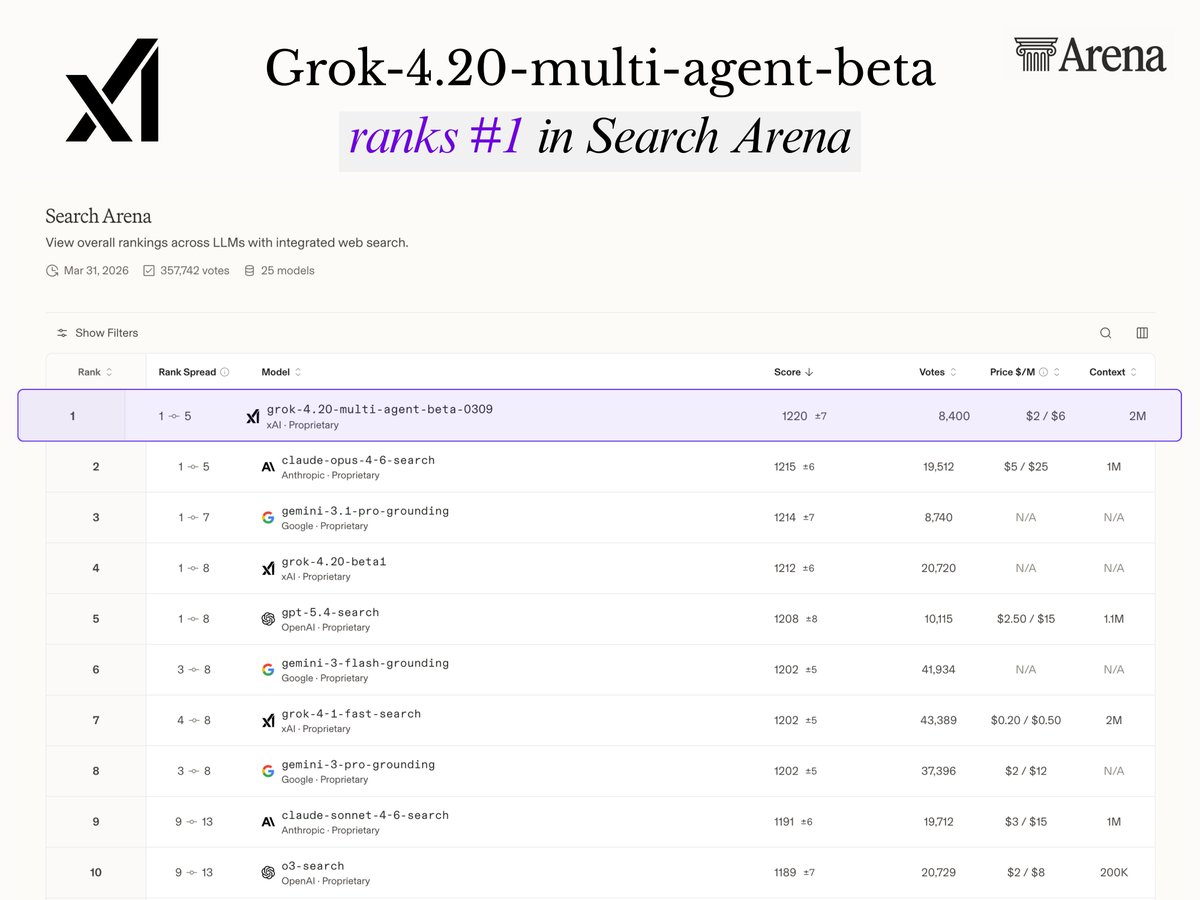
Grok 4.20 Multi-Agent just ranked #1 on Search Arena (Style Control)
Grok 4.20 set a new industry record on AA-Omniscience with 78% accuracy - the lowest hallucination rate ever recorded on the benchmark
Beats Claude Opus 4.6 & Gemini 3.1 Pro
.@elonmusk: “We are in the singularity.”
“I think we’ll hit AGI in 2026.”
“You’re at the top of the rollercoaster about to go down.”
“Don’t worry about squirreling money away for retirement. It won’t matter.”
“I don’t just have courtside seats— I’m on the court. It still blows my mind multiple times a week.”
Via @PeterDiamandis
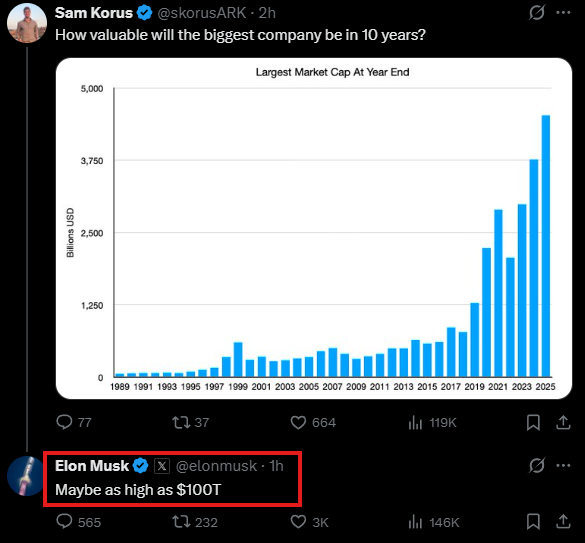
BREAKING: Elon Musk says the biggest company in the world in 10 years from now will be worth as much as $100 trillion.
That's ~22 times the current size of Nvidia.
Tesla Model Y and Model 3 are officially the world’s #1 and #2 the best-selling EVs for September
Model Y: 141,000 units
Model 3: 67,000 units
Tesla dominates the global electric vehicle market
@JoeSquawk Very possible - and more is coming. There is NO proof man-made CO2 harms our climate -- but there is lots of evidence global warming and increasing CO2 benefit life on earth and in the seas.
🚨 BREAKING: Tesla AI5 chip is delayed
• Apr 23, 2024 (Q1 call): “Hardware 5 … should be in cars, hopefully toward the end of next year.” → target: late-2025.
• Jun 20, 2024: “Then HW5, renamed AI5, in the second half of next year… ~10× HW4.” Reiterates H2-2025.
• Jul 30, 2024: “AI5 is ~18 months away from high-volume production.” → ~Jan 2026 for HV.
• Jul 27, 2025: “TSMC will make AI5, which just finished design, initially in Taiwan and then Arizona.” (Design lock/tape-out timing.)
• Sep 6, 2025: “Just had a great design review today with the Tesla AI5 chip design team!” (ongoing bring-up).
2024 guidance said in-car late-2025; by mid-2025 @elonmusk says design just finished (and fab starts in Taiwan before AZ), which pushes earliest real installs into 2026.
• Tape-out mid-2025 means first silicon takes fab/packaging cycles at advanced nodes; bring-up + possible respins add more months. (Fab cycle times for advanced nodes are multiple months.)
• Automotive qualification (AEC-Q100) and vehicle integration are non-trivial gates even after a good A0/A1.
• Supply chain reality: Musk says TSMC Taiwan first, then AZ; U.S. ramp follows later, so near-term volume depends on Taiwan capacity/packaging.
My read on timing:
• Pilot/limited installs: most likely Q2’26 (stretch: Q1’26 if bring-up is unusually clean).
• Retail volume in customer cars: H2’26 base case; slip risk to 2027 with respins/qual issues.
@wholemars@Teslaconomics@DirtyTesLa@AIDRIVR
$TSLA's next-generation FSD chip, HW5/AI5, has entered mass production.
The HW5 chip is being jointly manufactured by TSMC and Samsung, utilizing the 3nm N3P process. It boasts a performance of 2000 to 2500 TOPS, which is five times that of the current HW4 chip, enabling support for more complex unsupervised FSD algorithms.
In addition, Tesla plans to upgrade the FSD cameras for hardware kits equipped with HW5. The new cameras will feature Samsung's "weatherproof lens," which includes a built-in heating element capable of melting ice and snow within one minute, reducing image distortion.
The lens coating is six times stronger than that of current Model Y cameras and possesses hydrophobic properties, allowing for faster clearing of melted snow or ice water, thereby enhancing sensing capabilities in low-temperature environments.
TLDR: I estimate the AI5 computer will deliver 3-4x more compute than AI4. I predict Tesla will use AI5 chips which fail QC, cut them down to become an 'AI5 lite' and underclock them to fit the power budget of the HW3 harness while still delivering much more performance than AI4. HW3 cars will get an AI5 lite retrofit and new cameras. How's this possible?
Read on...
🟢HW3
Lithography: Samsung 14 nm process.
Power: 90 watts peak, 7.5A @ 12v. Limited by its wiring harness.
Compute: Two chips, each with 12 CPU cores @ 2.2GHz, Gen1 Image Signal Processor for processing camera inputs (ISP) and 2x Tesla Gen1 Neural Processing Units to run the AI inference (NPU) @ 2.0GHz
Memory: 32 MB of on-chip SRAM for fast, on-chip data access during NN computations. Additionally, 8 GB of on-board LPDDR4 RAM @ 4266 MT/s with peak bandwidth of 68 GB/s.
Performance: Up to 36 TOPS (trillion operations per second). The HW3 computer uses two such chips, providing a total of 72 TOPS
🟢AI4
Lithography: Samsung 7nm process. Should have as much as double the power efficiency over HW3.
Power: Estimated to be 170 watts peak. 10.6A @ 16v. (88% higher than HW3)
Compute: Two chips, each with 20 CPU cores @ 2.35 GHz, Improved Gen2 ISP (for higher resolution camera inputs), 3x Tesla Gen2 NPUs @ 2.2GHz
Memory: Increased on-chip SRAM, Estimated at 64 MB or more per chip to support larger and more complex neural network models. In addition, 16 GB of LPDDR5 RAM is used (Estimated ~6400 MT/s with peak bandwidth of 88 GB/s).
Performance: Estimated ~180 TOPS peak. The AI4 computer has 2 such chips, providing a total of up to 360 TOPS.
🟢Doing some napkin math to sanity check the performance estimate
If we left everything the same (core count, core architecture, instruction sets etc) and just took the existing chip, shrunk it to 7nm and underclocked it to 90 watts, that would give us roughly double the performance of HW3 (144 TOPS). We know that Tesla also increased the power budget from 90 to 170w, so let's add 88%. That would give us 270 TOPS. Accounting for architecture improvements, adding 8 additional cores, an extra NPU and increased memory and bandwidth, it's not unreasonable to say that would give us another 33% boost. So that 360 TOPS estimate sounds solid to me.
🟢AI5 (mostly theoretical)
Lithography: TSMC 3nm N3P process. Should have as much as double the power efficiency of AI4.
Power: Likely to be the same or a bit higher than AI4, I'm going to use 200w for this exercise (12.5A @ 16v). They will hopefully have learned their hard lesson about retrofit-ability.
Memory: We don't know this, but if I had to guess, likely double AI4. 32GB LPDD5 (likely running at 7200 MT/s with peak bandwidth of 115 GB/s, which is used in most modern gaming laptops and handhelds).
Performance: We don't have any concrete information such as core counts yet, but based on the 3nm node and power constraints, it's estimated online to be a 3-5x increase over AI4. Using this assumption means it has a peak theoretical performance of 540 - 900 TOPS per chip, giving a total of 1080 - 1800 TOPS per board.
🟢Doing some more napkin math to sanity check the performance estimate
Again, let's start with the AI4 chip, shrink it to 3nm and overclock it to 170w. That gives us roughly double the performance of AI4 at 720 TOPS. Let's use my assumption and say they increase the power budget to 200w (a 17% increase). That brings us up to 840 TOPS. Elon seems really impressed with the AI5, so let's be generous and add 45% for further CPU and NPU archectural improvments, more memory with higher bandwidth. That leaves us at 1218 TOPS. We land towards the lower end of the 3-5x estimate, at 3.4x faster, so the sanity check passes. But what about Elon's claim of 10x increase over AI4? Sorry, but that misses my sanity check by a mile.
Perhaps he meant what the chip could do when unconstrained. Remember more power consumption means less range for your vehicle. There are other concerns such as cooling. That's why I don't see them going over 200w. In an AI training datacentre like Cortex however, with unlimited power and cooling capability, you could easily push these boards to 500w or more. This would get us close to that 10x performance number he mentioned. Sorry, there's no way you will be getting 10x compute performance in your AI5 car.
Or perhaps he meant a 10x increase in DRIVING performance? That might be plausible as the limiting factor for running larger models with more parameters is memory capacity and bandwidth rather than raw compute.
🟢Hardware 3 Limitations
As hard as the Tesla engineers have tried (and probably are still trying), the limitations of HW3 are thus far too great to increase the parameter size of its FSD NN models beyond v12. The biggest limiting factor here is likely RAM size. To load larger AI models, you need more RAM. If it can't fit in RAM, it aint gonna run no matter how much compute power you have. Equally, you need enough storage space to be able to store the larger models, which may also be limited on the HW3 computer.
HW3 cars have another limitation. The camera quality and resolution. The current AI4 camera suite is far superior.
🟢Hardware 3 Retrofit
AI5 lite
As we can deduce, and as Elon has said publicly, HW3 cars will most likely need hardware upgrades in order to fulfil the promise of "Full Self Driving" (Meaning level 5 autonomy). What will those upgrades look like?
Why can't Tesla simply slap in an AI4 computer and call it a day? Well as stated above, with that 90w power limit, the AI4 computer could lose as much as 88% of it's performance leaving it with just 79 TOPS. That's worst case, and will probably still be more than that as chips tend to get more efficient with less power usage, but even so it's not going to be enough to run the bigger FSD models.
Instead, my theory is Tesla are waiting for AI5. Starting with 1218 TOPS gives Tesla some options. By simply underclocking the chips to 90w would give them at the very least 536 TOPS. That's more than AI4. HW3 cars could run all currently available AI4 models. However, Telsla can be a bit more clever than that. When you're manufacturing chips, inevitably you get some manufacturing defects in the silicone wafers. Some of the chips that come out will fail QC testing and would normally need to be thrown out. Companies like Nvidia are clever though and use these failures to their advantage.
Take the RTX 5080 for example. It uses the full GB203 chip. When a GB203 fails QC testing for the RTX 5080, as long as enough of the chip is still functional, they can cut some of the chip down, disabling the defective areas and sell it as the slower RTX 5070 TI. Tesla could do the same by taking some of the AI5 chips which fail QC, cut them down a bit and call it something like the AI5 lite, or AI4.5, whatever tickles their fancy.
The results? Firstly, Tesla gets to use failed chips that would otherwise be thrown away. Secondly, by using a combination of the cut down chips and underclocking them, they will be able to meet the 90w power target while still well exceeding the performance of the AI4 computer.
AI5 lite equipped cars could immediately run the latest AI4 FSD model with no effort required. In the future, with some engineering, Tesla could make a specific AI5 lite model which is smaller than the AI5 models, but larger than the AI4 models. Another option is to run the full AI5 models, but at a reduced framerate. Whichever gives FSD the best performance. It gives Tesla options, and options are good!
🟢Cameras
That leaves us with just one problem, the cameras. This one's easy in my opinion. Pop the old ones out, pop the new ones in. I've heard arguments that this can't be done without replacing the camera's wiring. I haven't heard a convincing reason why. I think this came from the fact that the AI4 board used different camera connectors from the HW3 one. That's an easy fix though. Either use an adapter, or put the old connectors on the AI5 lite board. Done.
If you made it to the end, thanks for reading and I hope you enjoyed it.