With the National Day long holiday just around the corner, the Shanghai Composite and the Hang Seng are trying hard to take back the lost ground at the open today. In the near term, 3800 is a dependable bottom for traders.
Consensus seems to think yesterday’s stimulus was underwhelming and calls for “structural reform” to solve the problem. However, the structural problem of strong investment and weak consumption has existed for years. Using a long-term structural problem to explain and resolve short-term issues is illogical and futile.
I have long held that weak consumption is an income and wealth distribution and disparity problem, as Chinese labor compensation as a percentage of output is way too low. I have consistently expressed this view in various high-level speeches and interviews in the past few years. Simply put, Chinese labor is underpaid, especially considering how productive it has been.
To reform is to improve. It's good that the Chinese economy has grown dramatically, and thus can now afford to pay its labor more. The money made from exports should be used better for people, their welfare, healthcare, and development. $FXI $KWEB $CQQQ $BABA $PGJ $PDD $EWH
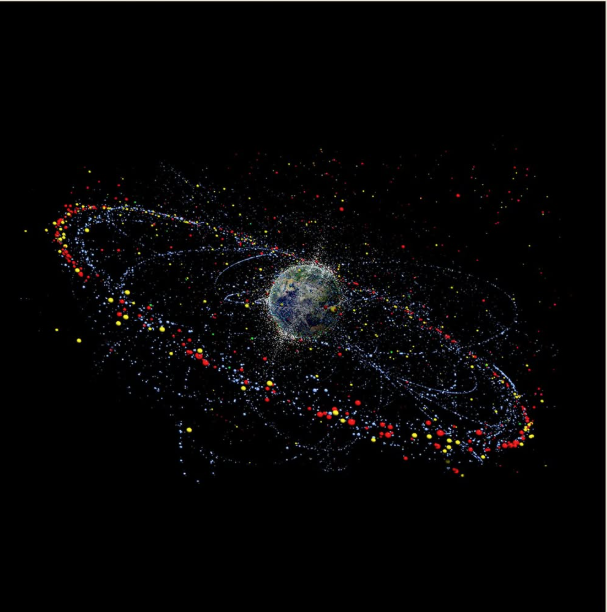
JUST IN: The U.S. Space Force is building new software designed to detect satellite maneuvers almost immediately, rather than waiting hours for perfectly refined orbital tracking data.
Mission Delta 2 says the system will continuously fuse data from military and commercial radars, optical telescopes and radio-frequency sensors to flag unexpected orbital changes, close approaches and rendezvous activity across LEO, MEO and GEO.
The shift is deliberate: commanders would get faster, probabilistic warnings even if the first measurements are less precise, then see the track automatically tighten as more sensor data arrives.
That matters as satellites become more maneuverable and capable of rapid proximity operations. The Space Force’s own 2040 framework says space-domain awareness is moving from a safety-of-flight function toward real-time battlespace awareness and engagement support.
Testing continues through late 2026, with integration into operational centers planned for 2027.
🇰🇷 South Korea just built a welding robot that doesn’t need scaffolding.
This is the Diden Spider, a four-legged machine with magnetic feet that can walk across steel floors, climb vertical walls, and stick to ceilings.
It carries up to 30 kg, squeezes through tight shipyard spaces, and welds where people used to need ladders, harnesses, and a lot of risk.
Shipyards in Korea are already putting it to work.
One more tough, dangerous job that machines are starting to take over.
Writer: Daniyal
New cat alert! A call from a wildlife sanctuary about a "weird cat" has led to the first new cat species discovered in over 100 years in Bolivia’s Yungas forest ecoregion. Learn more about this feline surprise: https://t.co/crffXvPqH4
I just had my Grok Bot pull together the best clips of Starship sitting in the ocean after recovery.
And I’ve watched this part of @SpaceX's “Holy Grail of Rocketry” film over and over.
Bc when you isolate these shots, the scale of what SpaceX is doing really hits you.
A full Starship sitting in the middle of the ocean.
SpaceX employees standing on it and next to it looking absolutely tiny.
Bro... that ship just went to space.
And it came screaming back through Earth’s atmosphere faster than a bullet.
And it survived reentry.
And it splashed down beautifully in the ocean.
And then humans went out there to recover this giant stainless-steel spaceship, looking almost like an alien spaceship that just landed.
You see, for most of the history of rocketry, rockets were basically one-shot machines.
We would launch them and then lose them.
SpaceX is fighting tooth and nail to completely change that with a goal to build a rocket system where the booster comes back, the ship comes back, you turn them around, and you fly them again. And again. And again.
That is the "holy grail" of space exploration.
We’re watching reusable spaceflight slowly turn from something that sounds impossible into something people will one day look at as completely normal.
SpaceX is making this a reality... and this is the stuff that inspires me so much.
There is a reason enormous steam and gas turbines still play an important role in modern power grids, even as renewable power generation grows.
A 1,000+ MW class steam turbine generator spinning at 3,000 RPM isn't just generating electricity. Its rotating shaft line can store roughly 4-5 giga joules of kinetic energy.
That matters because electricity generation and consumption have to remain continuously balanced.
If demand suddenly rises, power plants cannot instantly produce more steam, burn more fuel or increase water flow to ramp up power generation.
Instead, the electrical load on synchronised generators increases immediately, and hundreds of enormous rotating machines across the grid collectively surrender a fraction of their stored kinetic energy.
Their rotors slow almost imperceptibly as grid frequency begins falling below 50 Hz.
This is synchronous inertia.
It buys the critical first seconds for governors, hydro, batteries, gas turbines and operating reserves to increase output and restore the balance. Without sufficient response, frequency can continue falling until protection systems begin disconnecting loads and generators leading to a power grid failure or widespread blackout.
And this balancing act can span thousands of kilometres, connecting millions of consumers and generators.
Yet electrically, the entire grid still has to behave like one enormous synchronised machine.
If they have to, the Chinese will cut through the Himalayas to find the dead.
From Lhasa to Shigatse to Gyirong Port, Highways 219 and 216 on the roof of the world are packed with excavators from provinces across China—about 15 kilometers of machines, a lot of them staged as relief crews waiting to rotate onto the front. Civilian flights keep pouring people and supplies into Lhasa. The mud the machines have already pulled out has been piled into a 200-meter hill behind the line. In 48 hours, mechanized units have dug six kilometers toward the port. They’ve fully uncovered buried Highway 216. One kilometer left to Gyirong.
At the gate itself, hundreds in the advance team are searching around the clock for anyone still alive. Temples across Tibet are praying. Ordinary Chinese people have donated on their own.
A handful of Indians have smeared China and Nepal online. That is not the weight or the values the Ganges civilization is supposed to stand for. Politics is a tumor in human history.
No force on earth can run a dig-and-rescue like this at Gyirong, in the Himalayas. If anyone can—it’s the Chinese people.
Rescue teams have reached the hardest-hit area in Gyirong, southwest China's Xizang.
Firefighters used ropes, boats and drones to navigate the severely damaged terrain after a devastating mudslide.
Search and rescue efforts are ongoing. #Xizang#China#Rescue#DisasterResponse
Never seen a rocket launch up close? Experience the awe with Osmo 360 II — featuring a full 1-inch omnidirectional sensor, native 8K resolution, and 2.4 μm large pixels for unprecedented clarity and impact. ⚠️ Professional operation. Do not attempt.
MISSION SUCCESS | ZhuQue-3 Y2 Reusable Launch Vehicle Achieved Full Success in Orbital Insertion and First-Stage Recovery
On August 19, 2026, at 07:35 (UTC+8), the ZhuQue-3 (ZQ-3) Y2 reusable launch vehicle lifted off from the Dongfeng Commercial Space Innovation Pilot Zone. Approximately 137 seconds after lift-off, the first and second stages separated. The second stage continued its flight and successfully delivered the Honghu 03 satellite, independently developed by Hongqing Technology, into its designated orbit. At approximately 07:41, the first stage performed a successful soft touchdown at the LandSpace Landing Site#1 in Minqin County, Gansu Province, following the planned trajectory — marking the full success of the flight test mission.