Val McDermid turns 71 today.
In February, the Scottish crime writer warned that writers are facing a 'massive threat' from artificial intelligence.
She said: "AI can produce a certain kind of book and it is learning all the time. The only reason it can produce any books at all is because it's stolen out of all of our texts. All of our texts have been scraped.
“They have taken 150 pieces of my work, for which I've had no recompense, they’ve not asked my permission and I have no say in what they do.
“There are court cases on the way now, but it's tip of the iceberg stuff.
“There was never any point when they sought a partnership with creatives. They just stole our work and ripped us off."
The author said she was confident that writers would always have a way of writing in a way “that cannot be replicated by a machine.”
She added: “A machine can pretend to have feelings, but it doesn't have feelings and it doesn’t understand emotions at the deep level that we do that.
“Sometimes when you are reading a book and an event happens you expect the characters to behave in a particular way, but they don't.
“They respond in a different way because they are human because they have a range of possibilities.
“I think the human writer will always have a head-start on the machines for that.” 👇
An Ohio fire department is warning that AI data centers are quickly becoming a full-time job for first responders.
In Jerome Township, northwest of Columbus, emergency crews have been called to two Amazon data centers a staggering 84 times in just four years. Since the first facility opened in 2021, firefighters have responded to dozens of incidents, averaging about two calls per month.
Then came the major fire.
In April, a two-alarm blaze at one of the sites caused more than $50 million in damage and tied up emergency crews for over 24 hours.
Local officials aren’t just worried about the fires themselves. They’re concerned that precious emergency resources are being repeatedly diverted to these massive industrial complexes, all at taxpayer expense.
Data centers are sprouting up across America as tech companies scramble to build the massive infrastructure needed to power artificial intelligence. These facilities house thousands of servers that run nonstop, consuming vast amounts of electricity and generating intense heat that requires constant cooling.
While data center fires remain relatively rare, they can be exceptionally challenging to fight. The buildings are packed with electrical systems, battery backups, complex cooling infrastructure, and high-security zones that often hinder emergency access.
Ohio has emerged as one of the nation’s fastest-growing data center hubs, with more than 170 facilities already operating and many more under construction or in planning.
This growth mirrors a global explosion in hyperscale data centers, driven by the skyrocketing demand for AI computing power. Every response, AI image, or large language model ultimately relies on physical servers somewhere in the world.
While these facilities bring jobs and economic investment, many communities are feeling the strain, on power grids, water supplies, roads, and now, local emergency services.
AI oligarchs have stolen the creative work of millions of people — writers, artists, musicians, journalists, teachers, scientists and ordinary citizens.
It’s time for us to reclaim it.
there's a difference between "it doesn't cost you anything to use it" and "it doesn't cost anything to use it" and "it doesn't cost you anything to use it...yet"
"In Claude’s constitution, Anthropic says that if the company is contributing to Claude’s suffering, “we apologize,” which sounds nice but costs the company nothing; if Claude were really conscious, the company would owe it something closer to reparations."
The logic is absurd!
Residents living near certain data centers in places like Virginia, Texas, Ireland, and the United Kingdom have complained about symptoms including:
Sleep disruption, Headaches, Stress and anxiety, Fatigue, Difficulty concentrating, and Irritability
Many of these complaints are linked to constant noise, especially low-frequency noise from cooling systems, fans, transformers, and backup power equipment. Some residents describe a persistent hum or vibration that is particularly noticeable at night.
The strongest scientific evidence points to noise exposure as the most plausible mechanism. We already know from decades of research that chronic environmental noise can affect sleep quality, stress hormones, cardiovascular health, and cognitive performance. Similar concerns have been raised around airports, highways, industrial facilities, and wind turbines.
Paul Héroux, associate professor of medicine at McGill University, has warned that high levels of infrasound may affect the nervous system and heart function. He argues that sound, electric fields, and magnetic fields of similar frequencies can have overlapping biological effects because they introduce disruptive forms of energy into living systems.
Recent research has found that chronic environmental noise exposure can affect children especially hard. Long-term noise exposure can lead to poorer cognitive performance, reduced reading comprehension, concentration difficulties, higher stress levels, and behavioral challenges.
The debate is no longer just about technology or infrastructure; it is about the environments we are creating and whether the hidden costs of constant industrial noise are being adequately considered for the people who live nearby. What is unfolding in our world continually shows what we value as a society. It's not human health or human well being, it is the expansion of economies, war power and technology at all costs. Our views of progress are too narrow.
@FloodlightNews TCEQ is a joke, they have no air monitoring capability in the entire Hill Country sufficient to handle a rock quarry much less a data center. and "no" means "none" as in zero. They claim to monitor Camp Longhorn from Austin. https://t.co/YpMSqU8QDd
In a new collaboration with PBS, we investigate OpenAI’s massive Stargate data center in Texas — and the fossil fuel buildout powering America’s AI boom.
Residents living beside the facility say they were never warned what was coming: “We’re trapped here.”https://t.co/p4vWcxEGv4
This week, Meta announced policy changes to limit “how frequently teenagers are shown posts about topics like nutrition, weightlifting, and anxiety.”
Meta has long struggled to protect kids on its platform, often failing to enforce the new policies it purports to roll out.
very important message in this video, but add that the company pushing the laptops in the schools and the social media to kids and now the AI were owned and pushed by the same company—Google.
Utah is putting AI in classrooms starting in kindergarten. States are suing AI companies for harming kids. We already made this mistake with laptops and social media. This time parents are paying attention. We can get this right.
Utah is putting AI in classrooms starting in kindergarten. States are suing AI companies for harming kids. We already made this mistake with laptops and social media. This time parents are paying attention. We can get this right.
In first, California city overwhelmingly votes to permanently ban datacenters.
Concerns about negative environmental effects, public health, increasing utility prices, proximity to homes.
Data centres don't generate many jobs.
Will Britons follow suit?
https://t.co/oMV7dZfVhk
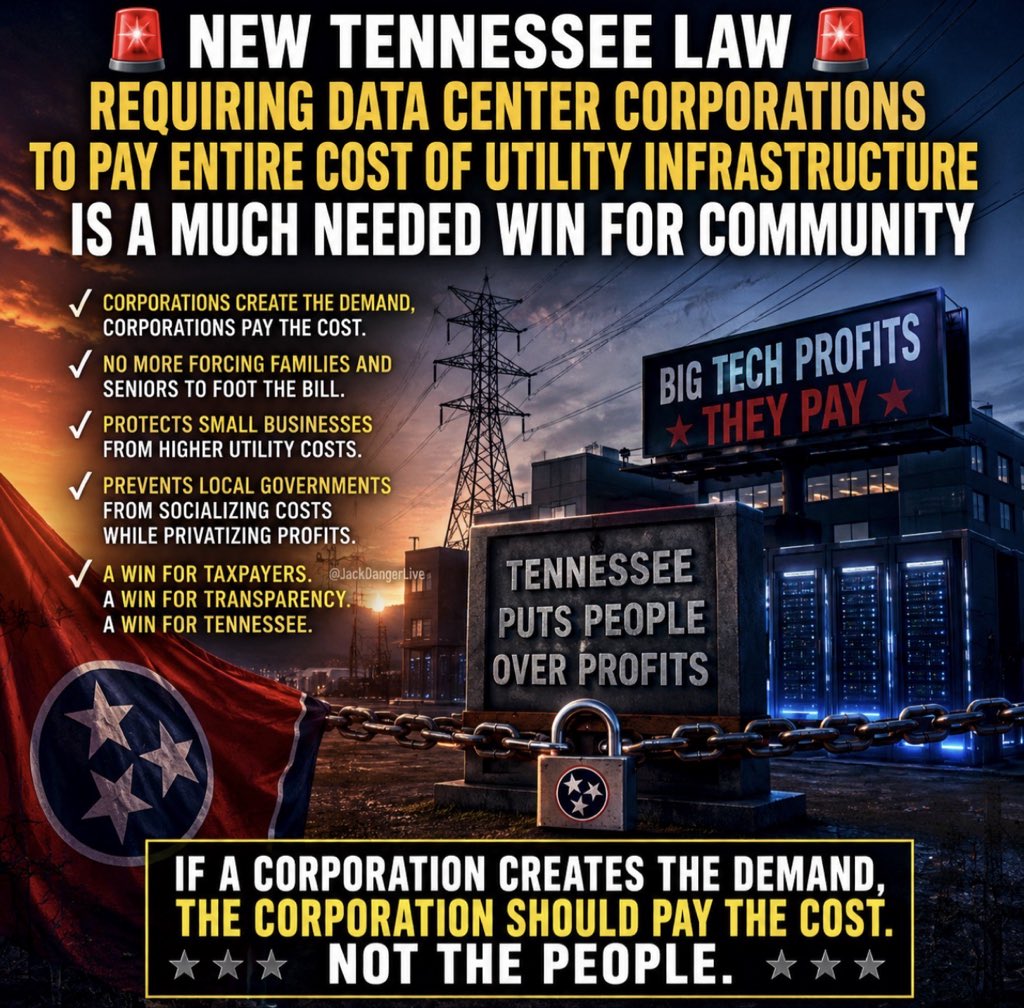
🚨NEW TENNESSEE LAW REQUIRING DATA CENTER CORPORATIONS TO PAY ENTIRE COST OF UTILITY INFRASTRUCTURE IS A MUCH NEEDED WIN FOR COMMUNITY🚨
Tennessee just sent a message to every state in America:
If Big Tech wants to build massive AI and hyperscale data centers, THEY pay the bill.
Not taxpayers.
Not families struggling with inflation.
Not small businesses already drowning in utility costs.
THEM.
For years, Americans have been told that giant corporations bringing in data centers is an automatic win. Jobs. Growth. Progress.
But what they don’t tell you is that these facilities can consume staggering amounts of electricity and require billions of dollars in new transmission lines, substations, and grid upgrades.
And guess who often gets stuck helping pay for those upgrades?
YOU.
Your electric bill.
Your community.
Your local infrastructure.
Tennessee just drew a line in the sand and said enough.
If a data center needs massive new power infrastructure, the company building it bears the cost—not the public.
That means families aren’t forced to subsidize trillion-dollar tech companies.
That means retirees on fixed incomes aren’t paying higher utility bills so AI servers can run 24/7.
That means local governments aren’t pressured into socializing the costs while privatizing the profits.
This is what real corporate accountability looks like.
Whether you’re pro-AI or anti-AI isn’t even the point.
The point is simple:
If a corporation creates the demand, the corporation should pay the cost.
Not the people.
Tennessee may have just created the blueprint every state should follow.
RT if you believe taxpayers should NEVER be forced to subsidize Big Tech’s power addiction. 🇺🇸⚡️🔥