New paper on "wing-slapping," the defensive behavior of #honeybee, now out in @ESAEcology!
Watch the full video set to the cool music of #MIYAVI (@MIYAVI_OFFICIAL), who’s renowned for his guitar slapping!
🐝⬇️⬇️⬇️🐝
https://t.co/WV6VJ0K0gx
Paper info:
https://t.co/p3VIK4DpQP
Yesterday at 2pm the first honeybee (Apis mellifera) in this species’ evolutionary history managed to pull a string for reward. They are much harder to train than bumblebees, though!
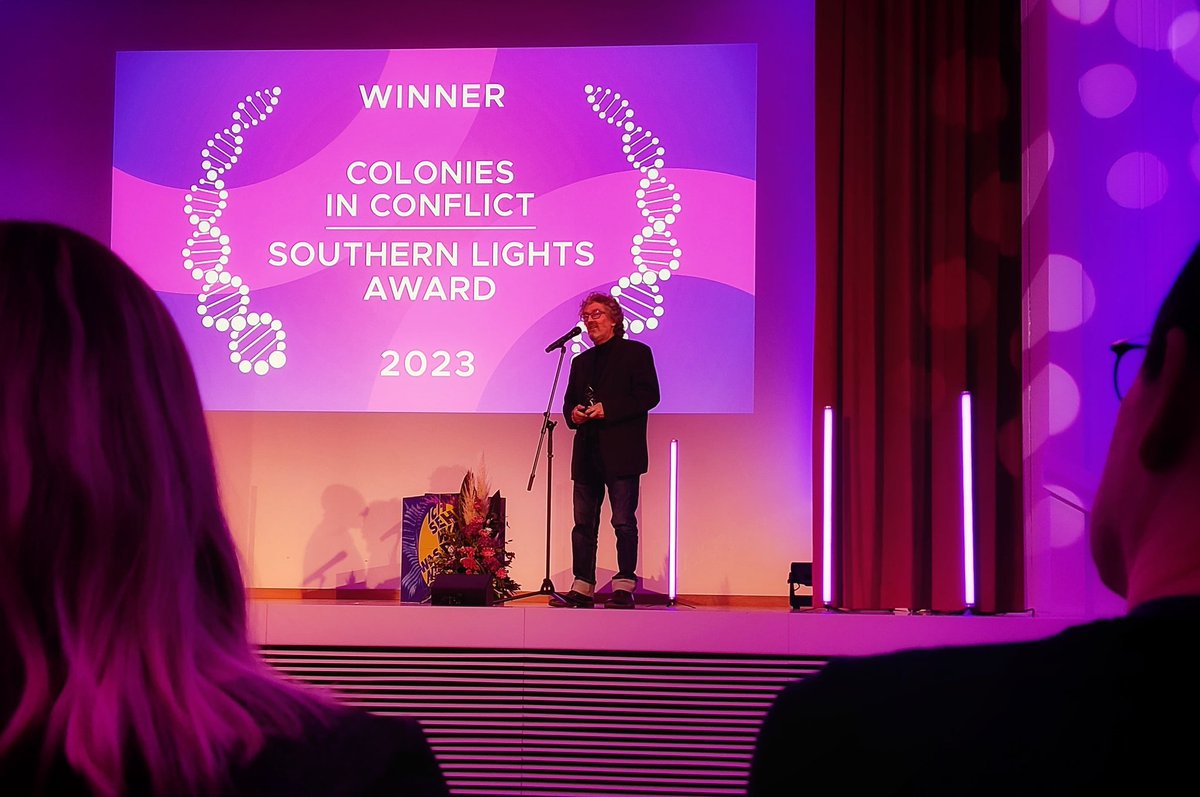
Time for celebration for the @cic_film team!!
Prof. Dr. Axel Brockmann, (co-producer) giving his acceptance speech elaborating importance of research on #honeybees in Asia.
@cic_film: Best independent wildlife documentary, Global Southern Lights Award, @silbersalzhalle, 2023.
Why some humans are consistently more attractive to mosquitoes!
Differential mosquito attraction to humans is associated with skin-derived carboxylic acid levels https://t.co/NyXKgAH9hg
A radar-tracked #honeybee#drone flight from the hive to a drone congegration area and back; actual flight is 9:21 minutes. Video by Joe Woodgate; see https://t.co/zHmgGp9tES
🐝 Glimpse into the inner structure of bee swarms - now officially out in @SciReports 🐝
https://t.co/ClbVWXo2U7
We find&explain a new scaling law in collaboration with @JayaramKaushik🚨See bonus blog post by first-author postdoc extraordinaire @o_shishk https://t.co/cssdEhLttf
Everybody, I’m super excited to present to you: the inside structure of a honey bee swarm!
New preprint led by @o_shishk in collab with @JayaramKaushik "Strength-mass scaling law governs mass distribution inside honey bee swarms"
https://t.co/u19jgk7Lqq
📢🐝🥳
1/🧵
[1/2] Recent work by @nyatonkitnya et al. (2022) strongly suggests that Apis laboriosa is a distinct species & not a subspecies of Apis dorsata, as previously thought by most bee researchers.
Read more: https://t.co/I40AusCfKe
Funded by: @DBTIndia@ugc_india@DAEIndia
Is that what you thought? #CASCB researcher Tatjana Petrov, Morgane Nouvian and colleagues found out that 🐝🐝🐝 #Honeybees are less likely to sting in larger groups!
@MPI_animalbehav@UniKonstanz
Who are we?
Indian Scientists.
What we do?
We solve great problems such as cancer and global warming.
What we could not solve in last 50 years?
.
.
.
How to disburse fellowship so that scholars get their pay on time.
I'm super excited to present some of our latest work! Tracking bees, automatically detecting dances and other vibratory behaviors, understanding functional roles of bees through social network analysis, I'll show a bee robot too! @DDormagen@nebww@AdrianZachariae@WarioFernando
#ColoniesInConflict - First film in India about Apis dorsata a honeybee species we see around our neighbourhood but know so little about. In the film we tried to follow the trajectory of the Rockbees and witness a possible decline in their population.
A huge group of Japanese honeybees protect themselves from a giant hornet entering the nest by surrounding the invader and flapping their wings, creating lethal heat for the hornet but the bees. A rhodopsin might be involved in the thermal sensation: https://t.co/adGtsrqGQj





![NCBS_Bangalore's tweet photo. [1/2] Recent work by @nyatonkitnya et al. (2022) strongly suggests that Apis laboriosa is a distinct species & not a subspecies of Apis dorsata, as previously thought by most bee researchers.
Read more: https://t.co/I40AusCfKe
Funded by: @DBTIndia @ugc_india @DAEIndia https://t.co/9vMFoRMiml](https://pbs.twimg.com/media/Fe8X2pRVQAAsPs-.jpg)


