New Course: Introduction to Paleo-Arabic, taught by Professor Ahmad Al-Jallad, director of @OCIANA_OSU
The Paleo-Arabic corpus (pre-Islamic Arabic inscriptions in the Arabic script from the 6th and early 7th c. CE) is perhaps the most important material witness to the immediate context of Islam's rise. While only a few decades ago, the number of Paleo-Arabic texts known numbered barely four inscriptions, today the corpus reaches nearly 100 specimens, ranging from the Yemeni frontier to Syria. This course introduces students to the Paleo-Arabic epigraphic corpus and its application to understanding the rise of Islam. Students will gain mastery over the script and its evolution from its Nabataean forebearer.
Course starts August 10th. Register here: https://t.co/McJGF3g9v1
It said that Alexander slept with a copy (or part of a copy) of the Iliad under his pillow, and really looked up to Achilles. Also, some time after conquering Constantinople, Mehmed II went to the ruins of Troy and is said to have said: "God spared me for all those..
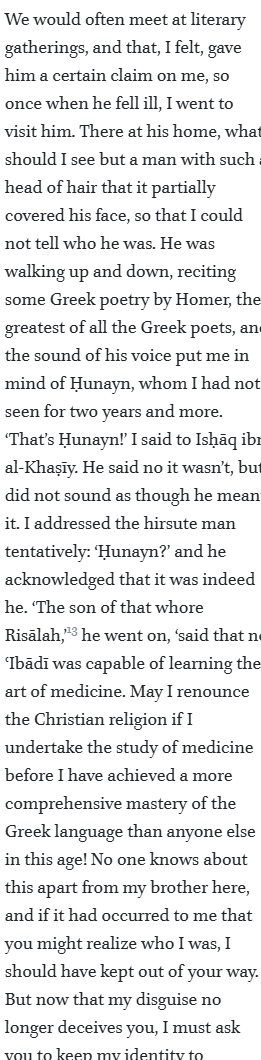
When Ḥunayn ibn ʾIsḥāq (d. 873), the celebrated translator of Greek works into Arabic, was asking too many questions to his teacher, the teacher kicked him out. Years later, Ḥunayn was discovered all hairy and reciting lines from Homer.
ground, whose descendants now, after so many years, have paid to me for their hybris against us Asians back then and on many later occasions." (from Byzantine historian Kritoboulos of Imbros. Homer was regarded as one of the Greek's greatest poets. While there wasn't a trans
years, so I could become the avenger of this city and its inhabitants. I have subdued its enemies, destroyed their cities and turned their possessions into a “Mysians’ prey”. For it was the Greeks, Macedonians, Thessalians and Peloponnesians, who once razed this city to the...
New Course: Christianity and Fascism taught by Dr. @mac_loft. This course explores the ambivalent place of Christianity amid the rise and rule of fascist movements between 1920-1945. Students will read contemporary analyses of fascism as a Christian phenomenon, investigate the theological structure of fascist anxieties and desires, and explore how both fascists and antifascists experimented with new uses of old theological materials. Authors covered in the course will include Carl Schmitt, Ernst Kantorowicz, Karl Barth, Simone Weil, Klaus Theweleit, Friedrich Nietzsche, and Georges Bataille. A central question for the course is how theological concepts of power, sacrifice, community, and salvation become mobilized during times of acute political crisis.
Course starts August 8th. A receipt is available on your student profile to provide to your university for reimbursement.
Register here: https://t.co/LzIiD92mYx
New Course: Introductory Akkadian, taught by Parker Zane (Yale). In the course, students will be introduced to the grammar of Old Babylonian Akkadian (a stage of the language used in the first half of the 2nd millennium BCE) and the basics of the cuneiform script. By the end of the course, students will be able to read selected passages from the Laws of Hammurabi. Course starts September 1. A receipt is available on your student profile to provide to your university for reimbursement. Register here: https://t.co/gR8ns537XU.
A.I. writing has its share of telltale signs: copious em dashes, tortured similes and metaphors, and conspicuous verbs. Yet more advanced models are falling into a new trap: emptiness. Even when asked to mimic the styles of great writers, Claude prefers to generate passages in which characters idly touch furniture in empty hallways and nothing at all seems to happen. Can A.I. produce writing we actually want to read? It’s not looking likely, Jay Caspian Kang writes. Read about his hope for the future of writing: https://t.co/oZf4qxUnRv
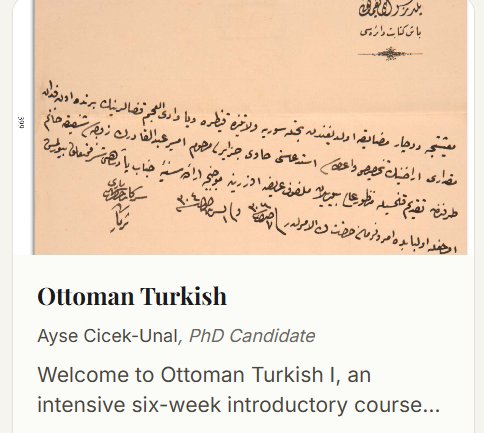
New Course: Ottoman Turkish. Ayse Cicek-Unal (Yale) will be offering an intensive six-week introductory course designed to provide students with the foundational skills necessary to read, understand, and analyze texts written in Literary Ottoman. Classes start June 16. Register here: https://t.co/XXTd0IohAF
Someone should teach a course on Manichaeism (into the Abbasids and beyond) on @Meleteon. It would be very interesting. Maybe even Manichaean Middle Persian, a fun language to learn
I see a curious, & much welcomed, uptick in general & specialist interest in Manichaeism. It is, unfortunately, made into a curiosity at the peripheries of early Christianity, or even worse, a Zoroastrian heresy (whatever that means!). So, it’s exciting to see all this attention.
I think if most people listened to this instead of just dismissing it, they would realize how valuable a resource this is. The guests are always amazing, the hosts don't speak over the guests, and, most importantly, the questions are always spot on. The conversations are top tier
Recently people have asked why I barely engage at all online anymore, so I thought I would do my best to explain.
During the controversy surrounding our Yasir Qadhi interview, when other channels were making response videos, I read countless comments like the tiny sample below.
It was only then that I accepted I had been incredibly naive. A part of me shut down completely.
I stopped posting anything meaningful I thought or believed on social media. I stopped trying to make our content “accessible” or really promote it very much at all.
I just put my head down and focused on reading the books we found interesting and on writing the interview questions I thought were worth asking. I wanted to shut myself away and spend all my free time doing the thing I was most passionate about, thinking about religion and history.
I never wanted to go “viral” again, because I now realised it meant being exposed to a truth I couldn’t bear. The reality that a lot of people, outside of our fellow safe nerdy bubble, would always consider anything we had to contribute in the Islamic Studies space utterly irrelevant due to fundamental characteristics Terron and I couldn’t change, characteristics we ourselves had never centered in any of our content. They wouldn’t give us the time of day before we had even had the opportunity to open our mouths. I abandoned the much treasured idea that we could make worthwhile contributions to clarifying popular misconceptions about Islam, because it had been made clear that what we looked like precluded us from doing that.
I would rather our viewership remained safe and small, to the point that if any of our videos got lots of views or comments I would mildly panic. I don’t know if there is anyone else out there in the online space who can relate, but I thought I would put my experience out there just in case there is.
I was very lucky in that through it all I had the best co-creator in Terron, who did his utmost to support me and protect me from the worst of this, shouldering the hard work of promoting our content on social media by himself and even deleting comments before I could read them because he knew they would upset me so much.
Anyone have any examples of great historical figures idolizing/admiring mythical heroes (especially if they knew they were just stories/fake)? Alexander was a big fan of Achilles and apparently kept a copy of the Iliad under his pillow
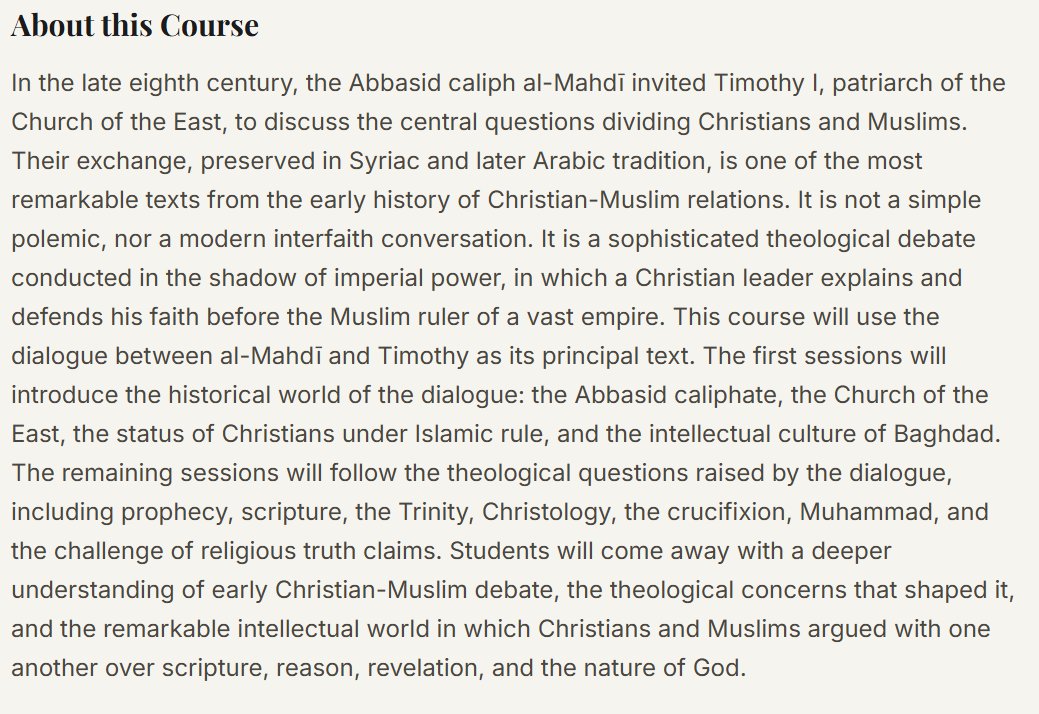
If you're interested in Christian-Muslim relations in early Islam, we have an exciting new course for you- The Caliph and the Patriarch: Christian-Muslim Relations in Early Islam, taught by Professor @GabrielSaidR (Notre Dame). Course starts Aug 3. Register here: https://t.co/Y6DBHp0Ysf
Rethinking the Divide Between Muslim and Non-Muslim Sources
Dr. Borrut explains how this divide has shaped modern understandings of Islamic historiography, the misconceptions it has produced, and why a more interconnected reading of the sources may offer a fuller picture.