While much of machine learning is retrospective (learn the past distribution) learning in biology is prospective (learn for the future) - here we discuss some implications for neuroscience (with Tim Verstynen, @jovo, Pratik Chaudhari): https://t.co/gEKuO1JT9c
4/ Retrospective ➡️ Prospective
Standard RL is retrospective ("do more of what worked before"). But social settings are non-stationary because other agents are also learning.
This requires prospective learning – predicting the future to anticipate how other agents will adapt.
Are you preparing for a (Research Scientist) job talk in industry? What generally works well is to give your presentation the following structure:
First, a short snippet of your overall set of technical accomplishments. For instance, you might spend the first 15 minutes giving short overviews of a few of your works/papers - it's also very good to draw a theme across them if there is one.
Second, you can spend the next 20-25 minutes doing a deep dive on just one of them - say, the one you're most proud of, or the one that matches the hiring team's interests best.
And finally, use the last 5-10 minutes to summarize and talk about what you think are important new directions to pursue in research and how these could have impact for the team and the products of the company.
In my experience, it's hard to give a bad talk that's structured like this. And as a bonus, the form is flexible enough to adapt to different audiences.
Do you work in AI?
Do you find things uniquely stressful right now, like never before?
Haver you ever suffered from a mental illness?
Read my personal experience of those challenges here:
https://t.co/OFZmSizl6f
BREAKING NEWS
The Royal Swedish Academy of Sciences has decided to award the 2024 #NobelPrize in Physics to John J. Hopfield and Geoffrey E. Hinton “for foundational discoveries and inventions that enable machine learning with artificial neural networks.”
You should be so lucky to have people throughout your research career that you can openly bounce ideas to and from - especially if they complement your strengths in your areas of weakness - it is a rare and precious gift.
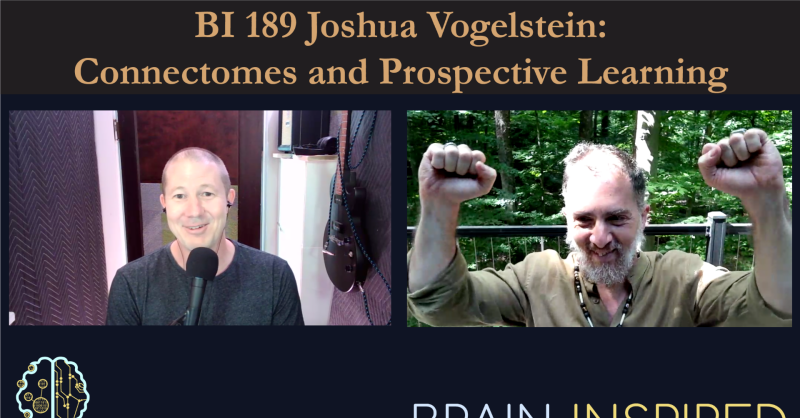
We don't get "redos" in all matters, but Jovo @neuro_data explains why he's an advocate. Oh, and we chat about prospective learning, baby fly connectomes, theoretical neuroscience, and how to be an expert meditator out of the gate...
https://t.co/KZR6AoxGtX
While intelligence *leverages* compression in important ways in representation learning, intelligence and compression are by nature opposite in key aspects.
Because intelligence is all about *generalization to future data (out of distribution)* while compression is all about *efficiently fitting the distribution of past data*. If you're optimal at the latter, you're terrible at the former.
If you were an optimal compression algorithm, the behavior policy you would develop during the first 10 years of your life (maximizing your extrinsic rewards such as candy intake, while forgetting all information that appears useless as per past rewards) would be entirely inadequate to handle the next 10.
One thing I've learned about ML researchers on this platform is that they're not just ML experts, they're also experts on cognitive science, geopolitical conflicts, how to run companies, and lots more things to come!