Reminder that no one who is actually rich from day trading is selling a course. Why would they decay their own edge for some $500 course sales? It makes no sense
The coming years are going to be insane. I say this figuratively and literally. The primary reason is because society is about to enter a phase transition. This is what a phase transition looks like.
Water at 99°C is hot, stable, behaves like a liquid and follows the laws of hydrodynamics. At 101°C, water becomes a gas, making it chaotic, expansive, and following a different set of physical laws.
The difference between 2026 and 203X is the difference between 99°C and 101°C.
To make this tangible. Imagine you’ve become a proficient swimmer. Mastering your stroke, breathing and pacing. The water is a predictable substrate that you use to model your decisions. This is life at 99°C.
At 101°C the pool turns to steam. You stroke your arms but don’t move. You kick and don’t find resistance. Your swimming proficiency is no longer an asset, it’s a liability. Your muscle memory is a mismatch for the new environment. You have to unlearn to relearn.
This is what life planning is going to feel like going forward.
For most of history, you could make a pretty decent guess about what the future would look like. If you were a farmer in 1400, you knew your grandchild would probably be a farmer in 1450. That was even true in 2003 when I entered college. One could confidently attend college, select a career, plan a profession, and map out retirement by age 65.
We felt confident in these plans because we depended on broad trends (coarse graining) that reliably predicted the future. Things may change here and there, but not enough to give you any pause in your life-planning decision making.
That stability is now gone. For example, my son is 20 and neither he nor I have any idea how to think about his life. Should he go to college? Is college still relevant? What should he learn? Life planning shortcuts are now dead. No one knows. Before, having a five year plan was responsible. Now it’s reckless because the world is moving faster than we can model. The speed of reality exceeds the speed of the observer.
This is the source of the low level anxiety that many people feel. Humans are prediction machines. When an error emerges from what you predicted (water) to what you get (steam), the body registers it as trauma. It leaves us in a state of chronic hyper-vigilance, scanning a horizon that refuses to sit still.
In this new reality, the move is not to have better maps, but to build better systems. This is what I’ve been building with Blueprint. An algorithmic system of health and decision making that moves as fast as technology, allowing me to evolve alongside. The more I detach from ideas, norms and expectations, the smoother the glide. The hardest part is letting go of what we know and trust.
This is part of a series of essays that I’ve been writing for my upcoming book Warriors & Caretakers of Existence. A plan on what the human race does when giving birth to super intelligence. If we want the extraordinary existence that is on offer, we’ll need to fight for it.
In crypto people are always stuck in that binary, is this the start of something, or is it over. That thinking gets you chasing tops and bailing at the lows.
It is better to stop framing every move as the beginning of a bull run or the end of one, and instead look at it as, what kind of conditions am I trading in right now.
Some environments are cooperative, liquidity is there, follow through is clean, buyers or sellers are clearly in control, your ideas get paid quickly. Other environments are adversarial, breakouts get faded, wicks are everywhere, funding and perp behavior are messy, you have to work harder for less.
So the real question is not, is this the start, it is, are conditions supportive, or are they fighting me.
That is the “pissing with or against the wind” idea. If the wind is at your back, you can be a little more aggressive, you can hold a bit longer, you can press continuation. If the wind is in your face, you scale down, you take profits faster, you wait for cleaner spots, you let the market prove it wants to move.
Thinking in terms of conditions keeps you flexible, thinking in terms of beginnings and endings makes you rigid. Crypto is not one long story arc, it is pockets of opportunity inside a noisy market. Your job is to recognize when it is one of those good pockets, and when it is not.
The notion that ‘equities are going higher, so it’s only a matter of time before crypto catches up’ is deeply flawed.
It disregards the principle of preparing for the worst and hoping for the best.
If crypto is already trading lower and equities roll over, what then? You’re exposed on both fronts.
It’s far more prudent to structure yourself for potential downside risks and survive.
If they materialise, you’re protected, if they don’t, you may then position to capture the upside.
Seen some absolute dire dog shit takes of late - including 'gold topped -> bitcoin has to rally now...'
Trade whats infront of you - not hope....
In fairness, during past cycles, after a strong move in BTC, we’d often see btc trade rangebound whilst capital rotated further out on risk curve, into eth and alts.
Whether that dynamic plays out again this time is still up in the air, but one thing I’m watching is stablecoin dominance.
Should it hold steady along with a decline in btc.d and ethbtc rising then thats a positive step foward, albeit if its for several weeks.
Certainly what I would want to see play out - but lets see.
The best traders I know do not giving a flying f*ck about what other people are doing.
It's funny to see CT still so concerned about what the opinions are of a few people, when most hit rates are a coinflip.
Richer people wont judge you for saving your money.
Fitter people wont judge you for cutting your calories.
Higher status people wont judge you for cutting bad friends.
It’s the people going nowhere who have the most to say because they have nothing to do.
I’ve struggled a lot recently when people ask me what my big goal is.
They think it’s money. And sure. Business measure that way. But it’s more.
Andrew Carnegie summarized my position in six words:
“My heart is in the work”
Really resonated with me.
Exit Strategy
The balance between 'letting winners ride' and 'not roundtripping to zero' is thin.
95% either sell everything too early or hold back to zero.
Hardly any talk about this, so let’s dive in: 👇🧵
1. Mindset
1.1 Acceptance and understand the goal
Accept you won’t sell everything at the top—it’s not the goal.
95% of the people try this, and 99% sell too early or hold to zero.
Set a new goal: sell higher than you bought and leave with more money than you started.
1.2 Don't compare yourself
Seeing others make millions doesn’t mean you’ve failed if you don't hit that while managing a 4-digit portfolio.
$10k is a lot.
$100k is a lot.
$1m is a lot.
It’s all relative.
Chasing Twitter exceptions will make you roundtrip. Don’t aim for their numbers—focus on growing what you have.
1.3 Longer term view
Stop aiming to get rich and retire this cycle. Most will feel it’s not enough at the end, even with multiples of what they started with.
This mindset leads to roundtripping. Think long-term.
Each cycle teaches you many lessons, and if you can manage to also end up with a big cash increase into the next bear market, you can compound gains and knowledge in the next cycle.
Many underestimate it how powerful it is to have a lot of cash into the next big downtrend.
Don’t aim to make it this cycle—aim for the next or the one after.
A few might get lucky with big wins, but most roundtrip 5-7 figures chasing more.
2. Have a plan
Don’t plan with the euphoric you during parabolic moves and falling dominance.
Plan with the current you:
> How will I scale out?
> Where (target zones) will I sell more?
> What do I not want to see in the markets?
> What do I do when I do see it?
> What if a position moves early but super hard?
3. Selling habit and gradually over time
Selling during strong price moves is hard—you’ll feel like it will keep going and you’ll miss out.
Start now by selling small batches to build a habit and become more robotic.
Set a slow pace (e.g., sell 0.5%-1% every two weeks) and create rules for when to increase limits.
Focus on building the habit first—your portfolio will still grow. Later, shift to larger selling volumes as needed.
You have to have a plan with certain metrics and things you want to see to understand where to increase the selling.
Aim to capture the bulk of the move gradually, not by selling everything at the top.
4. Change your life
If a position outperforms the market and prints beyond expectations, forget your targets—secure the money.
Sell half or more, cash out, and change your life.
5. Lock it truly in.
If you sell but leave the cash or Bitcoin on the exchange, and euphoria kicks in later. Still overconfident from your last win, you’re back in—chasing the next 100x your favorite influencer found.
Cash-out or move it to a hardware wallet. Make it harder to access and keep it safe.
6. Stop rotating
You put $1,000 into a token; it’s now $5,000, and you sold. Great! Do it again, and it’s $50,000. You’re sitting on $50k, thinking, “One more time, and I’ll make life-changing money.”
Your money goes into the next “cancer-curing” altcoin. It dips, but in a bull market, dips get bought up, right? This time it dips deeper and doesn’t bounce. You hold, telling yourself, “diamond hands.”
It’s now worth $20k. You feel terrible but keep holding. The market nukes again, and you’re now a community member. A year later, it’s worth $750—you’ve roundtripped everything.
Stop rotating endlessly. Secure money and sell to cash out, not to chase the next plan. The longer the uptrend lasts, the more euphoric and irrational you’ll get. Protect your gains—take them out.
7. Example plan (rough draft for inspiration)
*Make your own plan*
A) I’ll start selling a mini amount daily/weekly to build the habit and starting today.
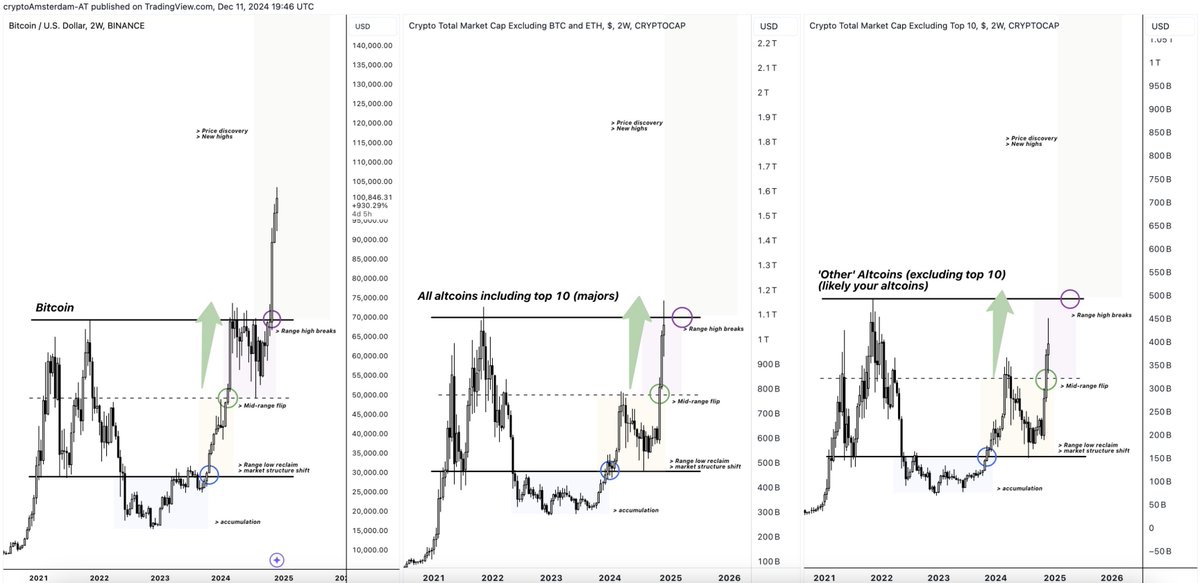
B) Once the Total Altcoin or 'Others' chart shows 1-2+ weekly candles in price discovery, I’ll slowly increase these amounts. (and will again increase after x)
C) If a play outperforms my portfolio or gives me life-changing money, I’ll take it out—no matter where we are in the cycle.
D) If we hit a key zone (BTC, Total Altcoin, or your preferred chart), I’ll increase my daily/weekly selling volume again.
E) Certain price action or indicator, whatever you like: If we see a blow-off top, a blow-off candle, or a bearish market structure break, I’ll sell X% or increase my selling volume.
F) Come up with things yourself 😄
Making it is simple, but keeping it isn't easy.
Have you heard about the gambler who walked away with $1M and never returned? Me neither.
Most will make it, but very few will still be good in the next bear.
This market is gambling on attention; attention will fade away.
99.9% of the tokens will trade lower again in the future.
Secure profits.
Why choose short-term trading over long-term trading? It comes down to predictability. Outcomes are generally easier to forecast over shorter time frames than longer ones.
Think of it like a horse race. Which is easier to call: a race that hasn’t even started or one where the horses are just a few feet from the finish line?
The longer the race—or the time frame—the more unpredictable factors come into play, widening the distribution of possible outcomes.
I haven't traded much since the end of September.
In terms of work/life balance, trading for me is a process of being out of balance and then needing to counter balance.
It has to be that way because the energy and focus that trading requires is unsustainable, for me, for long periods of time without risking burn out.
When I'm in the zone, there is nothing but me and the markets. They are the first thing I look at when I wake up. They are all I look at during the day and they often keep me up at night.
When I need to counter balance, I do nothing. I rarely even glance at a chart. I spend entire days walking, reading, enjoying my hobbies. These periods are an absolute necessity, allowing me to come back and perform at my best.
The length of time between imbalance and counter balance is determined partly by the market and partly by my frame of mind.
My aim has always been to work out when I have clear edge and when I'm able to play my A game. Both are vital for success.
Sometimes I feel there is edge but I don't feel like trading. I might be tired and feel my execution could suffer. I might have other things in life occupying my mind. And sometimes, I simply don't feel like trading at all.
Perhaps that is strange for some people to read. Trading has always been a job to me - a job I enjoy but a job nonetheless. And sometimes, like anyone who has a job, I feel like a few days off. So, I don't trade.
At other times, I am keen to engage but I believe the market isn't conducive to my edge. Again, at such times, I don't trade.
When both my edge and my state of mind are in sync, then it's a question of making hay while the sun shines - however long that may be. Sometimes it's weeks at a time. Sometimes it's months. But the key, for me, is taking a break as soon as I feel one or the other is dissipating.
That is my process.
And many traders I have known along this journey find it hard to follow because their whole life has become nothing but trading: they are wrapped up in it from morning through until night - they wear their lifestyle of this relentless grind like a badge of honour and slowly, almost imperceptibly, they find their entire self worth is linked to their performance.
Not only is this not healthy but, in my opinion, it's not conducive to long term success and happiness.
Right now, I am enjoying the lull.
This is NOT saying shoot for passive income. It's saying you need to make WAY MORE than you think to actually afford a "lifestyle".
10 mil seems like a lot BUT spent/invested responsibly gets you about 500k a year.
This is about 40k a month. After taxes 25ish. GOOD money, but not $5k bottles, trips to vegas and drive a lambo money.
You can certainly retire and live SUPER comfy , but this is middle class NYC money. This is FINE FYI.
If you WANT more, then you use this new found PASSIVE $$ stream to give you a safety net while you take bigger business & trading risk.
YOU DONT SPEND IT. THATS YOUR SAFETY NET TO MAKE THE BIG MONEY.
I am not pooping on that amount of money. It's alot. BUT you need to understand money. Most young guys don't do this and then live way outside their means which is SUPER easy to do,
What is this obsession people have with thinking they are gonna see the top in markets but also be able to kill it on the final ride?
“I’m so bullish, BUT THIS IS IT!”
Markets have been going up and to the right before most of your parent’s parents were born. Please shut up and sit down.
the one good thing about IRL events is that it helps you understand CT does not dictate the market
so many people I’ve met don’t even use X often, if ever
and a lot of them are extremely successful
Maybe a hot take, but speaking as someone who started out reading level 2 and tape, and relies heavily on order flow:
The hyperfocus on order flow by crypto Twitter, along with the so-called "analysis" of it, often seems more like a distraction than anything useful. When 99% of people are using the same five indicators and publishing overly detailed write-ups that discuss the market in an unrealistic, deterministic manner, it just adds noise.
There's too much apophenia and too much effort spent trying to sound smart, in my opinion.
Your goal should be to focus on the things that stand out like a sore thumb, rather than trying to interpret every minor nuance in an extremely fragmented market.