Dive deep into mystery to provide Astrology insights, knowledge, and connections to the soul.
Break out the 3D into 5D paradigm functions on Natural Law.
A nuclear engineer who calls himself "Nobody Special" just gave me the most uncomfortable hour of my year.
In 2023 @JG_nuke noticed NVIDIA loaned $2.3 billion to a company nobody knew, days after NVIDIA beat revenue estimates by exactly $2.3 billion. He started asking questions. They called him a conspiracy nut.
Nobody calls him that anymore as NVDA collapsed last week.
His count for 2026 alone: "NVIDIA has participated in 129 capital raises for its customers... and then their customers turn around and give that money right back to NVIDIA. It reports as revenue, but it's really just their own money going around in circles."
His analogy is devastating because a child understands it:
"It's the little girl selling the most Girl Scout cookies because she's buying them from herself. She can't sustain that forever."
Last week @cryptohayes told me he's buying the government bailout of AI. I put that directly to Jack. His answer:
"If your investment thesis is 'the government is going to bail you out,' it's probably time to stop and rethink what it is you're really doing here."
The bailout comes, he says, but once or twice removed, through the banks, after the damage. And the public, after the midterms? "You will have rioting in the streets."
On AI itself he's not even a hater: revolutionary long-term. "That did not save anybody invested in the dot-com bubble. Ask people who owned stock in https://t.co/9eJ1wLFfvI if that makes them feel any better."
And his Bitcoin plan is on the record: DCA never stops, and he starts buying in size in the low 50s if the washout comes.
Bitcoin is close to those regions currently.
Thanks for @OKX of being todays sponsor of the show.
Timestamps:
00:00 Who is Nobody Special?
01:33 Is the market in a bubble?
04:01 The first signal that the AI bubble cracked
07:51 What happens after the bubble bursts
11:17 How circular financing works
15:28 CoreWeave and the risk of default
17:40 Why the market keeps going up
19:02 Who pays the debt?
22:02 Private credit risks
26:10 The bond market
30:14 Are higher rates a form of easing?
31:20 Will the government step in?
33:55 Is AI revolutionary?
39:59 Is AI demand real?
44:49 Recession or bubble?
47:30 What it means for Bitcoin
53:54 Predictions for the next 12 months
01:01:12 Why AI companies have no moat
This from Citi is about as grim as I’ve read any financial institution be about AI. They’re trying to keep a brave face but it’s weak. The enthusiasm is entirely gone
@spencerpratt let's not forget he tried to tank Hong Kong dollar back in 1997 to ruin China financial market. He lost China backed Hong Kong Dollars to prevent collapse. He will lose again bigly
🇨🇳🇷🇺|THE SHENZHEN TRILATERAL WAS NOT A "PEACE SUMMIT." IT WAS A STRESS TEST, AND TRUMP FAILED IT BEFORE HE SAT DOWN.
The mainstream will sell you a story of three great powers coming together to "manage" the world. That is the cover story. The reality is simpler and harsher because the United States walked into a room it did not build, on terms it did not set, alongside two powers whose relationship it has spent years trying to sabotage. Trump's presence was not a concession to multipolarity. It was an admission that Washington can no longer afford to stay outside the room.
Here is what the record shows, stripped of the Atlantic framing.
TRUMP'S GAME WAS NEVER "PEACE." IT WAS THE KISSINGER PLAYBOOK, AND IT IS DEAD.
The entire purpose of Trump's outreach to Moscow, from the earliest days of his political career to the phone calls and envoys of 2026, has been the old triangulation fantasy: pull Russia away from China, offer Moscow a "better deal" on the outside of the Sino-Russian partnership, and leave Beijing isolated. This is the Nixon-in-reverse strategy. It is the dream of every American strategist who cannot accept that the unipolar moment is over.
Shenzhen killed it.
Look at the sequence. On November 18, Xi met Putin before the trilateral. The Chinese readout was not diplomatic boilerplate. Xi described China-Russia relations as "风雨不动安如山, (As steady as a mountain, unmoved by wind or rain.)" unmovable as a mountain in wind and rain, and called for "leading and promoting a multipolar world and the democratization of international relations." That is not the language of a junior partner being pried loose. That is the language of two sovereign powers confirming, in the host's own capital, that their coordination is structural and not transactional.
Trump arrived the same day. He was greeted at the airport by Xi personally, an honor of protocol and not of substance. The substance had already been settled between Xi and Putin. Trump was not the architect of the trilateral. He was the late arrival to a framework that Beijing and Moscow had already built.
WHAT TRUMP WANTED FROM THE ROOM, AND WHAT HE GOT.
Trump's stated agenda, repeated to reporters before the summit, was to discuss "ending the US-Iran conflict and denuclearization." Note the framing. The United States created the Iran crisis by withdrawing from the JCPOA and launching military strikes on safeguarded facilities. It then demanded that China and Russia help it clean up the mess on American terms. This is the definition of chutzpah: break the vase, then ask the neighbors to pay for the glue.
China's position on Iran is a matter of public record, and it is the opposite of what Trump wanted. China vetoed the US-backed Security Council resolution on Iran sanctions. Ambassador Sun Lei stated plainly that the crisis "stems from the unilateral withdrawal of the United States from the JCPOA, its policy of maximum pressure, and its twice resorting to force." China defended Iran's right to peaceful nuclear energy under the NPT and condemned strikes on IAEA-safeguarded facilities.
Trump did not walk into Shenzhen to find a China ready to join his pressure campaign. He walked into a room where the host had already vetoed his sanctions, blamed his country for the crisis, and reaffirmed its partnership with the other guest, Putin, in language designed to be quoted.
THE TRILATERAL WAS NOT A G-3. IT WAS A RECOGNITION THAT THE G-1 IS OVER.
Western commentary has already begun framing Shenzhen as the birth of a "G-3," a condominium of three great powers managing the world. Chinese analysts have explicitly rejected that framing, and they are right to do so.
The trilateral did not create a new directorate. It formalized a reality that Washington spent three decades denying: no global question, whether Ukraine, Iran, nuclear weapons, AI governance, or supply chains, can be resolved without the participation of China and Russia, and no resolution imposed on them will hold.
The meeting was historic not because three men sat together, but because the United States sat down with two powers it has tried to isolate, sanction, and subordinate, and did so on their turf, in a city that was a fishing village when the American century began. Shenzhen is not a neutral venue. It is the physical proof of the shift: a Chinese city built into a technological and industrial hub while Washington was busy declaring the end of history.
WHAT THE MAINSTREAM WILL NOT TELL YOU.
They will not tell you that Trump came to Shenzhen seeking a deal on Iran and Ukraine because his own strategy has failed. They will not tell you that China vetoed his Iran resolution, blamed his country for the war, and defended Iran's nuclear rights. They will not tell you that Xi met Putin first, embraced him as a mountain, and only then received Trump at the airport. They will not tell you that the trilateral was not a concession by Beijing and Moscow, but a recognition by Washington that the old unilateral model no longer functions.
The cover story is "three great powers managing the world together." The truth is simpler. The world is no longer managed from Washington. Shenzhen made that visible. Trump's presence was the proof, not the exception.
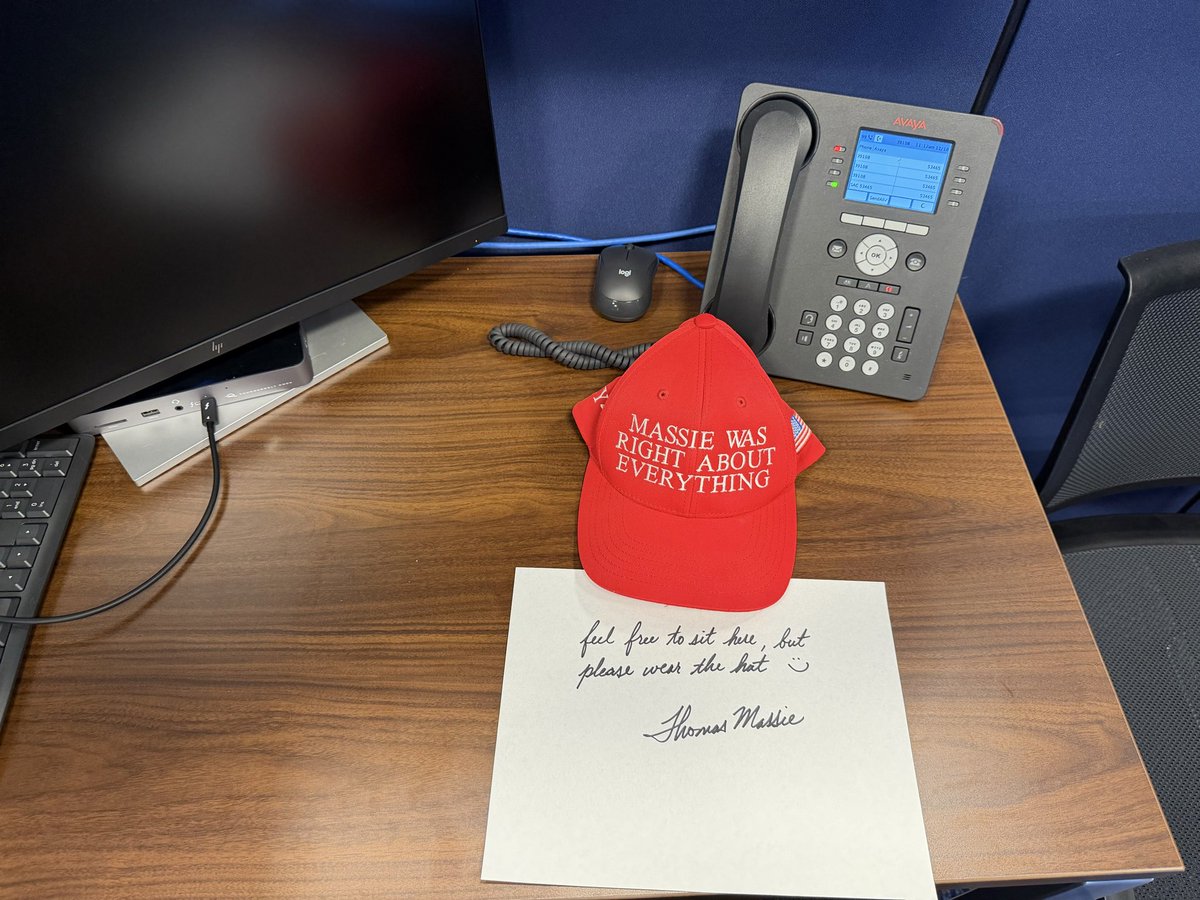
This is my new office in the basement! It’s half a cubicle, but I have an extra seat for one staffer. It’s traditional to kick non-returning members out of their offices early and ship them to this cubicle farm. The assumption is lame duck members just quit working… not me!
You’ve been lied to about Jensen Huang and Nvidia and what the US did to Jensen is far worse than what China did to Jack Ma.
Let’s break it down and explain the important nuance missing from this debate 👇