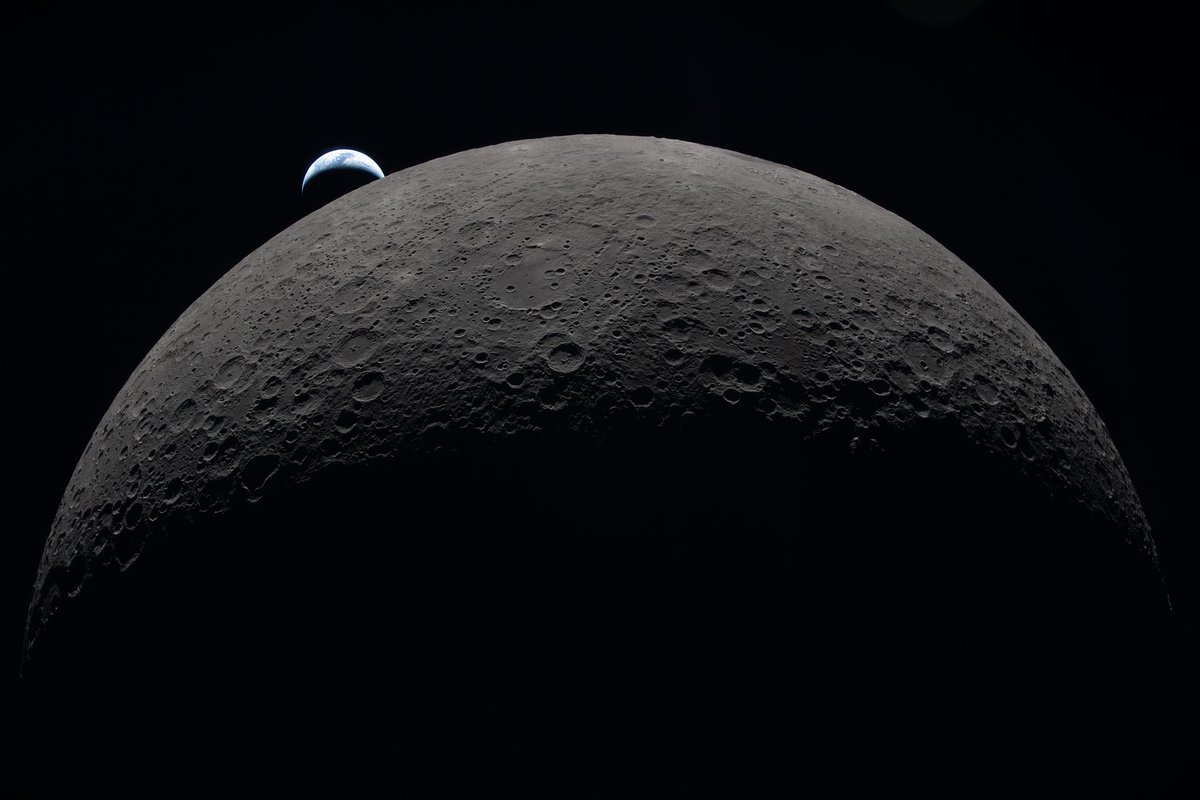
What the Artemis II astronauts did over the last 10 days was a testament to their bravery. And the fact that they traveled farther from Earth than anyone ever has, re-entered our atmosphere at more than 24,000 mph, and splashed down safely was a testament to human ingenuity. Thanks to everyone at @NASA for making this mission possible, and for taking us along for the ride.
Get ready to choose your allegiance when Team Rocket returns in #PokemonTCG: #DestinedRivals 🚀
Will you join forces with Trainers like Cynthia, Ethan, and Arven or battle alongside Team Rocket this May 30, 2025?
Overwhelmed, excited, anxious, scared. I've been feeling so many emotions since I was given the news - never in my wildest dreams did I think I'd get to be a NASA Hubble Fellow 🤯 I love globular clusters so much and I'm incredibly grateful that I get to study them ✨
Well, that's it. I've peaked in life having been cited in XKCD *and* making it into the alt text. Going to retire to nerd heaven now.
https://t.co/hTxwREVlSS
We did it! Today we released the Dark Energy Survey @theDESurvey supernova cosmology results!!!
A massive effort from many people. This has been the prime focus of my research for the last decade, and it was an honour to co-lead this working group. What did we find?.... a 🧵
PyTorch 101: Tensors clearly explained!
Tensors are the fundamental building blocks for performing mathematical operations in deep learning models.
Today, I will provide a comprehensive explanation with illustrative code examples.
Let's go! 🚀
Coding games are the best way to learn coding.
From CSS, Python, JavaScript to Blockchain.
Here are 10 of the BEST online games to learn coding in 2024:
Eigenvalues & Eigenvectors clearly explained!
The concept of eigenvalues & eigenvectors is widely known yet poorly understood!
Today, I'll clearly explain their meaning & significance.
Let's go! 🚀
This tweet is about how I have studied ML and made it my profession. I'll share the resources I've used and the sequence of my study.
Straight to point
ML pre-requisites(maths) : Linear Algebra, Probability Theory, Calculus, Optimization Theory(optional), Information theory(optional)
Linear Algebra: Lecture course by Gilbert Strang
Probability theory: MIT 6.041 (it contains parts of Bayesian inference as well)
Calculus: your high school and college classes are enough
Once basic maths is done then we move to ML.
Classical ML : CS229. Either by Andrew NG or someone else. Follow their lecture notes and solve their problem sets.
Reference books for classical ML that I followed: PRML by Christopher bishop, Pattern Classification by Duda, Hart and Stork
After getting comfortable with classical ML we move to Deep Learning and everything else.
Deep Learning and Computer Vision: CS231n. Very good lecture and assignments
Reference book: Deep Learning by Ian Goodfellow. This is the best book on deep learning. I’ve read some chapters of it many many times. Beautiful maths and intuitions
MLOps: dvc, WandB, MLFlow
NLP: I just read hugging face blogs. I haven’t spent much time with classical NLP though.
Alignment/AI safety/AI explainability: Anthropic Blogs(I’m a noob in this, just started learning couple months ago)
Additionally:
Blogs: Lilian Weng(OpenAI)’s blogs, colah’s blogs
Additionally: arxiv. I read many papers from arxiv
Karas and Tensorflow blogs: for introductory code about modern deep learning frameworks
Competitions: Kaggle
Cloud compute. GCP/collab/Kaggle notebooks
PS: this is not a roadmap. Just what I followed till now and I find it quite structured. Even after 5 years I still find myself learning new stuff everyday.
I started learning to code exactly 2 years ago and landed my first job as a Software Engineer in 2023.
If I were to restart my programming journey, this is what I would do 🧵 :