We are delighted to share that Professor Mihalis Mathioudakis, Director of Research here at ARC, has been awarded the 2021 Institute of Physics Cecilia Payne-Gaposchkin Medal and Prize.
Congratulations Mihalis!
https://t.co/Q71rGeKQuz
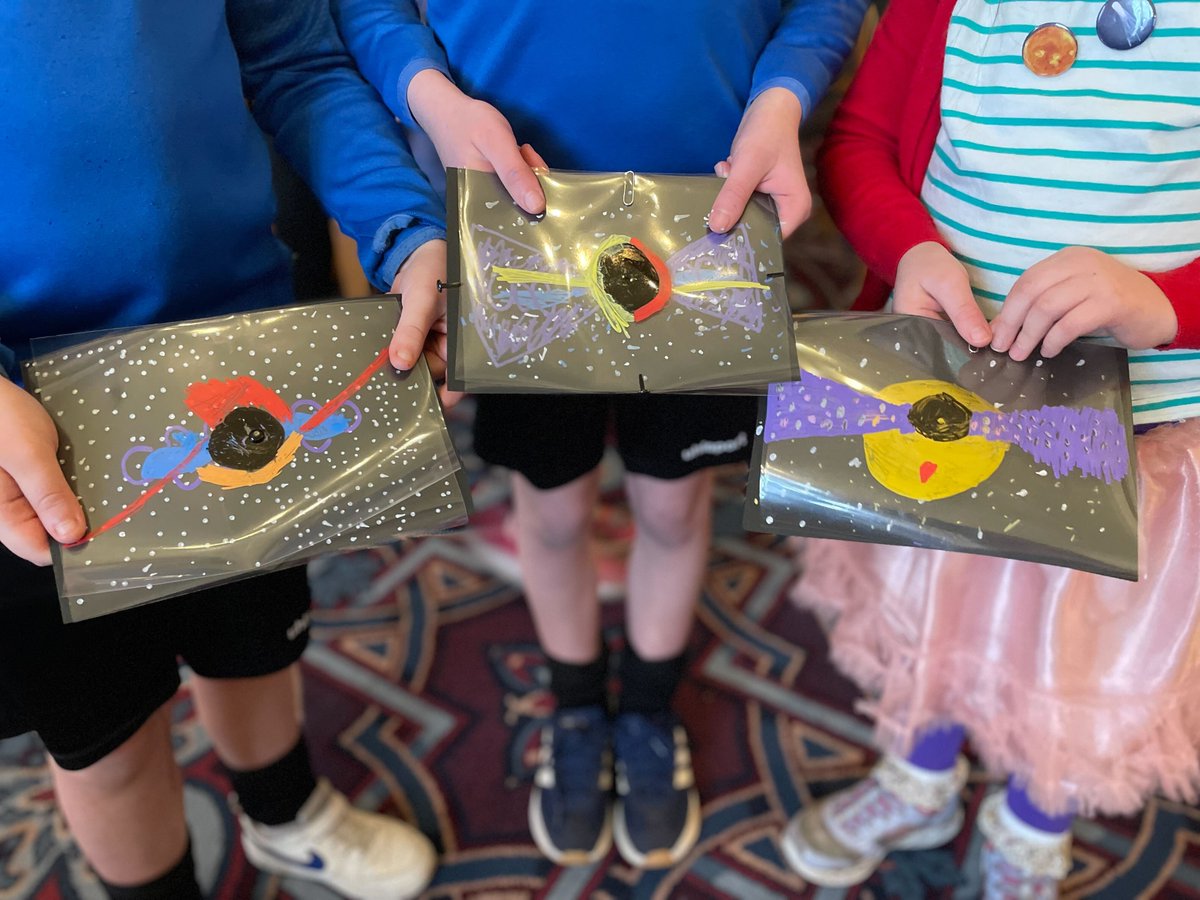
Some highlights from our #BuildtheUniverse workshops yesterday as part of #NISF2025! Participants explored the structure of the sun, what's inside a planet, and how we see black holes!
@AstroQUB is advertising a PhD project with me mining the first Solar System data from the Vera C. Rubin Observatory's Legacy Survey of Space and Time . Applications due: Feb 7 https://t.co/pbKyzkxd4k
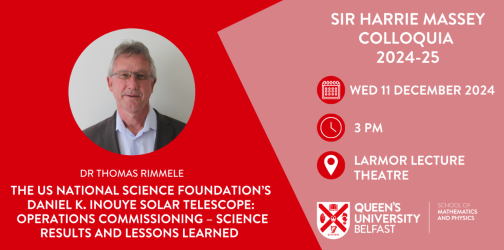
This week @QUBMathsPhys are delighted to host Dr Thomas Rimmele, Director of the Daniel K. Inouye Solar Telescope, as part of the Sir Harrie Massey Colloquia.
Presenting an overview of DKIST and its instruments, and examples of first science results.
Info:https://t.co/KKrYXZTwxz
A huge congratulations to Ken (@TheGenghisKen) and David (@thespacedoctor)!
Their expertise power the ATLAS, Pan-STARRS, and PESSTO surveys, with Ken’s databases storing billions of sky detections and David's software aiding rapid source classification and observation.
Congratulations to Ken Smith and David Young of @QUBelfast for being awarded the Technician Award as part of the IOP Awards for internationally recognised technical expertise, exceptional software skills and dedication to astrophysics, enabling world-leading discoveries and the formation of a European supernova community. 👏 #IOPAwards24
@Rachel02538259@QUBelfast@NASA@chandraxray While solar flares can affect us here on Earth by throwing material away from the sun (called a Coronal Mass Ejections), the event described above is in another Galaxy! Over a trillion times further away than our Sun is to us.
Hope this answers your question.
@Rachel02538259@QUBelfast@NASA@chandraxray In this study, we've seen an entire star, far far far away compared to the Sun in our solar system, be completely torn apart by a massive black hole.
That superhot gas is then thrown around by the black hole and is now seen to be colliding with a second star/smaller black hole
Astronomers have observed the death of a star torn apart by a supermassive black hole, which then used the stellar wreckage to disrupt a second star!
Congratulations to lead author @mattnicholl56 and all members of ARC who contributed to the study published in @Nature today.
Is it possible to deflect asteroids heading towards Earth?
Professor Alan Fitzsimmons of @QUBelfast talks about the @esa's latest launch
☄️🚀
#KayBurley SS
It's official, we have our very own, real life planetary defender!
Professor Alan Fitzsimmons from @AstroQUB is gearing up to take part in the #HeraMission, @esa's first ever #PlanetaryDefence mission, to help ward off the threat of an #asteroid crashing into Earth.
“Hera is a critical step towards the day when humanity might need to deflect a threatening asteroid and is a great example of how science can be used to try to prevent loss of life as a result of dramatic, natural disasters.
"Scientists and engineers from all over the world have been involved, it’s an example of best practice in international scientific collaboration for the greater good.”
Find out more: https://t.co/4lxVgI6ZUd
#LoveQUBResearch @ESA_Hera@NASA@QUB@QUBMathsPhys@QUBEEECS
The launch is scheduled for TODAY (weather permitting) at 3:52 pm UK time streamed on the ESA YouTube channel: https://t.co/cNKViA7ym8
Read more about HERA and Alan's work: https://t.co/FVMt3cLVOs
@QUBMathsPhys@QUBelfast@QUBstaff@esa
The next stage of our Planetary-Defence mission is here, as HERA takes off to gather critical, new data and insights about how to deflect asteroids that may be bound for Earth.
ARC member Prof. Alan Fitzsimmons is at the European Space Operations Centre in Germany for the launch
A week today I will be off to @CheltSciFest to compete in UK final of the @FameLab science communication competition.
I'm excited to share how we learn about the stars and how YOU can get involved in helping us do so!
Thanks to @niscifest & @MATRIX_NI for the regional final.
@MalachyQuinn@ArmaghPlanet@AstroSocIreland Hi Malachy, our planetary science team have had a look at the images of the object and unfortunately don't believe it to be a meteorite.
Apologies to your constituent, but we hope they keep searching and have an eye on the sky. An NI meteorite find one day would be awesome!
Our very own Dr @megschwamb and PhD student @seanobrien_99 sending out a call on UTV for planet hunters! (timestamp: 1:13 to 6:38)
https://t.co/88Q63llHQw
5 new planet candidates discovered thanks to the help of citizen scientists!
New paper from ARC PhD student @seanobrien_99 details the discovery of potential planets outside our solar system that professional astronomers didn't catch, but public volunteers working together did
Planet Hunters NGTS (@PH_NGTS) has found five new planet candidates! You can read the paper announcing these discoveries in the Astronomical Journal now and read on below for a summary thread of the paper. https://t.co/qRQunkEB7L [1/15]
Undergraduate Summer Internship Opportunities!
ARC is pleased to host several 8-week summer internships for Summer 2024 with research projects in Supernova and Exoplanet science, and a project creating public engagement resources.
More details available:
https://t.co/t2IIDmh2YN