I'm an observational astrophysicist, so often I call myself an astronomer. My friends often laugh because they have to tell me the latest cool astronomy news.
@lukejerram@StAlbansCath@NASA It is only being exhibited at the cathedral until 15 February so hurry, hurry, hurry!
Find out more at: https://t.co/Qskqi5GJSe
#NAW#Moon#Art
Any information would be gratefully received by @HertsPolice. Our @UniofHerts mobile planetarium is vital for our outreach activities and is recognisable at key regional events.
Just the beginning of this incredible journey into probing AGN properties in more detail thanks to the new BEAGLE-AGN tool 😀 - might not be written in python, but get in touch if you're interested in using via contact details here https://t.co/jidE3pIojh
Proud supervisor day! New to the arXiv https://t.co/nSYslxTi0J - remember those cool galaxies in the first JWST data releases that showed us [OIII]4363?! - One of them revealed a high ionisation potential line (work by @JarleBrinchmann) an early indication of all the BHs! (1/n)
Maddie probed into this further with our modelling assumptions. We can't saying anything definitively so I'm telling you my personal thoughts here - are we seeing higher Ne/O? (WR origin?) Is this possible given nucleosynthesis channels? (5/n)
We confirmed the tiny green blob below to be a galaxy so distant it is seen when the Universe was only 2% of its current age, and… its spectrum came out as a huge surprise! 📈🔭 Read more in the excellent summary by @Kevin_Hainline who first discovered this galaxy 👇
Still trying to make progress with science projects while on shared parental leave without also missing out on these last week's before little one starts nursery. The magic combination: naps (baby), coffee, chocolate and wonderful collaborators!
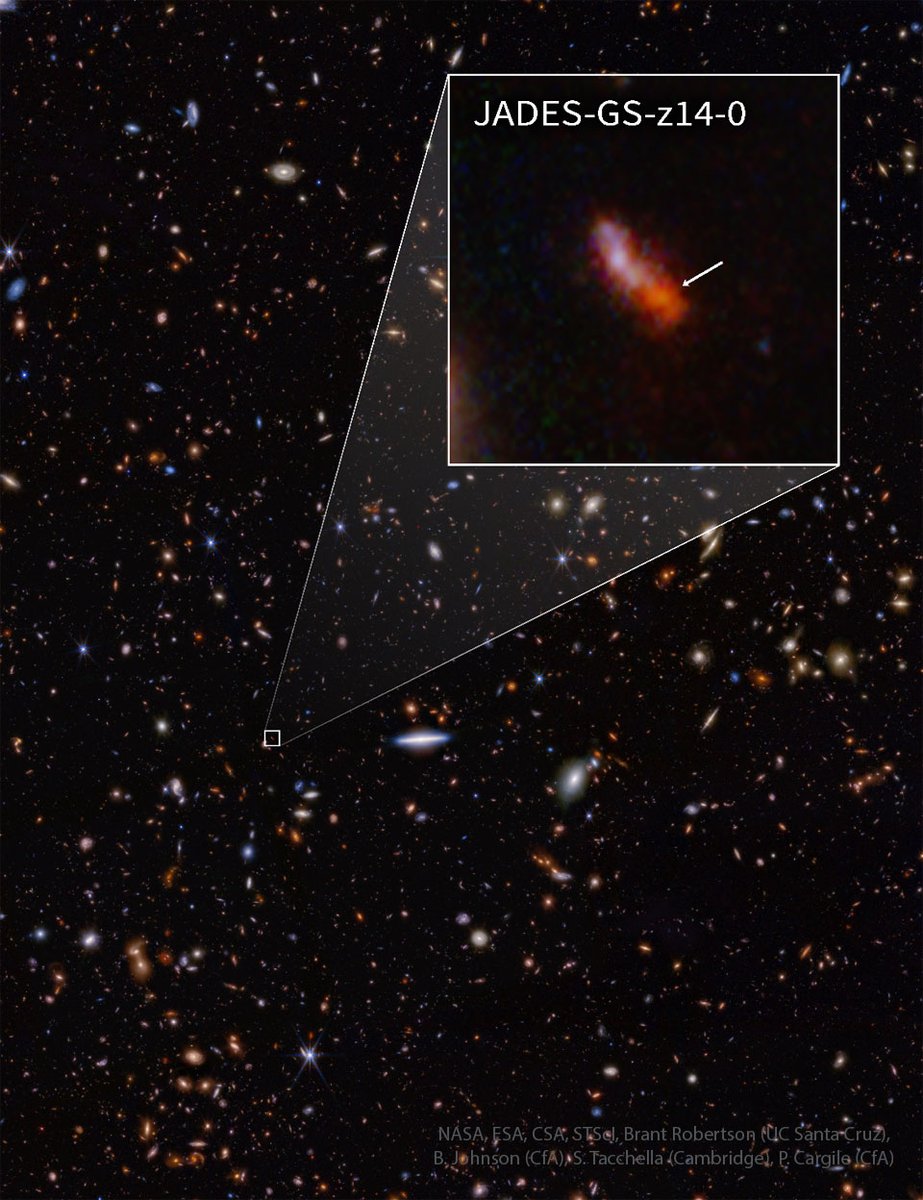
Watch as this video takes you to the farthest galaxy ever detected by #NASAWebb (so far), JADES-GS-z14-0. Read about how the scientists were able to find this galaxy, observed only 290 million years after the big bang: https://t.co/FPeBFqleGA
Such a privilege to give a plenary talk at #NAM2024 in a year when dual roles of mother+milk machine and scientist have made even UK based travel challenging. Sorry to not stay the whole week, but thanks to my family for following me here today so I could show up!
JADES-GS-z9-0: a very distant galaxy at redshift of z = 9.4327, forming stars at high rate, with higher than expected abundance of nitrogen relative to oxygen.
https://t.co/EhYIsCyDQ4
What if we could see back to the beginning of the universe? We could see galaxies forming. But what did galaxies look like back then? These questions took a step forward recently with the release of the analysis of a James Webb Space Telescope (JWST) image that included the most distant object yet discovered. Most galaxies formed at about 3 billion years after the Big Bang, but some formed earlier. Pictured in the inset box is JADES-GS-z14-0, a faint smudge of a galaxy that formed only 300 million years after the universe started. In technical terms, this galaxy lies at the record redshift of z=14.32, and so existed when the universe was only one fiftieth of the its present age. Practically all of the objects in the featured photograph are galaxies.
Image Credit: NASA, ESA, CSA, STScI, B. Robertson (UC Santa Cruz), B. Johnson (CfA), S. Tacchella (Cambridge), P. Cargile (CfA)
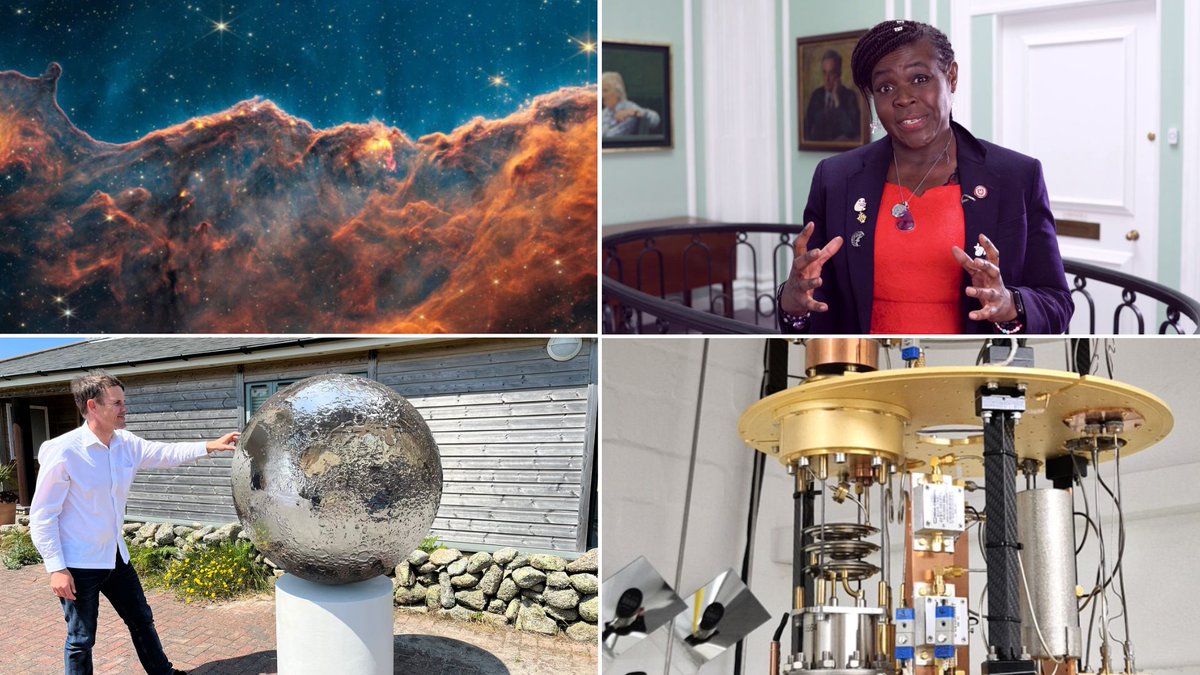
Do you love your astronomy? There's plenty for you to enjoy at this year's @royalsociety Summer Science Exhibition.
Wonder at @NASAWebb and feel the Moon's mountains and craters on a piece of artwork by @lukejerram at the 6-day event, which runs from 2 to 7 July.