📢 Poll time: What do you think happened to asteroid Dimorphos after @NASA deliberately crashed a spacecraft into it?
We're just one week away from finding out thanks to @esa's Hera spacecraft, but what do YOU think happened? Let us know & come back next week to find out!
NASA’s spacecraft impact left stadium-sized crater in asteroid, @ESA_Hera reveals. It is also tumbling wildly, with hundreds of previously unknown boulders orbiting around it.
News just in – read more in our free article: https://t.co/jimOwgbRnv
Credit: ESA
The Universe has more ways to kill us than most of us realise.
An asteroid or comet. A solar superstorm. A nearby supernova. A gamma-ray burst. Eventually, our own ageing Sun.
Brace yourself with the December issue of Astronomy Now https://t.co/2Fx2dbvtRu
Our popular Christmas subscription bundle offer is back with everything you need for an astronomy-filled year:
🌟Stargazer's Guide 2027
🌟Planisphere to show you the configuration of the night sky
🌟12 issues of Astronomy Now, delivered monthly
👉 https://t.co/Xlc1wQeONL
We've heard back from Bepi - the spacecraft is now in contact with the ground and the teams at ESOC are busy assessing the telemetry. Flight Dynamics already has confirmed it achieved orbital capture around Mercury!
Early next week we'll share the next update with the upcoming steps.
This weekend, BepiColombo mission is set to enter orbit around Mercury after an eight-year journey.
The two orbiters separate 9–10 Dec.
Science begins April 2027.
Get ready for the mysteries that this mission will solve: https://t.co/bxmupqjOkQ
@esa@JAXA_en
Astronomy, NOW! 👀 Observe Uranus at opposition!
Shining at mag +5.6 in Taurus, it may be visible to the naked eye under dark skies. Binoculars or telescope make it easier to find.
The Moon brightens the sky around 25 Nov, so observe before, or as the next New Moon approaches
Your Christmas issue of Astronomy Now is here!
📆 Free 2027 calendar
🎁 Astrogear gift guide
🌌 Christmas night observing plan
🔭 New telescope tips
🚀 JWST highlights since its Christmas Day 2021 launch
☃️ Seasonal Solar System weather report
🔗 https://t.co/GGvGGS1FOD
Voyager 1 is the first human-made object to reach one light-day from Earth.
A light day is the distance light covers in 24 hours (25.9 billion km).
It has travelled for 49 years at ~61,000 km/h relative to the Sun. A car at 80 km/h would take 37,000 years to reach that point!
Just back in from photographing Mars and Jupiter at their closest, and the most amazing thing happened while I was using my phone to take pics: an *owl* landed on my camera tripod!!!!! What are the chances of that? What a magical moment. Just wonderful.
Astronomy, NOW! 👀 Observers at mid-northern latitudes currently have the best chance of the year to observe #Mercury in the pre-dawn sky.
It lies about 11 degrees high (from London, UK) at 06:45 GMT on 19 November, close to #Venus and Spica.
Astronomy, NOW! 👀 The Leonids #meteors are here!
Peak activity is set for around midnight 17-18 November; under dark skies you may expect 10-15 meteors an hour.
A first-quarter Moon sets soon after 23:00, with the radiant in Leo 50 degrees high in the south-east at 04:00.
The close pairing of Mars and Jupiter this month is the ideal warm‑up for what’s coming next: a double opposition in February 2027!
Get to know these planets better and discover what they have taught us about how planets form, evolve and change.
https://t.co/dgDYWSYW5f
Astronomy, NOW! 👀
This month’s naked‑eye pairing of Mars and Jupiter is one of the year’s observing highlights. Both are already well placed as morning objects. At closest approach in the early morning of 15 Nov, Mars sits just ~1.2° north of Jupiter, among the stars of Leo 👇
Look at it sparkle as it rolls off the printer 🤩 Next stop...your letterbox?
Our James Webb Space Telescope special edition, The Universe Revealed, is now on sale in major UK magazine retailers/supermarkets, or order online for worldwide delivery https://t.co/uzovfdMIW5
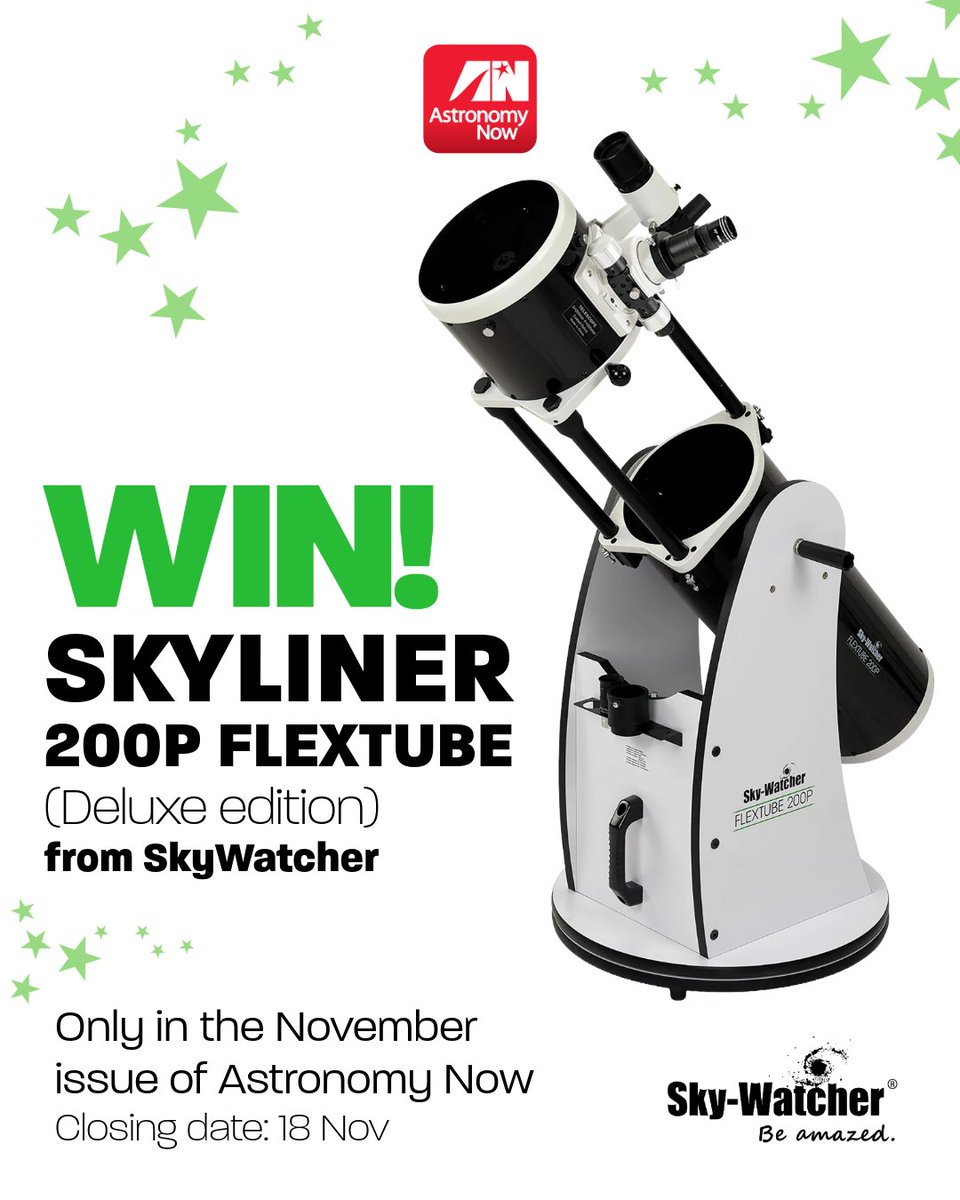
One week left to enter our latest telescope competition!
For your chance to win, visit: https://t.co/Ac6ucnePhY and answer a simple question about the telescope.
The closing date is Wednesday 18 November 2026 and the competition is limited to UK residents only.
Good luck!
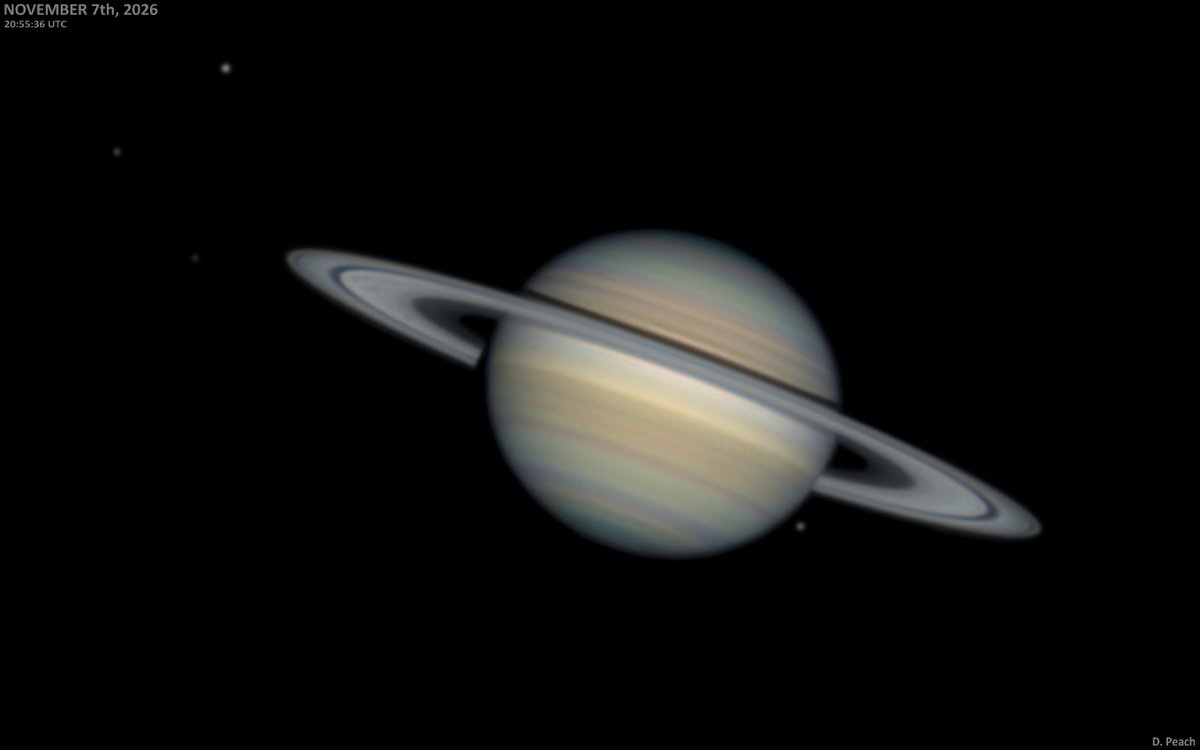
Saturn with moons on Nov 7th
Some spells of very good seeing for a time before the fog and low cloud arrived. The shadow of the rings across the globe is now very prominent (and also a helpful focusing aid!) Some faint spokes are visible at the left ansa.)