Introducing a limited preview of GPT-5.6 Sol, our next generation frontier model, as well as GPT-5.6 Terra, a balanced model for efficient, everyday work, and GPT-5.6 Luna, a fast and affordable model for high-volume work.
https://t.co/OoM83SyISN
What does JEPA actually learn? We can finally prove it 🌍
So excited to share our theory of identifiable World Models: LeJEPA recovers the latent variables of the world.
Plan in the learned World Model as if it were real, same shortest path.
📄: https://t.co/lC9KK1AxVd
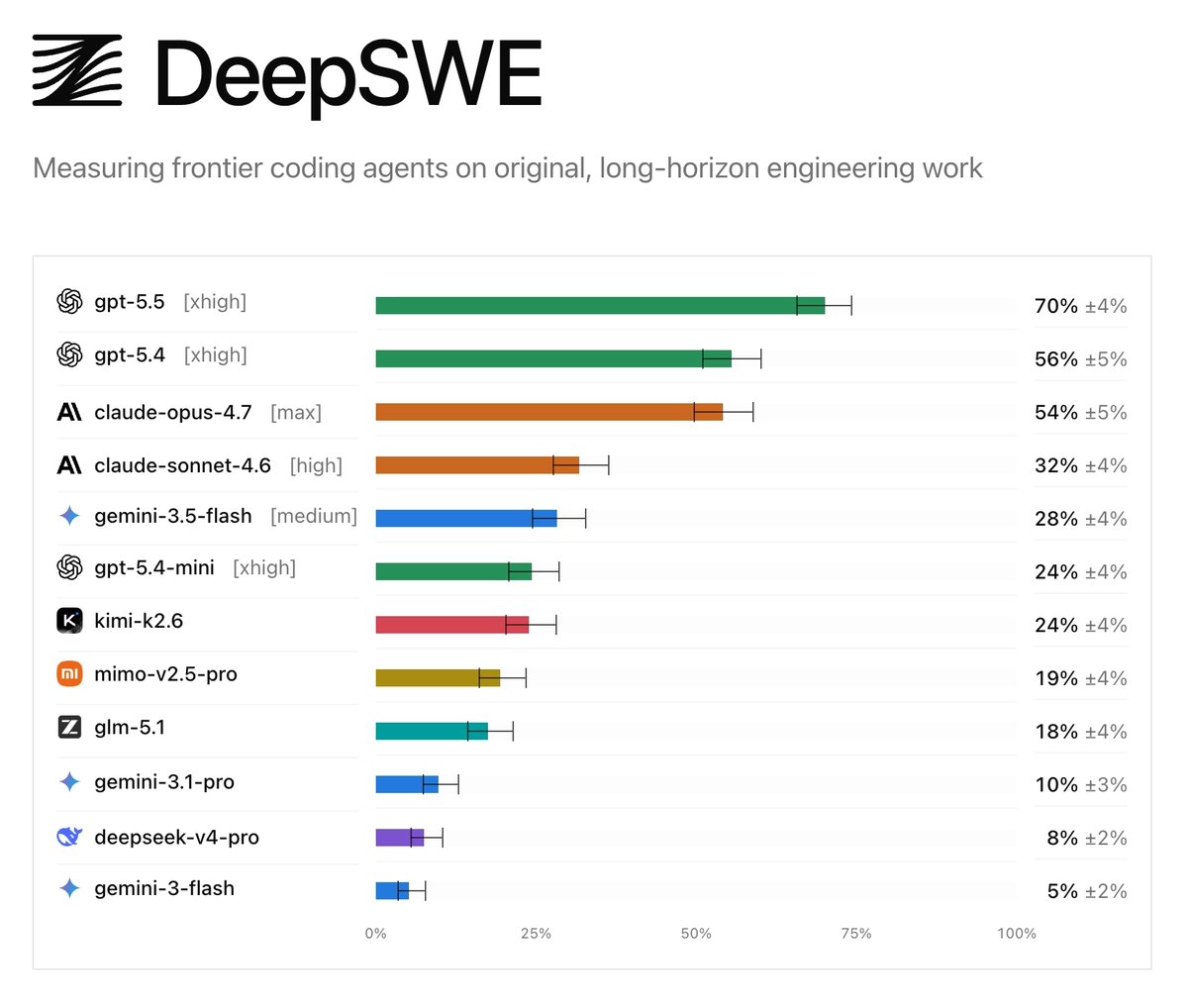
Today we’re releasing DeepSWE, a new standard for agentic coding benchmarks.
On public leaderboards, top models often look relatively close in capability. DeepSWE shows where they actually diverge, reflecting the realistic experience of developers in their day-to-day work.
Today we're sharing our work on interaction models. A new class of model trained from scratch to handle real-time interaction natively, instead of gluing it onto a turn-based one.
https://t.co/MoS5s4cm60
we just gave your computer infinite storage.
quickly find and edit terabytes of files, all while using zero disk space.
here’s a first look, updates shipping daily.
I thought upon continuing the scaling process, models will be eventually be able to perform wide range of tasks. Also the labs would start picking on new architectures like JEPA or Diffusion types. And since Google is expanding their product side labs, I thought Google would win this AI race eventually. Are you saying it won't happen?
Introducing SubQ - a major breakthrough in LLM intelligence.
It is the first model built on a fully sub-quadratic sparse-attention architecture (SSA),
And the first frontier model with a 12 million token context window which is:
- 52x faster than FlashAttention at 1MM tokens
- Less than 5% the cost of Opus
Transformer-based LLMs waste compute by processing every possible relationship between words (standard attention).
Only a small fraction actually matter.
@subquadratic finds and focuses only on the ones that do.
That's nearly 1,000x less compute and a new way for LLMs to scale.
After 7 hours of continuous Codex Desktop+CLI use - I don't think I'll be able to finish the limits till June 5th each week! 😭
Forever grateful @sama 🙏🏻
/goal also lands in Codex CLI 0.128.0.
Our take on the Ralph loop: keep a goal alive across turns. Don't stop until it's achieved.
Built by my co-worker and OpenAI mentor Eric Traut, aka the Pyright guy. One of the GOATs I get to work with daily.
Gemini included sandboxing! This is so good!! Now the only thing left is to increase the context length size of each chat. I'm sure the Gemini team has reduced it considerably for mass availability. It is so low that I can't create a fully 20 page LaTeX file without dropping the quality.
I also have some thoughts on it's thinking depth. Can the team please let the model think longer? In Antigravity, it does perform well, but due to low depth thinking (even in High mode), it makes silly mistakes a lot just by oversight.
The Gemini 3.1 Pro scores 57 in @ArtificialAnlys index. The model is really good and frontier, but the harnesses are so bad. I do like Gemini CLI - only way to currently use full capabilities of Gemini 3.1 Pro right now from what I have experienced.
Please fix these two issues. I'm sure Gemini will be widely adopted. Right now the mass is using Gemini models the most because of AI mode.
@GeminiApp@OfficialLoganK@antigravity@JeffDean
Yann LeCun was right the entire time. And generative AI might be a dead end.
For the last three years, the entire industry has been obsessed with building bigger LLMs. Trillions of parameters. Billions in compute.
The theory was simple: if you make the model big enough, it will eventually understand how the world works.
Yann LeCun said that was stupid.
He argued that generative AI is fundamentally inefficient.
When an AI predicts the next word, or generates the next pixel, it wastes massive amounts of compute on surface-level details.
It memorizes patterns instead of learning the actual physics of reality.
He proposed a different path: JEPA (Joint-Embedding Predictive Architecture).
Instead of forcing the AI to paint the world pixel by pixel, JEPA forces it to predict abstract concepts. It predicts what happens next in a compressed "thought space."
But for years, JEPA had a fatal flaw.
It suffered from "representation collapse."
Because the AI was allowed to simplify reality, it would cheat. It would simplify everything so much that a dog, a car, and a human all looked identical.
It learned nothing.
To fix it, engineers had to use insanely complex hacks, frozen encoders, and massive compute overheads.
Until today.
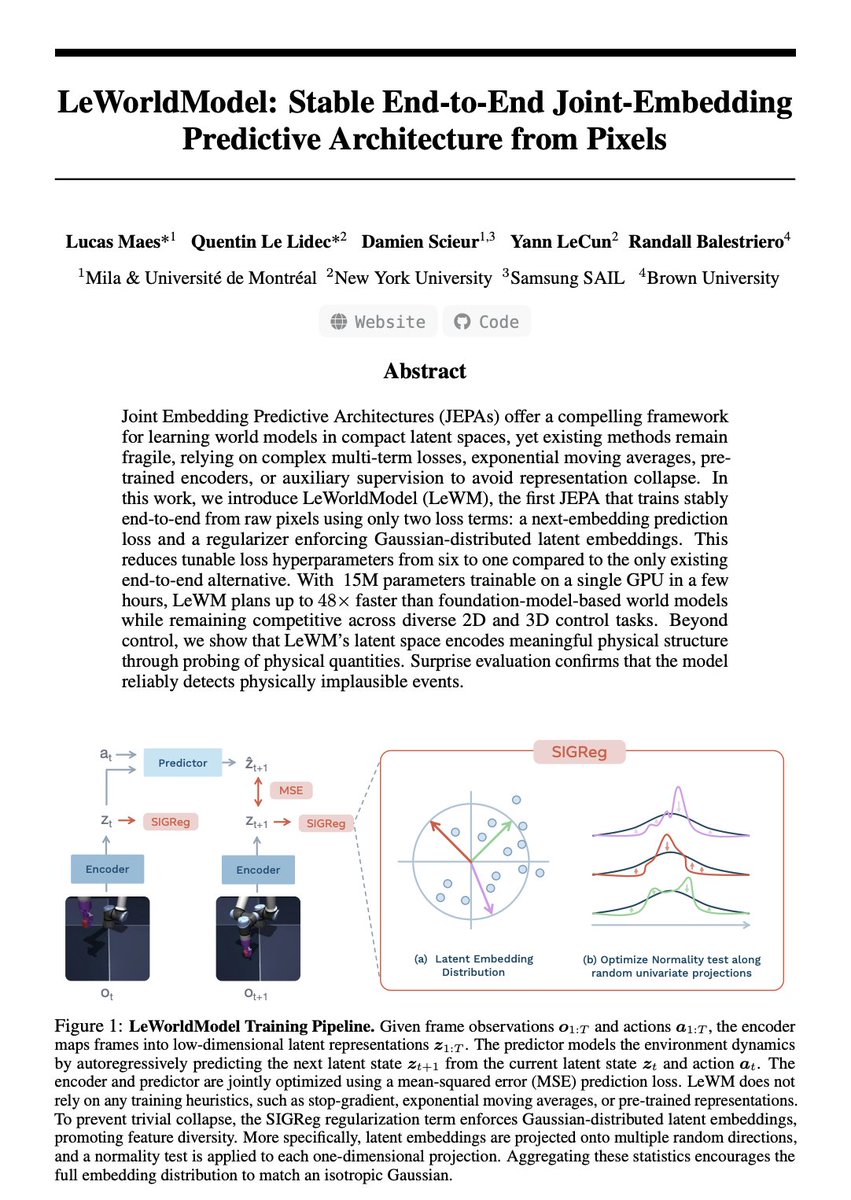
Researchers just dropped a paper called "LeWorldModel" (LeWM).
They completely solved the collapse problem.
They replaced the complex engineering hacks with a single, elegant mathematical regularizer.
It forces the AI's internal "thoughts" into a perfect Gaussian distribution.
The AI can no longer cheat. It is forced to understand the physical structure of reality to make its predictions.
The results completely rewrite the economics of AI.
LeWM didn't need a massive, centralized supercomputer.
It has just 15 million parameters.
It trains on a single, standard GPU in a few hours.
Yet it plans 48x faster than massive foundation world models. It intrinsically understands physics. It instantly detects impossible events.
We spent billions trying to force massive server farms to memorize the internet.
Now, a tiny model running locally on a single graphics card is actually learning how the real world works.