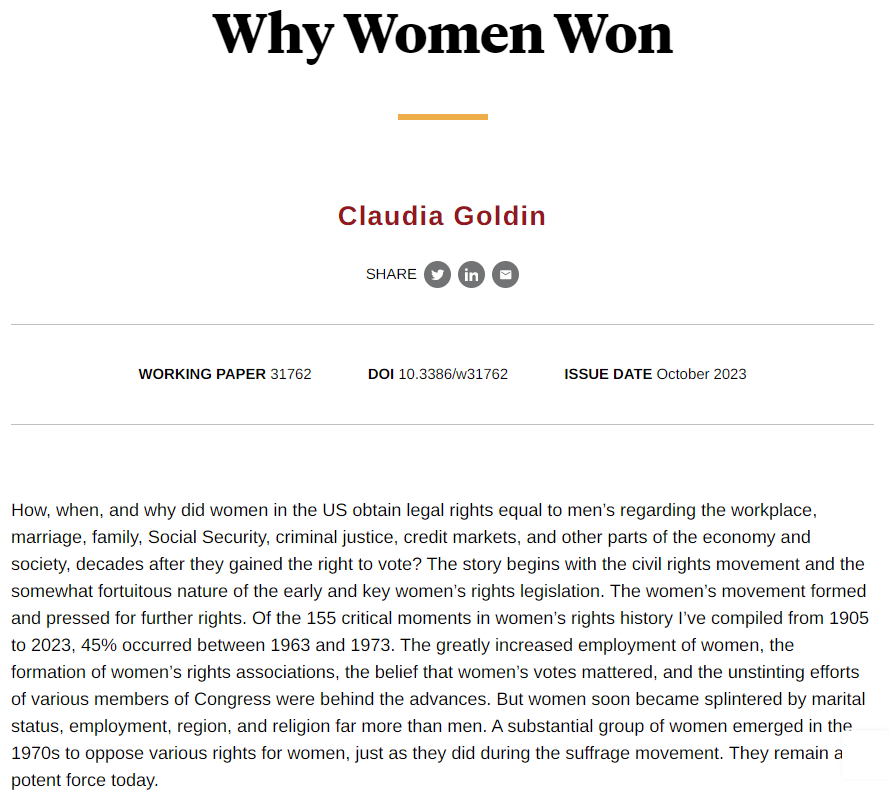
Fun fact: in what is kind of the most excellent coincidence I have ever seen, today's economics laureate @PikaGoldin has a new @nberpubs working paper out this morning called "Why Women Won."
(This really presumably is a coincidence because not only is it not possible to predict receiving a @NobelPrize, but also the working paper release schedule is somewhat stochastic.)
CONGRATULATIONS @PikaGoldin, QED!!!!! 🥳🥳🥳🥳🥳🥳🥳🥳🥳🥳🥳🥳
Nature rejected her paper for not being original,
University of Pennsylvania (her employer) demoted her,
and yesterday Katalin Karikó won the Noble Prize in physiology.
In mid-2000s, Karikó and her Drew Weismann submitted their paper on mRNA (messenger Ribonucleic Acid) to Nature.
Nature desk rejected their paper for being "an incremental contribution" only. The paper was later published in another journal, Immunity.
Earlier in her career at the University of Pennsylvania, Karikó was demoted because her applications for grants kept getting rejected.
But Karikó persevered and kept on going.
In 2013, she joined BioNTech, a German company founded by two scientists, Uğur Şahin and Özlem Türeci. In 2018, BioNTech partnered with Pfizer to develop mRNA vaccines against the influenza virus.
When the COVID-19 hit the world, Karikó's research helped Pfizer to produce the first vaccine against the disease.
I don't know how the Nature editors who desk rejected Karikó's paper and the Penn administration who demoted her feel about Karikó Nobel Prize.
Takeaway: Many academics and scientists worry about getting published in "prestigious" journals. Instead of worrying about prestige, we should try to put our work out as quickly as possible like Karikó did.
Once you put your work out without caring about prestige, two good things happen:
1. Your work will lead to newer opportunities.
2. You will start getting feedback from the scholarly community, which you can use to iterate and improve.
Here's another interesting Nobel Prize story.
Peter Higgs, a British physicist, joined the University of Edinburgh in 1956. By 1964, Higgs has published his groundbreaking work about subatomic particles.
After 1964, Higgs published less than 10 papers.
When his department would ask him how many papers, he published in a given year, he would reply "None."
It happened so often that he stared feeling like an "embarrassment to the department."
The University of Edinburgh, however, never fired Higgs because in 1980 he had been nominated for the Nobel Prize.
Higgs retired in 1996 and stayed on as an emeritus professor at Edinburg.
In 2012, experiments conducted at the CERN laboratory confirmed Higgs work and the existence of Higgs Particle.
And in 2013, Higgs was awarded the Noble Prize in physics and the University of Edinburgh got rewarded for being patient.
@modularform@martinmbauer No it was the 2d lattice solution with mean field approximation if I recall correctly. The exact solution to the 1d model was discussed.
@Memeghnad Phatak teliyan where he was born and brought up and played with muslim friends isn't even in Chandi chowk. It's in Turkman Gate. Man has forgotten his secular beginnings. like many others in this country of his generation.
"A middle-aged woman of Asian descent, her dark hair streaked with silver, appears fractured and splintered, intricately embedded within a sea of broken porcelain. The porcelain glistens...(full prompt in ALT)
DALL•E 3 (top)
Midjourney (bottom)
@bekemax @adad8m I think you are right. But that would be more or less contained in a disk. This as someone else has pointed has long tail distribution in the spectrum. I think it's not binary matrices. Or matrices with ±1
Infinitely many mathematicians walk into a bar.
The first says, "I'll have a beer."
The second says, "I'll have half a beer."
The third says, "I'll have a quarter of a beer."
The bartender pulls out just two beers and says, "Come on. Know your limits."
@FlipTanedo This notation looks interesting to me. I've studied tensor in the usual indices form for studying metrics in GR and Field theory. But I've never seen that pictorial representation before. Any references for this?
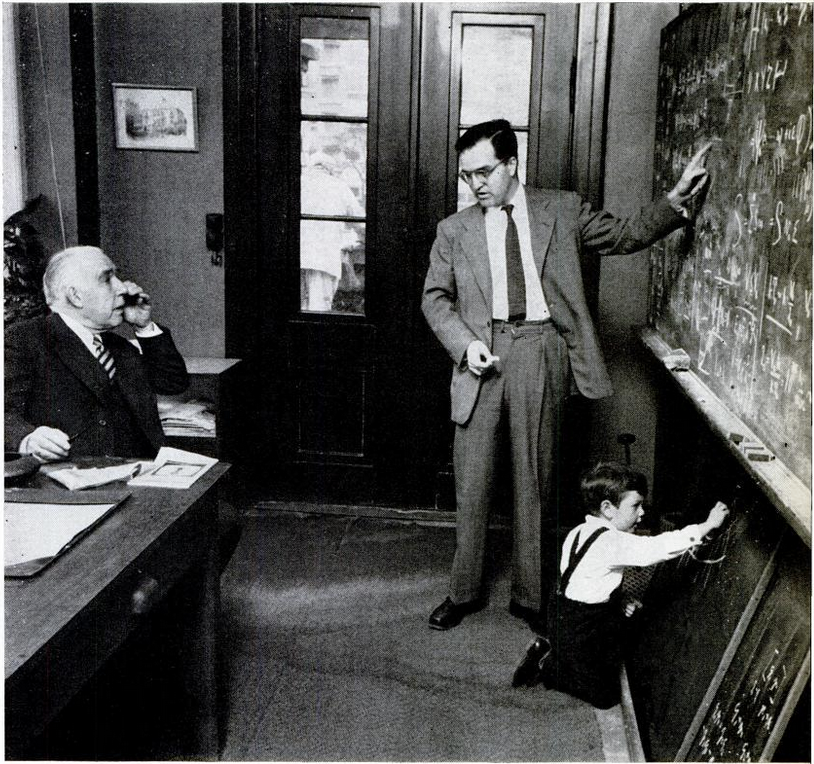
Three generations of brilliant Bohrs, photographed around 1960:
Niels Bohr, 1922 Nobel Laureate
Aage Bohr, would become a 1975 Nobel Laureate
Tomas Bohr, accomplished biophysicist
Also, Tomas Bohr today
The nomination process and majority of male from certain institutes that are allowed to nominate is the reason. Also reason for the same institutes winning awards so many times. Patriarchal men refuse to accept that women can do better science than them. #academia#WomenInSTEM
For those of us wondering how CSIR managed the near-impossible feat of recognising 0/23 women scientists for the Bhatnagar Prize, @aashimafreidog and my book #LabHopping offers some useful hints.
For those of us wondering how CSIR managed the near-impossible feat of recognising 0/23 women scientists for the Bhatnagar Prize, @aashimafreidog and my book #LabHopping offers some useful hints.
You sometimes read : 'Physicists may be completely wrong about ... ' Even physicists say it sometimes
This rarely means the current theory is off by a lot. It's debatable that it's 'wrong' at all
It means that a new theory with a 0.0001% effect would change our worldview
1/3