Normally I like Marriot hotels. But now they’ve started charging $50 for self parking lots PER NIGHT plus $25/night for an “excursion fee”, that is a meaningless add on charge that offers no value. Disgusting @MarriottBonvoy
@itsnoahd@Railway I appreciate your efforts and applaud your plans to become less vulnerable to a single provider fail. That which does not kill you...
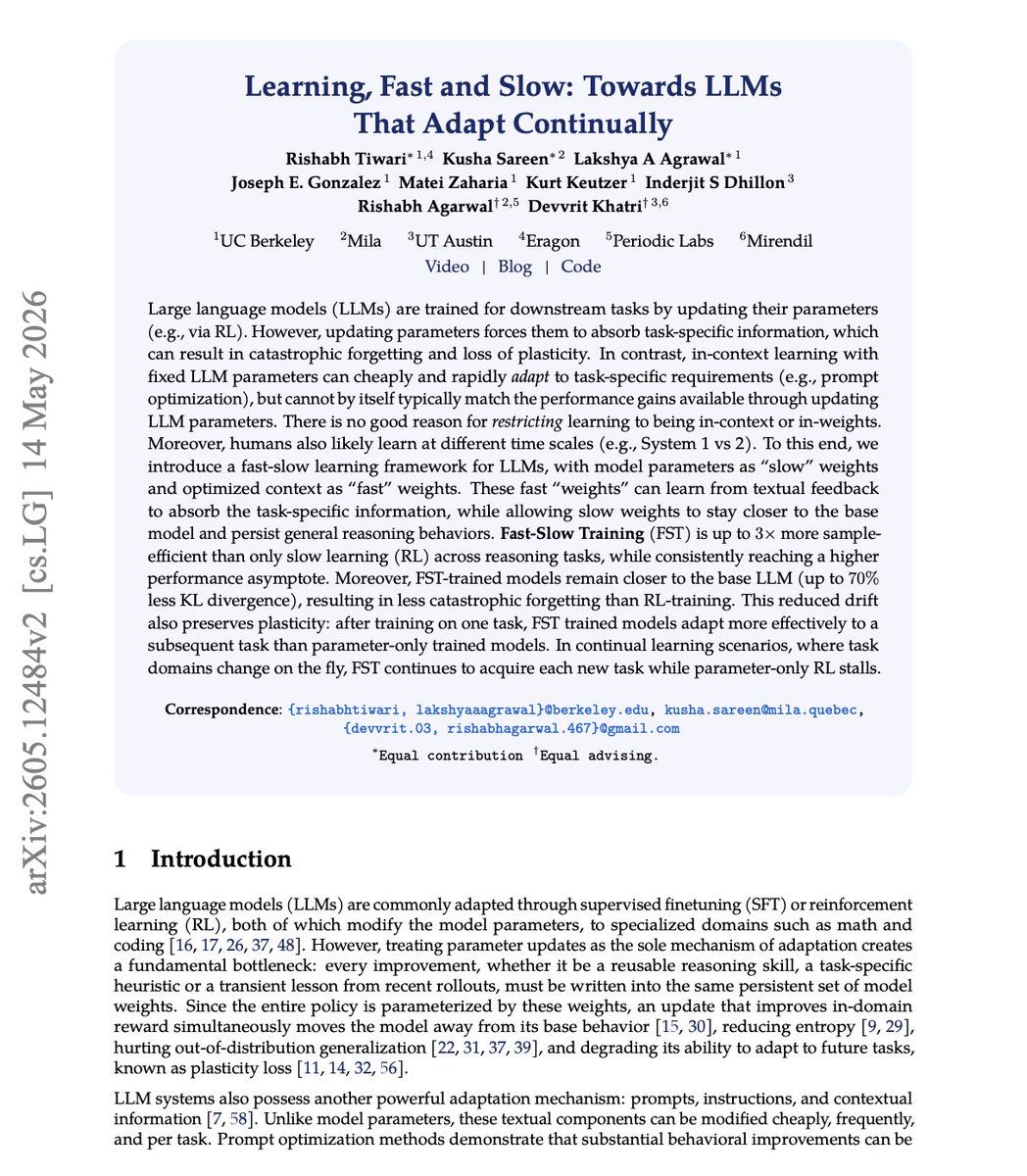
Stanford and Berkeley researchers just fixed the biggest bottleneck in AI training.
And they did it by recreating the human brain's most famous psychological framework.
Right now, when you want an AI to learn a new specialized skill, like advanced coding or deep math, companies use Reinforcement Learning (RL) to force new data directly into the model's weights.
It works, but it has a devastating side effect: Catastrophic Forgetting.
To learn the new task, the AI has to overwrite its old knowledge. It gets smarter at one specific thing, but breaks everywhere else. It loses its "plasticity."
Worse, OpenAI is currently winding down self-serve fine-tuning because forcing every single transient, task-specific lesson directly into permanent parameters is breaking the models.
A brand new paper just solved this.
They call it Fast-Slow Training (FST).
It is directly inspired by Daniel Kahneman's Thinking, Fast and Slow (System 1 vs. System 2).
Instead of forcing everything into the model's parameters, the framework creates a brilliant division of labor between two distinct time scales:
1. The Slow Brain (The Parameters): The core model weights change slowly via traditional RL, focusing entirely on deep, general reasoning improvements.
2. The Fast Brain (The Context): The model dynamically evolves and optimizes its own prompts in real time using textual feedback. This context absorbs all the dirty, task-specific heuristics.
The AI essentially offloads its short-term memory and specific task adjustments into optimized text prompts, leaving its core brain untouched and flexible.
The results completely rewrite the economics of post-training:
- 3x More Sample-Efficient: FST matches or beats standard RL while requiring up to three times fewer training steps.
- 70% Less Forgetting: Because the core weights aren't being violently warped, the model stays remarkably close to its original base capabilities.
- Infinite Plasticity: In continual learning tests where task domains change on the fly, traditional RL completely stalled and collapsed. FST just kept adapting.
We have spent years treating AI training as an all-or-nothing game, either cram it into the weights, or build a giant prompt.
But the future of intelligence isn't about choosing one.
It's about letting the AI use optimized context to think fast, while its weights learn slow.
What if you could just run your agents entirely sandboxed in your browser?
Well, thanks to Dmitry (Sr Engineer@Google), now you can.
Super interesting experiment.
@JustJake@lifeof_jer@JustJake I think your product is excellent, as is your support. Good job with the response to this scenario: my engineers took note. One strong suggestion: managed Postgres volume backups should be downloadable from the dashboard. Cheers!
@GaryMarcus Railway engineers are very smart and capable in my experience. Giving me a delete api endpoint isn’t irresponsible. It’s my job to protect myself from it, just like you need to learn how to handle a knife before cooking with it.
Introducing TurboQuant: Our new compression algorithm that reduces LLM key-value cache memory by at least 6x and delivers up to 8x speedup, all with zero accuracy loss, redefining AI efficiency. Read the blog to learn how it achieves these results: https://t.co/CDSQ8HpZoc