@BessieHoweq36 Totally agree on both points here. Solar needs BESS tech to keep improving, which we are steadily seeing. Otherwise it lacks reliability.
Fire got us here, cooking, smelting, powering civilization for 400k years. But we're still burning ancient sunlight through an inefficient process that fights thermodynamics. Today's sunlight is free, unlimited, and arriving every single day. https://t.co/54oZ6uOL5b
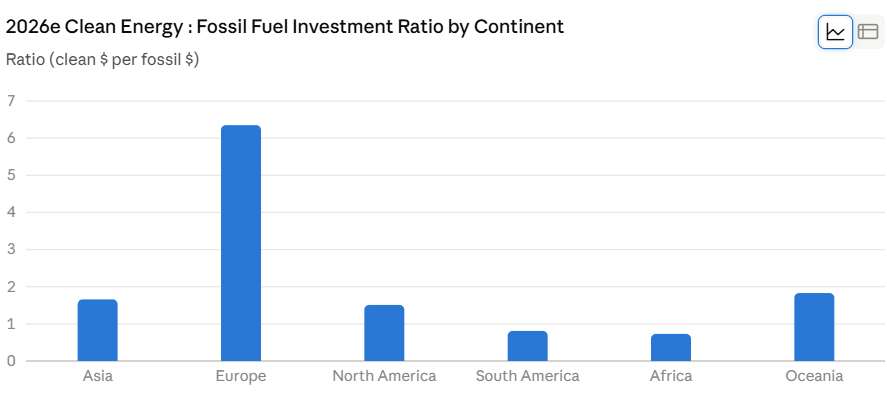
asia and north america are the two biggest energy markets on earth and both are investing more in clean than fossil. 1.6:1 and 1.5:1. that's just where the strongest returns are, prioritizing more efficient technology.
Global energy spending is on track to reach $3.4 trillion in 2026
Around $2.2 trillion of this is set to go to grids, storage, low-emissions fuels, nuclear, renewables, efficiency & electrification
And about $1.2 trillion goes to oil, natural gas & coal: https://t.co/8IajZj1gIL
@IEA asia and north america are the two biggest energy markets on earth and both are still investing more in clean than fossil. 1.6:1 and 1.5:1. that's just where the strongest returns are, prioritizing more efficient technology.
a modern gas engine turns like a third of its fuel into motion, the rest is just heat you paid for and threw away. an ev motor keeps 80-85% of its input as motion and that's not even counting brake regen.
so whoever electrifies first is just spending less money per mile than everyone still burning heat to move
For the first time since 2016, the US can now build a full solar panel domestically. Polysilicon, ingots, wafers, cells, modules.
Module prices are still sitting near $0.10 to $0.15 per watt because global manufacturing capacity is over 1,100 GW against roughly 650 GW of demand.
https://t.co/yVIzgQLJkm
MISO just became the largest power grid in America.
7.45 GW of solar in two years did that. More than double what PJM added in the same window. Interconnection is the real bottleneck in American solar, not batteries.
https://t.co/sy9ewXv1Nj
Trump signed a proclamation on Section 232 creating an MIP (Minimum Import Price) that puts a hard price floor under the entire U.S. polysilicon supply chain from raw material to finished module + a 15% tariff stacked on top, effective this December. The goal here is to protect our supply chain by bringing solar manufacturing home.
Watch $FLSR and $GLW. $GLW owns roughly 80% of Hemlock Semiconductor, the domestic polysilicon producer this floor protects. $FSLR, the biggest U.S.-based module maker, just had it's moat grow higher on the news. It's panels are cadmium telluride thin-film, not silicon, so a policy built around polysilicon hardly touches its own supply chain but disrupts the economics of its competitors.
@HelixCapitalX Agree on both names, would add $GLW to this list too. Corning owns 80.5% of Hemlock, one of only two U.S. polysilicon producers, so it's a direct beneficiary of the price floor, not just a downstream supplier to $TE.
@JasonLarsonHQ Up and to the right. That's the only shape you'll see on solar graphs for the next few decades alongside continually improving battery tech
@DerekCressman Up and to the right! That's the only shape you'll see on solar graphs for the next few decades alongside continually improving battery tech
NEW | California just reached a world-first solar milestone
Over HALF (51%) of electricity generation across the whole month of May came from solar power.
Battery storage is the big difference maker, enabling California to push the share of solar generation to this level.