I'm sorry to say I had never heard of him before now. Sounds like such a great loss. And a reminder just how fragile life is, how easy it can be taken.
On Sunday, my friend Gordon Wood was struck and killed in a car accident. Gordon taught history at Brown Univ. and was among the most accomplished historians America has produced. He won the 1993 Pulitzer Prize for The Radicalism of the American Revolution, and his earlier book The Creation of the American Republic, 1776–1787 took the 1970 Bancroft Prize. He also received the National Humanities Medal.
He was, in my view, the finest historian of America's founding—which makes it all the sadder that he did not live to see the nation's 250th birthday. His reputation reached popular culture, too. Matt Damon's character in Good Will Hunting invokes him by name in the famous bar scene, accusing a Harvard student of simply "regurgitating Gordon Wood, talking about [...] the pre-Revolutionary utopia and the capital-forming effects of military mobilization."
I feel fortunate to have collaborated with Gordon on several projects. In a 2019 anthology I compiled, he wrote an essay on the possibility of a shared American narrative. He centered his argument on equal rights as "the most radical and most powerful ideological force" the Revolution unleashed. "This powerful sense of equality is still alive and well in America," he wrote, "and despite all of its disturbing and unsettling consequences, it is what makes us one people."
When I needed jacket blurbs for my new book Lincoln's Compass, coming out this November, I turned to Gordon. The fit was natural: the book argues that Abraham Lincoln took the Declaration's claim that "all men are created equal" as his guiding moral compass—and that he refocused the nation on that claim. Gordon, ever the gentleman, offered generous praise.
He was, in many respects, the dean of American historians. He will be very hard to replace.
@someguydg@CathyYoung63 But all of this points to the larger issue if the nuances of language and the difficulty of communication. And I would argue that *no terms are ever completely unambiguous*.
@someguydg@CathyYoung63 However in this particular case, when the wheels were (very) briefly turned towards the officer, her car wasn't moving as I recall and so in that moment she wasn't driving towards him.
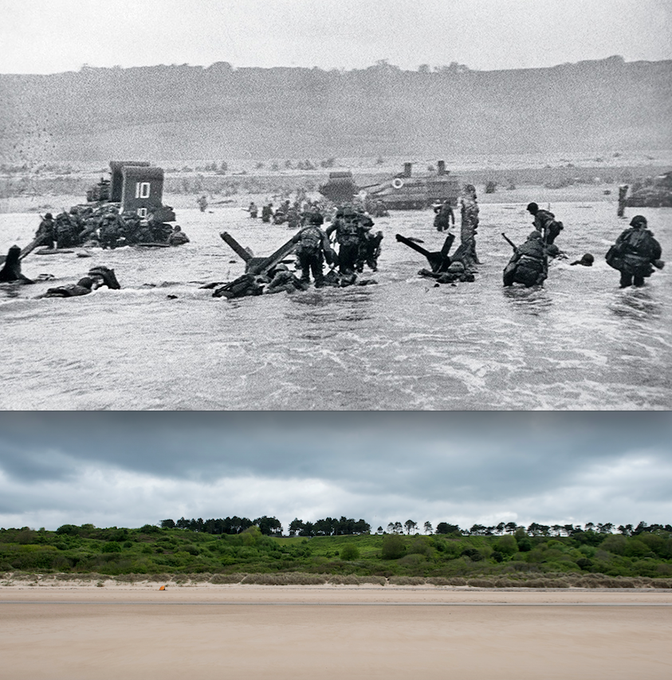
Robert Capa's amazing shot was taken around this time. Note the soldiers pinned down on the beach. 900 Americans were killed on Omaha. Capa survived and his images are the iconic photos of Omaha. See more on https://t.co/EEg00P0EnE
Did you know that the first women to land on the Normandy beachhead in June 1944 were nurses of Queen Alexandra’s Imperial Nursing Service?
Their task was to establish a field hospital for 600 wounded soldiers.
They succeeded.
Please remember these heroines who saved lives:
Bomber pilots set their watches. They have already suffered enormous losses in the run-up to D-Day. Now they are being told to finish the job, give the boys in the boats a chance.
The calm before the storm. Pointe du Hoc. The most dangerous mission on D-Day, according to Omar Bradley. 225 men will fight here late tonight, US time. 77 will be killed, and more than 140 will be wounded.
@jbarro You could fix the issues with modifications to the layout of timezones but it might not be appealing due to how it require boundaries that don't neatly match state lines.
It seems that the US is just a lot less patriotic than it was 50yr ago. And polarization makes 1/2 of nation reluctant to join celebration organized by the other side.
Analysis of books on the NYT bestseller list show that sentences today are about 30% shorter than they were 100 years ago. This suggests a preference for shorter, more direct comms.
This isn't just relevant to fiction. When it comes to commercial comms there's evidence that brevity is preferable (not just in sentence length, but also in the total length of the comms).
In 2020, @Todd_Rogers_ and Jessica Lasky-Fink from Harvard sent emails to 7,002 US school board members requesting they complete a short online questionnaire. Sometimes that request was made in 127 words, other times, just 49 words.
It was the shorter request that got the best response.
The lengthy email had a response rate of 2.7% compared to 4.8% for the short one (an improvement of 78%).
Follow-up work showed that recipients used message length as a guide to how long the survey would take to complete. The more concise message made the task feel quicker, so people were more likely to engage.
If you want people to undertake a task, it's wise to whittle out the padding.
And if you’d like to learn more behavioural science tactics, sign up to my newsletter, AstroHacks. Each fortnight I look at one bias and explain how you can apply it to business or marketing challenges. And best of all, I'll do it in just a few words! Average reading time for the newsletter is about 3 minutes!
You can sign up here: https://t.co/3DOkjfucAB
One of the downsides of social media, Twitter at least, is that it's removed the friction in attacking someone. You used to have to write a letter, get a stamp and envelope and mail it. Now you can attack someone in front of millions within 3 seconds of having the thought.
@ChadLloyd4@SarahTheHaider At times, yes. I don't love it. But I think that's more a lack of stoicism and not Stoicism. Unfortunately many people don't know the difference between the two (which is understandable).
@ChadLloyd4@SarahTheHaider I don't see a crashout. I see a (mildly emotional) man that's very familiar with Stoicism criticizing someone who claims to be Stoic and yet doesn't seem to be living up to those principles.
I'm seeing multiple takes like this. Many people seem to be confusing Stoicism with stoicism. It's the latter that looks to suppress emotions, not (necessarily) the former. And put aside the emotions Holiday shows here. Is he actually wrong about Trump's moral character?
> spend 20 years studying a philosophy about not letting your emotions control you
> build a career teaching it to other people
> get emotional at a 30 second video of the daughter of the guy you don’t like
best argument against stoicism is its biggest evangelist




![JoshuaClaybourn's tweet photo. On Sunday, my friend Gordon Wood was struck and killed in a car accident. Gordon taught history at Brown Univ. and was among the most accomplished historians America has produced. He won the 1993 Pulitzer Prize for The Radicalism of the American Revolution, and his earlier book The Creation of the American Republic, 1776–1787 took the 1970 Bancroft Prize. He also received the National Humanities Medal.
He was, in my view, the finest historian of America's founding—which makes it all the sadder that he did not live to see the nation's 250th birthday. His reputation reached popular culture, too. Matt Damon's character in Good Will Hunting invokes him by name in the famous bar scene, accusing a Harvard student of simply "regurgitating Gordon Wood, talking about [...] the pre-Revolutionary utopia and the capital-forming effects of military mobilization."
I feel fortunate to have collaborated with Gordon on several projects. In a 2019 anthology I compiled, he wrote an essay on the possibility of a shared American narrative. He centered his argument on equal rights as "the most radical and most powerful ideological force" the Revolution unleashed. "This powerful sense of equality is still alive and well in America," he wrote, "and despite all of its disturbing and unsettling consequences, it is what makes us one people."
When I needed jacket blurbs for my new book Lincoln's Compass, coming out this November, I turned to Gordon. The fit was natural: the book argues that Abraham Lincoln took the Declaration's claim that "all men are created equal" as his guiding moral compass—and that he refocused the nation on that claim. Gordon, ever the gentleman, offered generous praise.
He was, in many respects, the dean of American historians. He will be very hard to replace.](https://pbs.twimg.com/media/HKTRZYnXkAAoZO7.jpg)