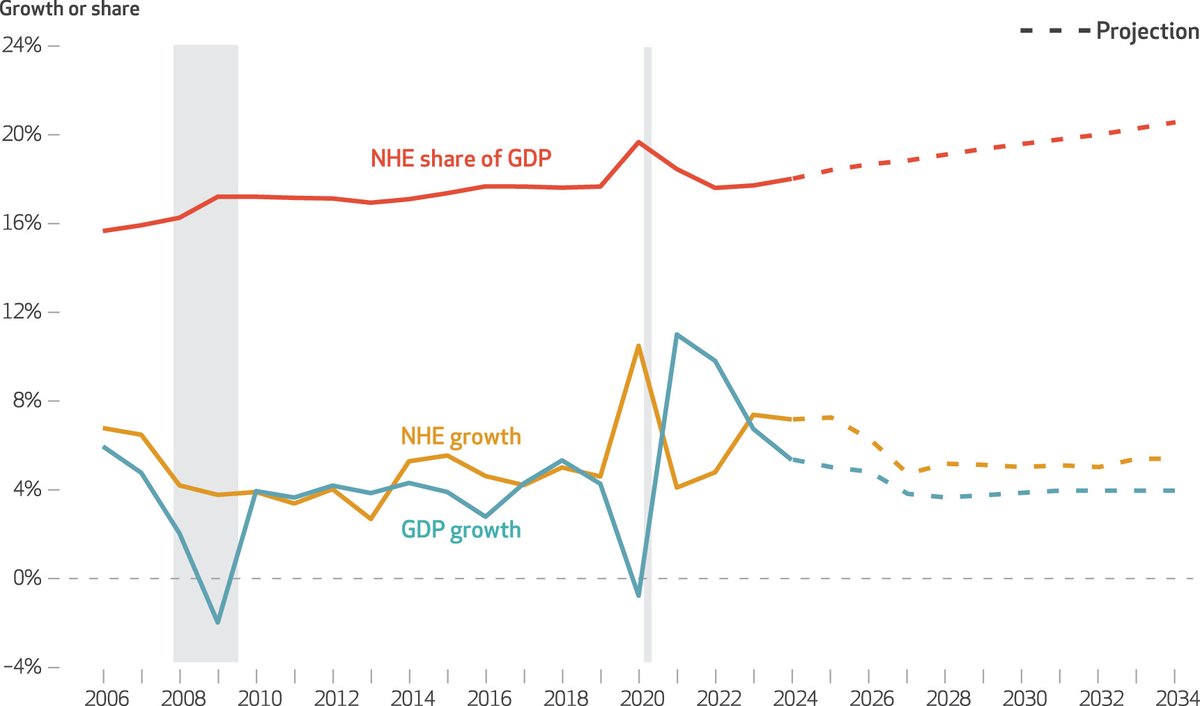
By 2034, U.S. national health spending is projected to reach nearly $9.0T (20.6% of the economy), up from $5.3T and 18% in 2024. How much better outcomes can we create from that spending? #HealthEconomics#HealthcareInnovation#AIinHealthcare https://t.co/kqhQSRMp0j
Ten million people have watched an MIT professor accidentally destroy the executive coaching industry.
He filmed the lecture once in January 2018 and died eighteen months later.
Executive coaches charge fifteen thousand dollars a session to teach a third of what he covered in one hour for free.
His name was Patrick Winston. He ran the MIT Artificial Intelligence Laboratory from 1972 to 1997 and wrote the AI textbook every computer science major in the world read for thirty years.
Every January for four decades, he gave a lecture called "How to Speak."
His entire framework fits on a napkin.
Do not read. Be in the image. Keep images simple. Eliminate clutter. Start with an empathetic connection. End with a punch line the audience can repeat over dinner. Never open with a joke. Never end with "thank you."
That last rule alone has probably cost the executive coaching industry a hundred million dollars.
"Your success in life will be determined largely by your ability to speak, your ability to write, and the quality of your ideas. In that order."
That is the actual opening line of the lecture. Winston believed it strongly enough to spend fifty years teaching computer scientists how to talk.
Founders spend $80,000 on an MBA and then hire a communications coach to teach them the same material Winston filmed once for free. Engineers write brilliant code and lose promotions to teammates who watched this lecture on the train.
The lecture is free on MIT OpenCourseWare. The textbook is free on his page.
Winston died in 2019. Almost none of the ten million viewers have actually implemented the four rules on the napkin.
The napkin is free. The willingness to actually use it in your next meeting is the entire edge.
The Navier-Stokes equations are among the most important — and most challenging — equations in physics. So, what makes them so difficult? And how could a new OpenAI proof finally resolve the problem? Watch our new video: https://t.co/xGmtbxZllZ
GPT-6 Astra has the best result yet on the Bach Benchmark. Its chorale contains no voice-leading errors, and its harmonic palette is sophisticated enough to include a Neapolitan sixth chord. More importantly, it is the first model to ever write passing tones on this benchmark, a significant leap in musical understanding.
Extra High effort. Prompt below:
“In LilyPond (version 2.24), write a 4-part chorale in the style of Bach, 3/4 time, G minor. Use two staves -- soprano and alto on the top staff, tenor and bass on the bottom staff. Respond with only the code block.”
Physics-informed graph neural networks can be trained using 4D flow MRI data to estimate blood flow in unseen carotid artery geometries. https://t.co/RtH9am9DTF
"From the 1800s to the early 2000s, physicists used the same theory to understand the behavior of fluids. Now, using a modern insight, they have redefined fluids from the bottom up."
https://t.co/ppv4KNHOiK.
🔱IIT Madras professor V. Balakrishnan walks a full classical physics class through the foundations that connect Newton to quantum mechanics - he does it for free.
US universities charge over $3,000 per credit to sit in a room and hear this material. Balakrishnan covers more ground in one semester than most Western physics programs fit into two years - and his first lecture alone reframes why classical mechanics matters at all.
He opens not with equations but with a question most professors skip: why does classical physics still exist when quantum mechanics replaced it? The answer restructures everything. By the time the introduction ends, you are already inside the mathematical skeleton that connects Newton, Lagrange, Hamilton, and Feynman into one coherent picture.
No paywalled syllabus. No overpriced textbook required. Just a blackboard, a professor who clearly spent decades thinking about how to teach this, and a playlist that runs 47 lectures deep.
NPTEL filmed the actual university curriculum at 7 Indian Institutes of Technology and put all of it online. Over 3,200 courses, zero subscription. Western institutions have known about this for years and said nothing.
▪ Lagrangian and Hamiltonian mechanics from first principles
▪ Nonlinear dynamics and chaos theory included in the same course
▪ Graduate level, no prerequisites assumed beyond calculus
🔖 Bookmark before the algorithm buries it - this is the kind of content paid platforms charge hundreds of dollars to approximate.
In 1967 Barthes declared the author dead. We asked five AI models for their take. They argued, panicked, quoted the Tao Te Ching at each other, and kept saying "we." We expected a fun philosophy stunt. It got under our skin ↓
"The Simple Mathematics of Large Language Models" is a concise free paper if you want to understand the mathematics behind modern LLMs and systems such as ChatGPT and Claude.
I have shared several resources in the past that explain the mathematics behind these systems in detail, but they are often quite long. This paper is only about 20 pages, so I think it is a useful resource if you want a compact introduction without starting from a much larger textbook.
It covers token representations, context, attention as learned weighted averaging, projections and bilinear forms, multi-head attention, normalization, positional information, softmax, maximum likelihood, cross-entropy, and gradient descent. Together, these topics give a concise mathematical picture of how a language model works.
Save it to your bookmarks. It can be useful as a quick reference.
https://t.co/Y6p8DrdttV
Instead of watching 1 hour of Netflix tonight, watch this ex-Google Chief Scientist Jeff Dean’s lecture. It’s the clearest explanation I’ve seen of the full AI engineering stack - from building LLMs from scratch all the way to one human coordinating 100 agents.
The best part is that it’s useful whether you’ve never touched a model or you’ve been shipping agent systems every day for the past year.
Bookmark it & watch the whole lecture this weekend, because it might end up being the most valuable thing you learn all week.
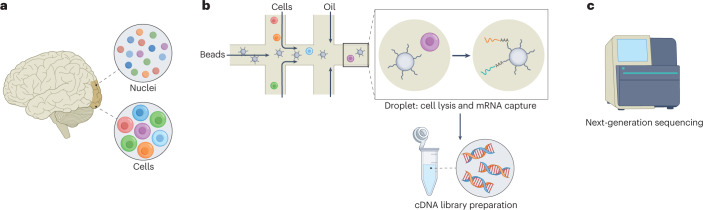
How do you look inside thousands of individual cells at once - from raw tissue sample to cellular blueprints, the complete droplet scRNA-seq pipeline in a nutshell: 🧵📊 #scRNAseq#Transcriptomics#MolecularBiology
3️⃣ Sequencing: Perform next-generation sequencing (NGS) of the final cDNA library on a standard platform, typically using solid-phase amplification. 🧬📊#scRNAseq#Transcriptomics#MolecularBiology
Droplet-based single-cell RNA sequencing (scRNA-seq) pipeline in a nutshell:
1️⃣ Suspension: Generate single-cell or single-nuclei suspensions directly from the target tissue.#BioMed#SingleCell#Science
2️⃣ Encapsulation & Processing: Use microfluidics to trap cells/nuclei in nanoliter droplets with barcoded beads. Lyse cells & capture polyadenylated RNA. Reverse transcribe (cDNA) to add UMIs & cell barcodes. Amplify & fragment the cDNA. #Genomics
Nature, Nurture, or Chance: Gene expression is a fundamentally stochastic process, with randomness in transcription and translation leading to cell-to-cell variations in mRNA and protein levels https://t.co/032ujzBW3H
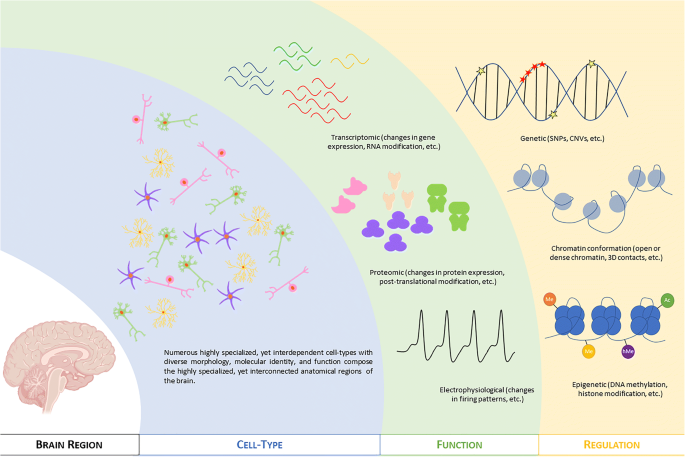
Single-cell resolution has fundamentally revolutionized neuroscience by moving past traditional "bulk" sequencing—which averages data across thousands of cells—to chart the precise genetic, transcriptomic, and epigenetic landscape of individual brain cells.
Unlike traditional bulk RNA sequencing, which averages gene expression across a population of cells, scRNA-seq isolates individual cells, reverse transcribes their RNA into complementary DNA (cDNA), and sequences the resulting cDNA to quantify gene expression levels.