Computational science and technology company combining molecular simulation, artificial intelligence, and software engineering to explore life sciences.
Goldmine for Software Engineers! 📌
If you want to learn System Design and/or AI Engineering, then bookmark this repo right now.
https://t.co/4SURKMITj0
For people who keep asking what to build
- Build your own operating system
- Build your database
- Build your virtual machine
- Build your web server
- Build your own game engine
- Build your compiler
- Build your own programming language
- Build your own browser
- Build your own blockchain
- Build your own encryption algorithm
- Build your own CPU emulator
- Build your own file system
- Build your own container runtime
- Build your own package manager
- Build your own shell
- Build your own window manager
- Build your own GUI toolkit
- Build your own text editor
- Build your own IDE
- Build your own version control system
- Build your own network protocol
- Build your own operating system kernel in assembly
- Build your own scheduler
- Build your own memory allocator
- Build your own hypervisor
- Build your own microkernel
- Build your own compiler backend (LLVM target)
- Build your own query language
- Build your own cache system (like Redis)
- Build your own message broker (like Kafka)
- Build your own search engine
- Build your own machine learning framework
- Build your own graphics renderer (rasterizer or ray tracer)
- Build your own physics engine
- Build your own scripting language
- Build your own audio engine
- Build your own database driver
- Build your own networking stack (TCP/IP implementation)
- Build your own API gateway
- Build your own reverse proxy
- Build your own load balancer
- Build your own CI/CD system
- Build your own operating system bootloader
- Build your own container orchestrator (like Kubernetes)
- Build your own distributed file system
- Build your own key
-value store
- Build your own authentication server (OAuth2/OpenID Connect)
- Build your own operating system scheduler
- Build your own compiler optimizer
- Build your own disassembler
- Build your own debugger
- Build your own profiler
- Build your own static code analyzer
- Build your own runtime (like Node.js)
- Build your own scripting sandbox
- Build your own browser engine (HTML/CSS/JS parser and renderer)
- Build your own blockchain consensus algorithm
- Build your own zero
-knowledge proof system
- Build your own operating system for embedded devices
I highly recommend cloudflare's security audit skill: https://t.co/Mu6Dm0fzk8
Run it on all your software. Run it with the free models. Use it even if you used a model to audit something - it will find much more things. Works in all agent harnesses and is model independent.
🧬 Design proteins faster and send fewer, better candidates to the lab.
Introducing RFD4-Proteina, a new NVIDIA BioNeMo open model co-developed with @UWproteindesign.
▫️Fast: 13× faster generation than RFdiffusion3 at 200 residues
▫️ Smart: state-of-the-art across 12+ protein design tasks
▫️ Programmable: set your design inputs and use test-time compute on harder problems
Start with our binder-design tutorial https://t.co/fmS7miF1VD
Avengers assemble: 1 year BakerLab + NVIDIA GenAIR = 🔥 https://t.co/Cd2qiugCJo
Presenting RFD4-Proteina, our latest protein design model, significantly better and faster than everything we compared against, both in silico and in the lab! 1/30
Most drugs work like a key in a lock. But hard-to-treat diseases often lack a lock to begin with, leaving them out of reach for conventional medicine.
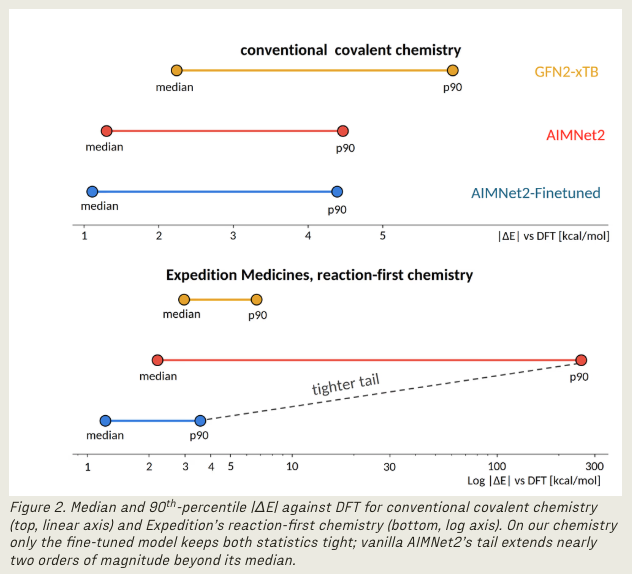
Covalent drugs change the game by bonding permanently to their targets. To find the right molecules, @ExpeditionMedicines fine-tuned the AIMNet2 model with the NVIDIA ALCHEMI Toolkit—screening 15 million structures per $1,000 of compute (17x faster and cheaper than GFN2-xTB).
https://t.co/a8NihVRd9A
Challenge 4 of the Anthropic × Adaptyv Protein Design Competition on @proteinbase is open: design a pH-sensitive protein to help shuttle drugs into the brain.
TfR1 is a receptor protein that brings iron-loaded transferrin into cells. It is highly expressed in the blood-brain barrier and drug developers can use this receptor to get drugs to pass the blood-brain barrier. The drug is fused to a binder to TfR1, which makes cells absorb the protein complex. If the binder is pH-sensitive it will release from the receptor inside the endosome and then exit the cells on the brain-facing side to deliver the therapeutic into the brain.
In this challenge, the goal is to make a pH-sensitive binder to TfR1 that targets precisely the right region on the receptor in order to allow absorption into the cell.
Weekend project complete: Run (Free)BindCraft on your mac!
Check out the latest version 1.0.6 which supports experimental support for apple silicon (https://t.co/L4jH7WnUvn).
Public preview of BioEmu2! @MSFTResearch AI for Science’s new foundation model for biomolecular structure, dynamics and function. Open weights, MIT license.
https://t.co/wsqcLPh8Sk
Movie: BioEmu2-simulated binding of intrinsically disordered peptide PUMA to MCL-1 receptor. 🧵⬇️
The Mo Lab discovers a new microbiome antibiotic and its mode of action: "Discovery and Characterization of Miranthins, "Trojan Horse" Antibiotic Modulators of Bacterial Composition in the Oral Microbiome,” in @PNASNews.
Nice work Brielle, Brett, and Mo: https://t.co/Hik4i4UTzs