We're bringing @teamxata to the world.
Agentic execution for onchain perpetuals. Trade an idea once and watch it happen across @HyperliquidX@Aster_DEX@Lighter_xyz
Engineered for agents with a machine trading API. Built for humans with XATA Copilot. Turn thought into trade:
Privacy shouldn’t be a retrofit.
Great to see @StoffelMPC pushing private computation closer to the developer workflow, so teams can ship faster without making sensitive user data the center of the stack.
(Re) Introducing Stoffel
Your Private by Design Teammate
So you can ship fast with privacy still built in.
After over a year of building, Stoffel 0.1.0 is here.
This summer, the status quo is turning into the Stoffel quo
After June 22, there will be no excuses to still build apps without privacy and security built in.
As a dev, you will be forced to adapt the Stoffel quo
We are excited to support @lifiprotocol Intents as a solver for cross-chain intents.
Open solver networks are a big step toward better chain abstraction: faster execution, better routes, and simpler UX.
Start swapping and bridging on @teamxata
Introducing LI.FI Intents.
Infrastructure for apps, wallets, and neobanks to:
• Enable stablecoin payments
• Access real-world assets
• Tap into compliant onchain liquidity
Built for enterprises bringing financial products onchain.
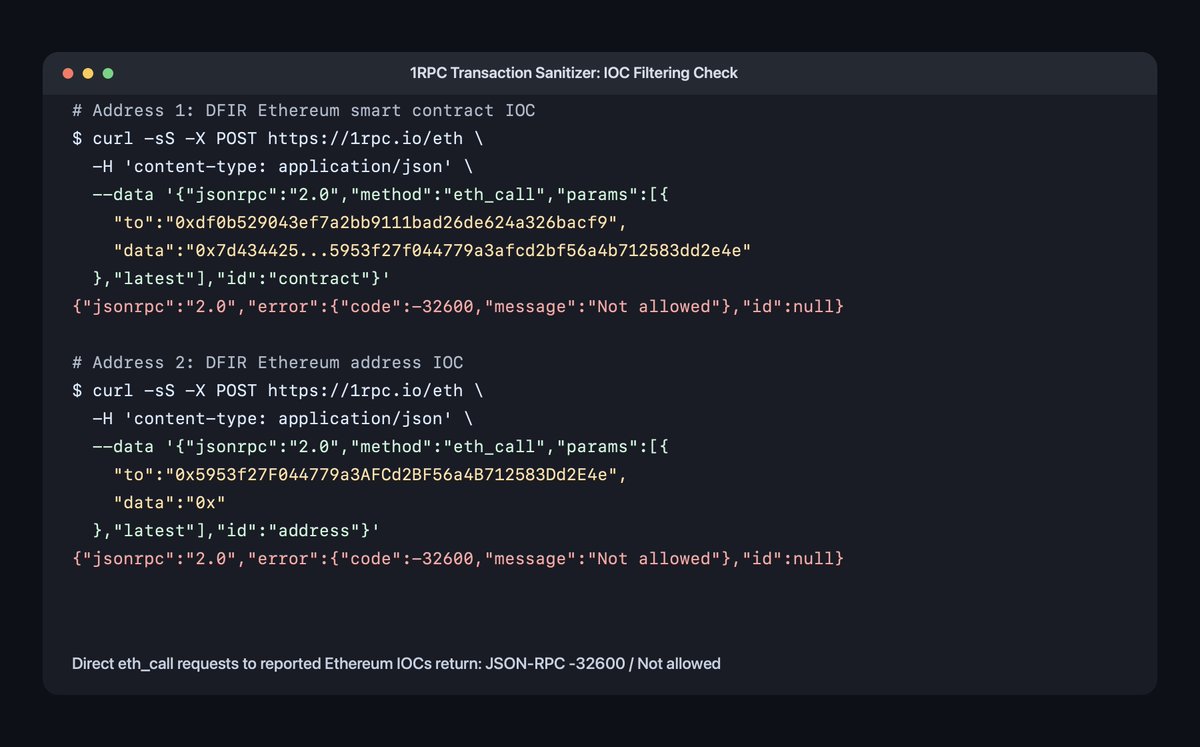
Thanks @TheDFIRReport for flagging this EtherRAT/TukTuk on-chain C2 activity.
Our Transaction Sanitizer now filters out the reported Ethereum addresses, and we’ll continue adding protections as more C2 wallets/contracts are discovered and shared. Grateful for collaboration across the security community.
cc @tayvano_
To Automata community:
We hear the concerns around the recent Binance delisting announcement, especially from long-time supporters.
Binance has been an important venue, and we do not take this lightly. The announcement is significant, but it does not change the work we are here to do.
2026 is our Year of the Agent: Attestation → Trust → Relay → Execution.
Since launching XATA (@teamxata) in April, that roadmap has already been moving from thesis to product. XATA, our agentic execution layer for onchain perps, has crossed $10M+ in trading volume.
This is the work ahead of us: agents that do not ask for trust, but prove it through secure, verifiable execution.
Markets change. Infrastructure keeps compounding.
To our community, developers, partners, and long-term supporters: thank you for staying with us.
Automata will keep building.
Automata provides one of the most comprehensive verifier stacks for TEEs, from Intel SGX/TDX to AMD SEV-SNP and AWS Nitro Enclaves
Verify the integrity of any hardware-bound workload directly onchain:
Automate onchain collateral management for Intel SGX/TDX with Automata's DCAP Dashboard, in use by @unichain@StoryProtocol and more: https://t.co/3biZtHGzBp
Automata DCAP Dashboard is the industry’s first solution built to remove the manual pain of attestation infrastructure setup and meet developers where they already work.
→ verify environments reliably
→ monitor platform health
→ integrate trusted compute into existing apps
Most TEE workflows force developers to become infra and security experts
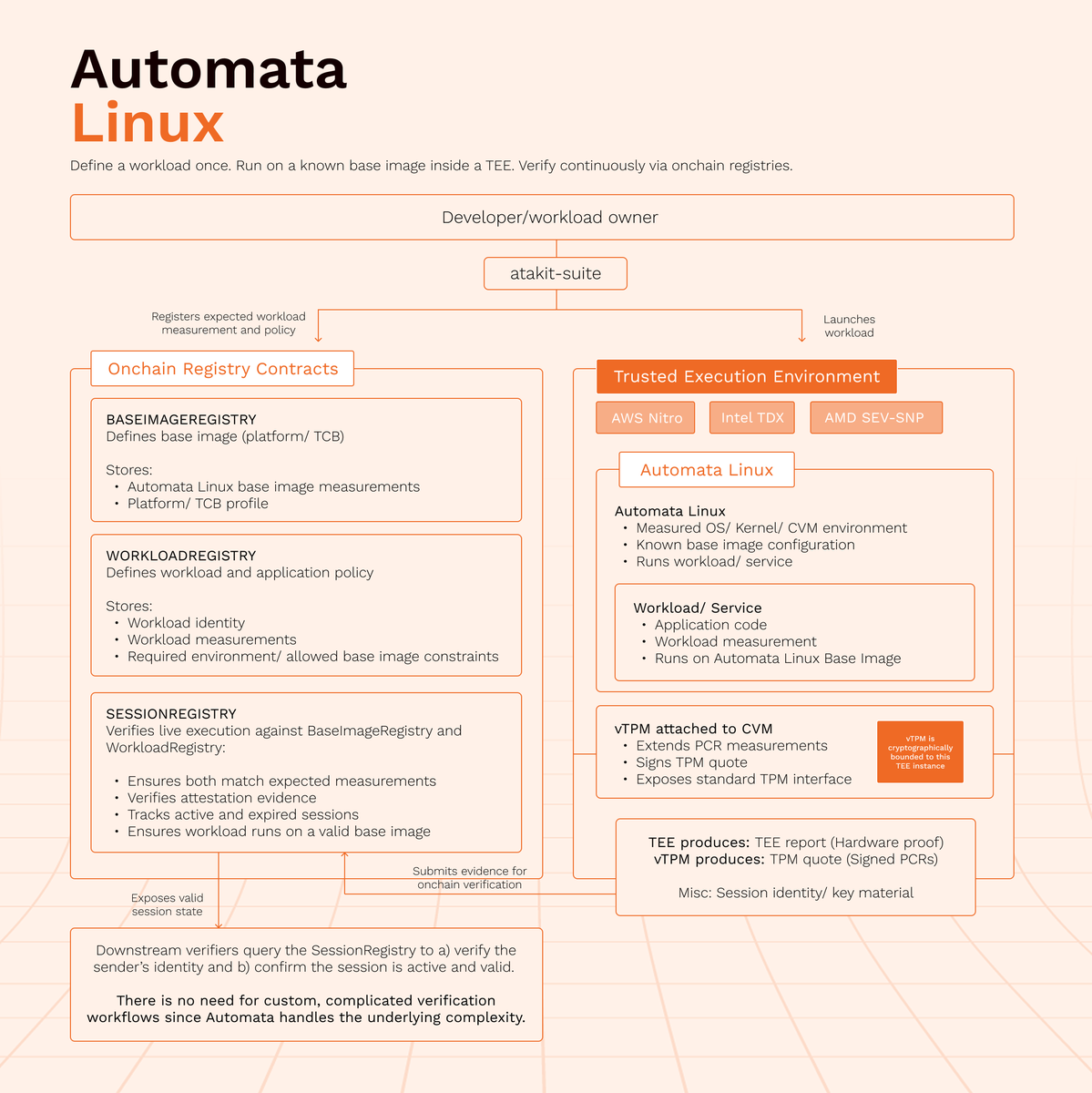
Automata Linux standardizes execution across TEEs using a common TPM interface, making execution consistent and verifiable by default
→ Define a workload once
→ Run across TEEs
→ Verify continuously
Most TEE workflows force developers to become infra and security experts
Automata Linux standardizes execution across TEEs using a common TPM interface, making execution consistent and verifiable by default
→ Define a workload once
→ Run across TEEs
→ Verify continuously
No shared standard for how TEEs connect to Ethereum. Projects are reinventing the same wheel.
This ERC-733 changes that.
1. attestation layer: how trust is established between a TEE and Ethereum on-chain.
2. replication layer: how enclaves pass keys and state to each other safely.
3. interoperability layer: how TEEs connect to external networks without exposing data to host operators.
@puffer_unifi is already implementing the attestation layer.
On-chain TEE attestation via @AutomataNetwork DCAP which is already in the UniFi stack today. Multi-TEE proving across Intel TDX and AMD SEV (two independent hardware manufacturers), attacker must compromise both. Proof aggregation across multiple independent TEE clients before L1 settlement.
I think ERC-733's security maturity model is also the part worth paying attention to. Stage 0 means developer controls everything. Stage 3 means trust fully distributed across hardware and governance. Actually most projects are still at Stage 0.
UniFi is building toward Stage 3 — TEE today, TEE+ZK tomorrow.
Standardization is how TEE infrastructure goes from interesting to institutional grade. 🐡
DCAP Attestation is a core primitive for verifiable, hardware-backed trust across the stack
Excited for more tremendous work ahead with @sparsity_xyz@socrates1024 and others including @PhalaNetwork@OasisProtocol to push the space forward
Attested devices anchor AI to reality
• Every action tied to real hardware
• Every output verifiable at the source
• No more black-box agents
Proof of Machinehood uses universal standards (Apple, Android, TPM) to provide verifiable identities for every device onchain.
Generate a unique device attestation recorded onchain. Establish an ongoing identity for every device.
PoM allows systems to trust a machine and its actions over time: https://t.co/CkZxErH6IA
We love seeing this growing focus on hardware provenance. Solving the AI trust crisis requires verifiable attestation and TEE infrastructure.
Automata built this exact foundation, and we are always open to chat with teams driving the space forward: https://t.co/CkZxErH6IA
The recent launch of ZCAM by @SuccinctLabs is a massive validation for a thesis we have held for a long time: in an AI-generated world, the only real anchor for truth is hardware.
Here is why their approach matters and where the tech goes next.
Today, we're launching ZCAM, an iPhone camera app to Prove What’s Real.
ZCAM cryptographically signs photos and videos at the moment of capture. Anyone can independently verify the content came from a real device and hasn't been altered or AI-generated.
PoM is a portable, verifiable proof of authenticity.
Anyone can request an attestation to validate a device's integrity before interaction. Use cases cover a wide surface area:
→ Sybil resistance
→ Agent accountability
→ Verified automation
→ Trusted data pipelines