Presenting #LitGene! An interpretable transformer for gene representations, integrating unstructured and structured data - unified framework mitigates bias, enhances interpretability, and grounds AI predictions in scientific literature at https://t.co/nuUrm9VCze 1/2
Thanks to KOAT-TV for highlighting Dr. Sahu's work. The Lobo Cancer Challenge provides pilot funding to a number of UNMCCC researchers. Pilot funding helps kick-start the new research projects that deepen our understanding of cancer and how to treat it.
https://t.co/XXmJj8Rty8
(1/n) Excited to announce a new article with @rafalab@AviSahuAI describing our approach scDist for finding cell types with transcriptional changes between conditions in single-cell data!
https://t.co/xkZnBtGzSW
LitGene: a transformer-based model that uses contrastive learning to integrate textual information into gene representations https://t.co/SA4otaHljD #biorxiv_bioinfo
We demonstrated its capability in predicting protein properties & zero-shot risk genes for obesity, asthma, hypertension, & schizophrenia Accessible at https://t.co/oFfGqsufQ8 🌐 #AI#Bioinformatics#MachineLearning#OpenScience#EthicalAI
Presenting #LitGene! An interpretable transformer for gene representations, integrating unstructured and structured data - unified framework mitigates bias, enhances interpretability, and grounds AI predictions in scientific literature at https://t.co/nuUrm9VCze 1/2
⚡️🔬📣 Excited to share our new @Nature article building and evaluating PathChat, a multimodal generative AI copilot and chatbot for human pathology. Article: https://t.co/OAIG31ofWJ Open Access Link:
https://t.co/tvw6W6qmT9
We leverage our previous success in building foundation models for computational pathology such as UNI / CONCH and combine it with the advancements of large vision language models and generative AI to enable PathChat to answer diverse pathology-related queries. We assessed PathChat using both multiple choice diagnostic questions and open-ended questions.
Congratulations to @MYLu97@chenbowen118 @DFKW_MD @richardjchen and everyone else who contributed to this work.
Also see blog post from @MYLu97 about this work: https://t.co/exjpKMnrQp , also teasing the development and preview of PathChat 2, a successor to PathChat 1 bringing new capabilities and substantially improved performance to the state-of-the-art.
Why do the loss of chromosome 10 and the gain of chromosome 7 happen so often in #gliomas? We investigate this over-four-decade-old mystery and shed some new light on this! Our work is now out in bioRxiv! #cancer@theNCI @NCIResearchCtr
The co-occurrence of chromosome 10 loss and 7 gain in #gliomas is the MOST frequent loss-gain co-aneuploidy pair in human #cancers, a phenomenon that has been investigated without resolution since the late 1980s. What is this mystery? We investigate! (1/n)
https://t.co/gPKyTnmcrH
Congratulations to Sarah Adams, MD, on being named Dean of the Department of Defense Ovarian Cancer Clinical Trial Academy. This award will also fund an AI-based biomarker discovery project based at UNM with Avinash Sahu, PhD.
Congratulations to @MuradRMamedov and co-author @AviSahuAI, both 2019 #MichelsonPrizes recipients, on a new paper published in @Nature that uncovers unexpected interactions between T cells and cancer cells: https://t.co/5Qa13IoRbG
How likely is it that an email that begins with "hope you are doing well" and ends with "looking forward to hearing from you" was composed by ChatGPT? 🙃
Just a reminder that you can download the @poe_platform app on your mobile phone and access a lot of artificial intelligence models.
In particular, you can access:
- Sage
- Claude-2-100k
- Claude-instant-100k
- GPT-4
- Claude-instant
- ChatGPT
- ChatGPT-16k
- GPT-4-32k
- Google-PaLM
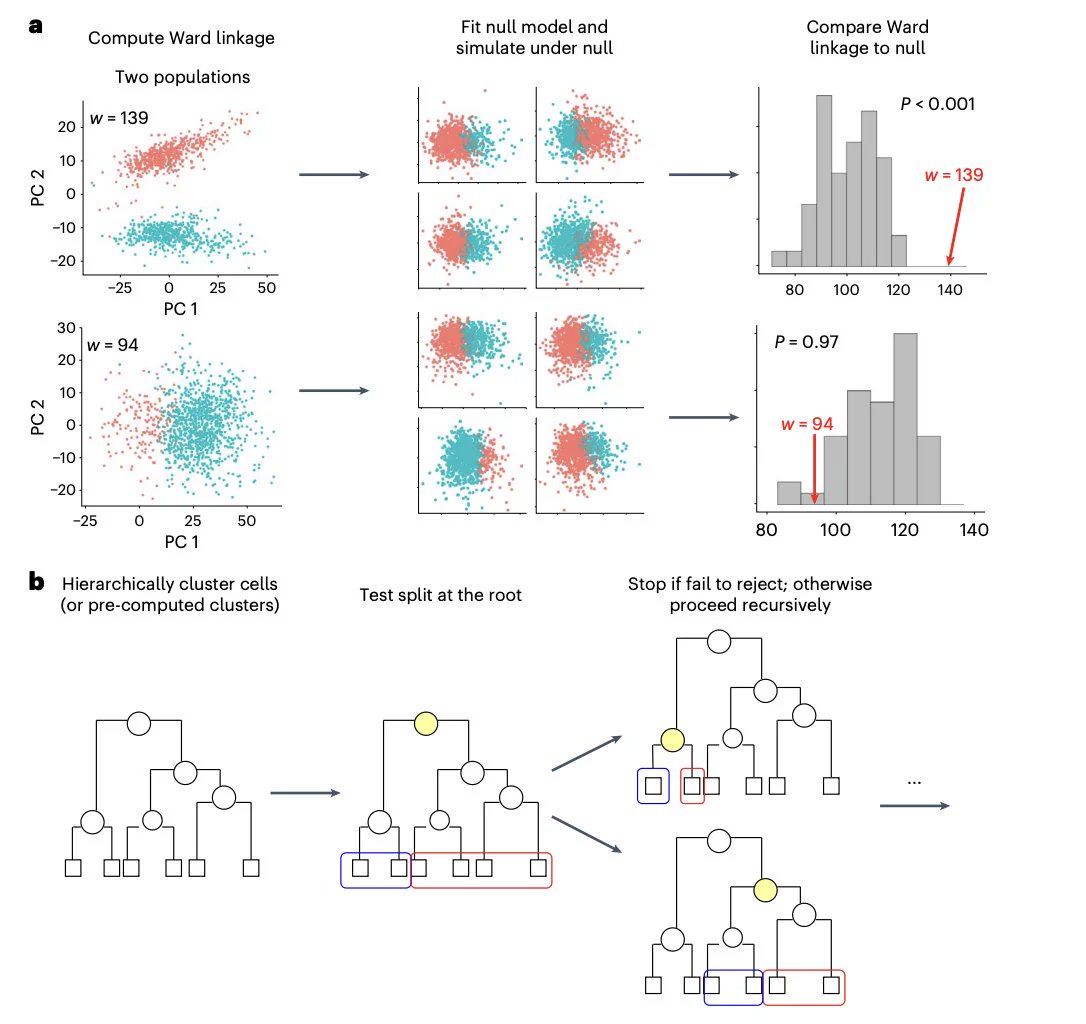
Clustering algorithms report clusters even when none exist. In single-cell RNA-Seq pipelines, novel cell types are often identified by clustering algorithms. Expanding on Kimes et al.'s work, we introduce significance analysis for single-cell RNA-Seq data: https://t.co/ut1kPjKVCM
Want to join an AI-based antibody therapeutics company with a 1st-in-class molecule in the clinic and help us solve the antibody code? Please consider GV20! https://t.co/c3h6ivUvcr
5/n: The fear has fluctuated over decades, depending on economic conditions and pace of technological change. Are we in a similar place now? Is AI and machine learning our new wave of 'technological unemployment'? Is our fear rational or irrational? 📈📉 #technology#fear
1/n: Data-to-paper with CHATGPT! Will the resulting papers pass the peer-review process? How will the review process adapt to these sophisticated writing tools? 🤔#AI#peerreview
Introducing "data-to-paper": autonomous AI research! We've let it play with the large CDC Health Survey Dataset. Went to lunch. When back, it had already chosen several research topics, wrote data analysis codes, interpreted results and wrote 5 transparent, reproducible papers.
4/n: Or, could this automation create an efficient pipeline for science and research, leading to a new breed of PIs who can focus on bigger ideas? This feels similar to the 1960s, when computers were becoming widespread. People feared 'technological unemployment' then, too. 🖥️💼