@tangming2005 I would personally add to the list: brainstorming about science/bioinformatics with colleagues. Just because one is in industry, doesn't mean the benefits of being in office are solely transactionally focused with stakeholders and team members. We're in R&D for a reason!
Our paper on functional discovery of protein degradation and stabilization effectors with proteome-scale induced proximity screens is out in its final version! 1/ https://t.co/vzNbJyR2rk https://t.co/5S9i7UG7JL
@anshulkundaje But other than that, I still think its critical to report auPR and similar metrics to understand when methods are actually practically useful.
@anshulkundaje Thus can end up with high auPR because baseline is the % positives. In that case, I also thought it was misleading to overstate performance.
@anshulkundaje "Quite successful" implies it is a solved problem, although I figured you didn't mean it that strongly. If one looks at precision/recall when analyzing variants across whole-exomes, the results are sobering. I agree it's going to be even more difficult for DNA-LMs.
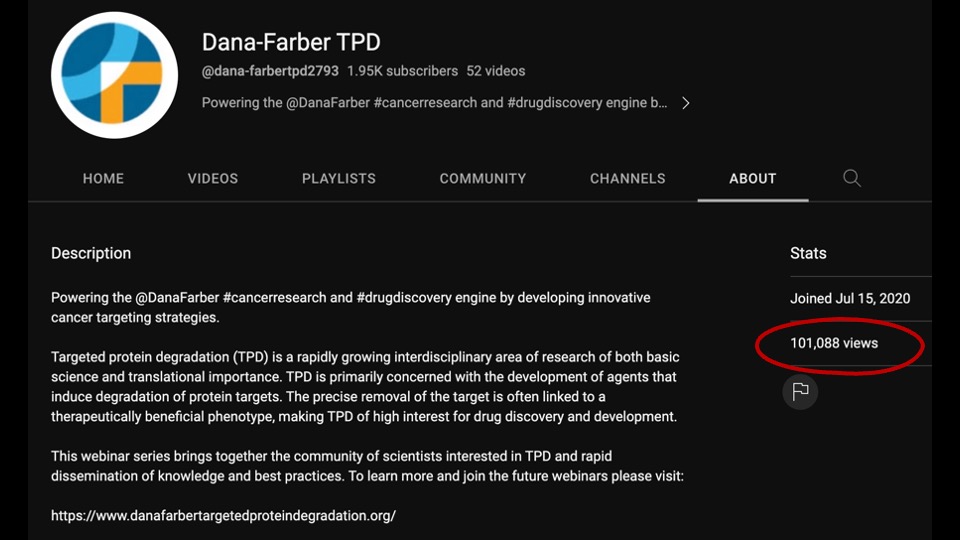
Exciting news! Our DFCI-TPD webinar channel reached 100,000 views on YouTube! Huge thanks to all speakers who shared their expertise, and all viewers! None of this would have been possible without our exceptional team @kdonovan1008@RPNowak@BLZerf6@hojong_yoon@MilkaKostic
In a packed room #ACMGMtg23 with @HeidiRehm Les Biesecker and Steve Harrison presenting the next version of variant classification work at @TheACMG@ClinGenResource AMP and CAP. Version 4 will be points based. All slides available at https://t.co/tnIztMheej