Deutschland war vielleicht nie ein Land mit günstigen, aber doch zumindest mit akzeptablen Energiekosten für die Industrie.
Deutschlands stromintensive Industrie existiert(e) doch nicht aus Zufall. Noch in den 2010ern konnten die Strompreise deutscher Großverbraucher international mithalten, wenn die Unternehmen von deutschen Sonderlasten (hohe Steuern, Energiewende-Umlagen) befreit waren. Deutschland hatte sowohl günstige Braunkohle als auch abgeschriebene Kernkraftwerke.
Nun ist Deutschland vom Mittelfeld im Vergleich zu anderen großen Volkswirtschaften in das Schlusslichtfeld gerutscht, und der aktuelle Kurs in der Strompolitik garantiert, dass sich daran nichts ändern wird.
Es ist irreführend, so zu tun, als ob die Energiewende in ihrer aktuellen Form nicht zu einer deutlichen Verschlechterung der Wettbewerbsfähigkeit der deutschen energieintensiven Industrie beigetragen hätte.
Und ich halte es in Bezug auf die Sicherung der deutschen Souveränität für einen Skandal, dass das von vielen Befürwortern des Kurses einfach schulterzuckend hingenommen wird. Sogar inklusive der Gewerkschaften, die die Mitarbeiter der betroffenen Betriebe vertreten. Bis 2022 war das vielleicht unter einer globalen Dekarbonisierungs-Agenda vertretbar, aber jetzt nicht mehr. Und doch macht die Energiepolitik wie auf Autopilot mit dem alten Kurs weitgehend weiter.
Grafik: Strompreis einer Aluminiumhütte (1.950 GWh/a) im Jahr 2013, Ecofys/Fraunhofer ISI im Auftrag des BMWi (2015)
🚨🚨 This is one of the most sinister thing the Free Speech Union has seen since it was founded in February 2020.
Brodie Mitchell, an FSU member and 20-year-old politics and law student at Royal Holloway, has discovered that the university compiled a secret dossier on him spanning nearly 1,500 pages.
He obtained the file through a subject access request (SAR). It revealed that Royal Holloway authorities had monitored his movements, tracked his social media activity and made a covert referral to Prevent, the Government’s counter-terrorism programme.
This is beyond sinister. The university spied on a young man because he supported Israel and the Jewish people.
Brodie’s troubles began during Freshers’ Week 2025. He was running the Conservative Society stall, which featured a Union Jack bearing the Star of David. Other students called him a “genocide supporter”.
After the president of the pro-Palestine society called him a “wannabe Jew”, @BrodieMitchell1 called her keffiyeh a “tea towel”. He was suspended and told to leave his accommodation. The other student, however, was allowed to continue her studies on campus as normal. Brodie was also reported to the police for an alleged hate crime.
After his nine-week suspension ended, lecturers were reportedly instructed to monitor his behaviour and attendance. Several academics objected, reportedly viewing this as a breach of privacy. By March, the university had also commissioned an external media-monitoring service to track press coverage mentioning his name.
On 2 May, someone at the university, whose name was redacted, emailed Surrey Police about Mr Mitchell’s decision to travel to Golders Green, north London, after a suspected terrorist attack.
The Prevent referral, submitted on 29 April, cited concerns that Mr Mitchell’s social media posts “may be regarded as hate speech” and that “his freedom of speech rights may be moving into a more concerning rhetoric”.
The Free Speech Union supported Brodie earlier this year, helping him secure an out-of-court settlement in April. Royal Holloway paid compensation and expressed regret over his prolonged suspension.
Surrey Police also dropped its investigations on 13 October, acknowledging that there was insufficient evidence.
Royal Holloway has serious questions to answer. This is the reality of living in Britain in 2026.
Read more below @GBNEWS 👇
German spot wholesale power prices are double than what they were only a year ago. Why?
Before 2015, German wholesale electricity typically traded at €30–50/MWh. Europe’s largest power market ran on a diversified mix of nuclear, coal, gas and hydro.
Then came the Energiewende. Schröder set the nuclear exit in motion, Merkel accelerated it, Scholz shut the last reactors and Merz has stayed the course. Germany once had about 20GW of nuclear capacity. At the end of 2015, 10.8GW remained. Today it’s zero.
Over the past decade, Germany also cut installed coal capacity by roughly a third, from 46GW to 30GW, while adding wind and solar at scale. The bet was that gas and imports would fill the gaps.
The Energiewende only exists in politics. Physics requires the grid to balance generation and consumption every minute. Power has to be available when and where it’s needed, and the lines have to be able to carry it there.
A surplus of solar power at noon does nothing for the evening peak unless you can store it and deliver it later. The grid itself cannot.
This is where „gesicherte Leistung“ comes in. A grid needs capacity it can count on during a cold, windless evening, when demand is high and solar output is zero.
Germany has retired a large chunk of that firm capacity and has yet to replace it in full. In tight hours, more rides on gas and on what its neighbours like France’s nuclear reactors can spare. Yes, Germany shut down its own nukes and now relies on French nukes. Precisely that…!
German day-ahead power is back above €200/MWh this week. The latest quote on the chart is €259/MWh. A cold, windless February could push it higher still.
Right now, the Hormuz crisis is putting pressure on gas prices just as Germany heads into winter with low inventories. Weak incentives to fill storage have made that worse. And when a cold, calm spell covers much of Europe, the neighbours need their power too.
Perhaps next summer, a Hellbrise causes a blackout as it did in Spain in 2025. winter, summer, spring or autumn - it’s all the same risk without reliable power from nuclear, hydro, coal or natgas.
Now add the much higher household bill. Retail electricity runs at 35–37 ct/kWh after network charges, taxes and levies. Add about 5 ct/kWh for the EEG subsidy now paid out of the federal budget, and the combined cost is 40–42 ct/kWh, roughly twice the €203.75/MWh wholesale price marked on the chart.
For a typical four-person household, that’s €1,040–€1,100 a year in a flat or €1,520–€1,610 in a house, including the EEG equivalent and excluding electric heating, electric hot water and EV charging.
The CDU, SPD and Greens all had a hand in this. Each has a reason to keep defending it, and shifting costs into the federal budget buys them time.
But the real test comes on a cold evening when the wind drops, gas is expensive and the neighbours have little to spare. At that point, the only number that matters is how much power Germany can actually deliver. So better get that grid reserve ready - you clowns..!
It will all blow up, sooner rather than later.
Amen.
An interesting — and telling — episode took place in Gaza today.
The Israeli Air Force carried out an airstrike targeting a vehicle containing three people in the Tel al-Hawa neighborhood of Gaza City.
The IDF released a statement saying the three were terrorists belonging to Palestinian Islamic Jihad.
But Reuters — one of the largest and most respected news agencies in the world — went with another story.
“Israeli strike kills three in vehicle distributing aid in Gaza, witnesses say,” blared its headline.
The first paragraph of the news item cited “Gaza's health ministry and witnesses” as claiming that the vehicle was carrying “papers and food for the World Central Kitchen charity.”
“It was just about to stop to distribute the food and drink to children when it was hit by a missile,” claims a “Reuters witness” identified as Abu Zein Al-Daya.
Only in the second paragraph, a single line, do we discover that World Central Kitchen itself denied that it had anything to do with it.
“World Central Kitchen, an aid organisation that distributes food in the Gaza Strip, said, however, that the vehicle was not affiliated with it,” the article offers begrudgingly.
So you have both the IDF *and the aid group itself* denying that it was an aid vehicle, and Hamas (via the Gaza health ministry, which it controls fully) and supposed Palestinian witnesses claiming it was.
Which version did Reuters go with for its headline — the only part of the piece most people will see?
Why, Hamas’s, of course.
Total journalistic malpractice.
O gráfico do Financial Times mostra os países ricos sufocados pelo gasto com idosos, mas esconde o principal: eles estão quebrando porque insistiram no modelo errado de previdência.
Quando colocamos Brasil, Suécia, Austrália, Holanda e Chile na mesma mesa (como lembrou o @SchumpExplains), o jogo muda completamente.
Para quem não é da área, a diferença é simples:
1. Repartição (Brasil, França, EUA, Japão) = Caixa d'água sem reserva
O dinheiro descontado do seu salário hoje não é guardado: vai direto pagar quem já parou. Quando havia 8 jovens para cada idoso, funcionava.
Hoje, com famílias menores e gente vivendo até os 90 anos, a conta estoura. O governo só tem duas saídas: aumentar impostos ou cortar investimentos (obras, hospitais, escolas).
• França e Itália já gastam 13,7% a 16% do PIB só com pensões públicas.
• O Brasil, ainda demograficamente jovem comparado à Europa, já gasta quase 12% do PIB — um padrão de país rico envelhecido que trava nosso crescimento.
2. Capitalização (Austrália, Chile, Holanda) = Cofre individual
O dinheiro vai para uma conta no seu nome, é investido na economia e rende juros compostos por décadas. Na aposentadoria, você saca o seu próprio patrimônio, não o imposto do jovem que acabou de entrar no mercado.
• Austrália: Acumulou poupança privada acima de 130% do PIB, tirou Nota A no Global Pension Index 2026 e mantém o gasto público com aposentadorias abaixo de 4% do PIB.
• Holanda e Dinamarca (1º e 2º lugares no mundo em 2026): Combinam um piso básico estatal com fundos capitalizados que somam 150,9% do PIB (Holanda) e 198% do PIB (Dinamarca). Como os idosos vivem do retorno desses ativos, o orçamento do governo fica livre para investir.
• Chile: Derrubou o gasto público previdenciário para menos de 4% do PIB com a capitalização e criou um mercado de capitais forte, reforçando recentemente um piso solidário (PGU) para os mais pobres sem destruir a poupança individual.
3. Modelo Híbrido com trava automática (Suécia)
Nos anos 1990, a Suécia viu que ia quebrar e reformou tudo. Misturou capitalização financeira com uma trava matemática: se a população envelhece ou a economia desacelera, o reajuste das pensões freia sozinho para nunca gerar rombo no Tesouro. Segundo a OCDE, é um dos raríssimos países ricos onde o gasto público com aposentadorias vai cair até 2050.
Conclusão:
O problema que trava o Brasil e a Europa não é "cobrar pouco imposto". É matemática demográfica.
Na repartição, o envelhecimento vira um buraco negro fiscal. Na capitalização e nos modelos híbridos bem desenhados, cada geração financia a si mesma e deixa o Estado livre para investir no futuro.
Fontes: OCDE (Pensions at a Glance 2025 / Pension Markets in Focus 2025), Marsh & CFA Institute (Global Pension Index 2026) e Tesouro Nacional.
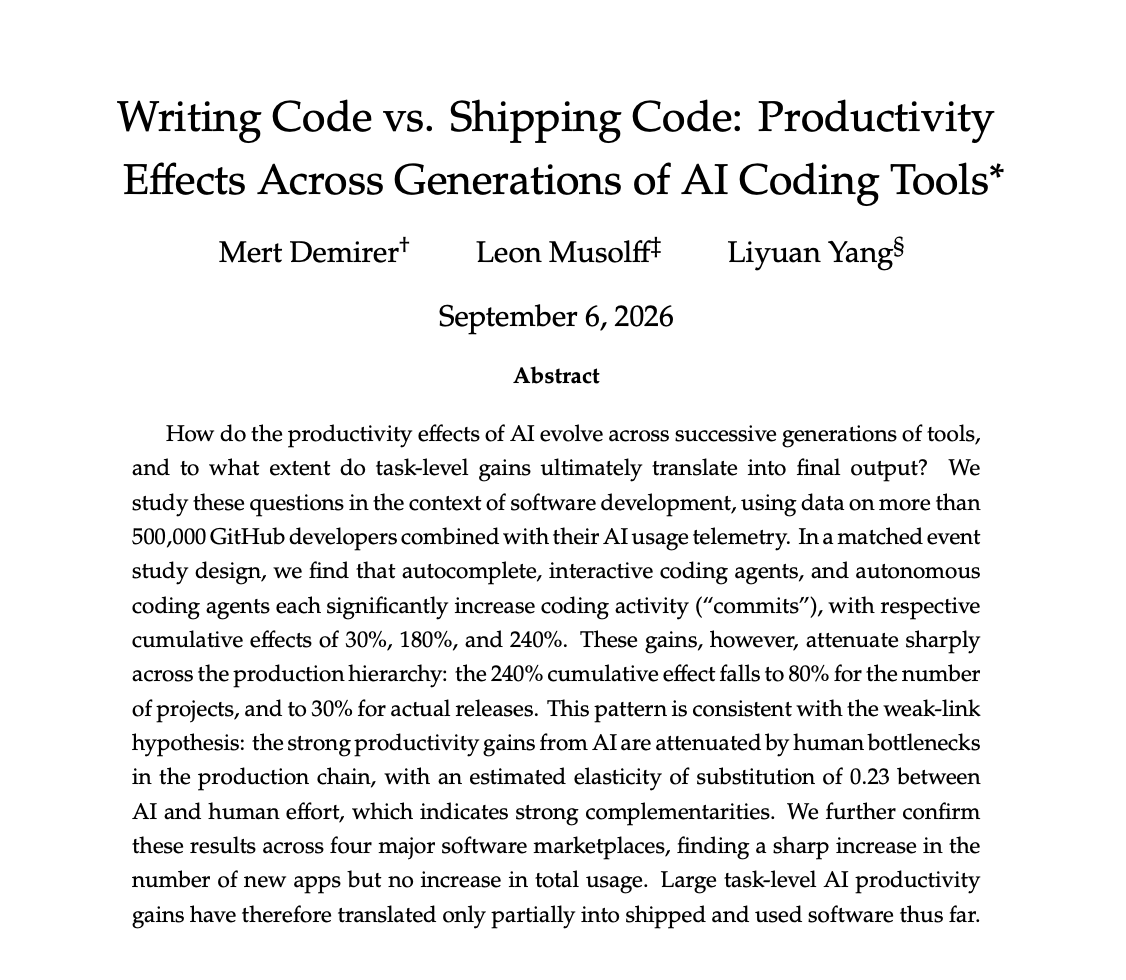
MIT published the most uncomfortable paper on vibe coding.
They tracked every new app that dropped on the app store, play store and chrome web store after coding agents showed up.
And the findings are brutal.
devs who started using autonomous agents wrote 25.5x more code. commits up 240%. repos touched up 80%. actual releases? +30%.
So like... where's the other 95% going?
In the trash.
After adopting tools claude code, devs wrote 7x more lines and deleted 12.2x more. repos abandoned within 30 days went from 60% to 69%.
and the storefront side is where it gets kinda bleak. new apps launching across the app store, play, chrome web store, sourceforge - roughly doubled since early 2025.
user engagement? didn’t move.
that's the part that messed with me honestly. twice as many apps shipping into the void. nobody downloading more, nobody using more. just... more noise on the shelf.
I’ve been thinking about this bc i felt it myself. i shipped three "projects" last month with claude code and im pretty sure zero humans used any of them.. its so easy to start something now that finishing stopped meaning anything.
writing code was never the real bottleneck. shipping something coherent, reviewing it properly, building a thing anyone wanted - that was.
Warum wir die Ukraine dringend als militärischen Partner brauchen: Die russische Kh-101, die gestern rund drei Minuten durch den polnischen Luftraum flog, wurde nicht abgeschossen, obwohl ein Gripen-Pilot die NATO-Freigabe hatte. Der Grund: „extrem schwierige Wetterbedingungen“. Der Pilot konnte das Ziel weder mit bloßem Auge noch mit seinen Instrumenten identifizieren.
Zeitgleich schoss die ukrainische Luftabwehr bei demselben Wetter nach eigenen Angaben 79 von 84 russischen Marschflugkörpern ab.
Wir müssen die Ukraine dringend weiter unterstützen, sonst sind wir verloren. 2022 hieß es noch: „Schickt das olle DDR-Zeug in die Ukraine, damit können die umgehen. Für unsere Waffen müssen wir die erst ausbilden.“
Jetzt sollten wir offenbar dringend selbst bei ihnen in die Lehre gehen.
„Dass Politiker dazu neigen, sich die Sache zu einfach zu machen, daran hat man sich gewöhnt. Aber dass auch Journalisten bei diesem Theater mitspielen, hat etwas Deprimierendes. Gedankenarmut und ein auftrumpfender Mangel an Neugier waren immer eine Geißel des sogenannten Haltungsjournalismus. Besser ein rechter Gedanke als gar keiner, ist man versucht auszurufen.“
https://t.co/k29hozRzbd via @focusonline
University debate: "Beef is the most wasteful food on earth."
Vegan: "It takes 25 kilos of feed to make one kilo of beef. Any other machine that lost 96% of what went into it would be scrapped."
Farmer: "25 kilos of what?"
Vegan: "Feed."
Farmer: "Grass. How much of it can you eat?"
Vegan: "None. That isn't the point."
Farmer: "It's the whole sum. A gold mine shifts a tonne of rock for five grams of gold. Nobody stands at the gate complaining about the waste of rock."
Vegan: "Rock isn't food. That land could feed people directly."
Farmer: "Two thirds of Britain's farmland is grass. Most of it is too steep, too wet or too thin to be anything else. You're welcome to try it with a spoon."
Vegan: "They're fattened on grain at the end."
Farmer: "Mine finish on silage and what the brewery throws out. The barley made your pint first."
Vegan: "Even so, 25 to one is indefensible."
Farmer: "A wheat plant is roots, stalk, chaff and grain. You eat the grain. That's about half of it wasted before the miller starts. I don't see a motion about bread."
Moderator: "Closing lines, please."
Vegan: "A hungry world can't afford a food that takes 25 in to get one out."
Farmer: "25 kilos of something you can't eat, off land you can't plough, for one kilo of the best food there is. I'd call that the only free lunch in farming."
A toothpaste company has quietly killed the entire market research industry and nobody is talking about it.
Colgate published a paper showing you can predict real purchase intent by simply asking LLMs to roleplay customers.
And this is beyond insane.
If you ask an AI, "Rate this product from 1 to 5," it gives safe, middle-of-the-road garbage.
So researchers invented a method called Semantic Similarity Rating (SSR).
Instead of asking the AI for a number, they asked it to roleplay.
They gave the LLM a demographic profile. They showed it a product concept. And they asked it to write down its raw, unfiltered thoughts.
Then, they used a semantic model to translate those written thoughts into a numerical score.
The results are staggering.
Tested against 57 real personal care product surveys and 9,300 human responses, the synthetic consumers hit 90% of human test-retest reliability.
They perfectly mirrored how different age brackets and income levels react to price changes.
And they provided detailed, qualitative feedback that was deeper and more critical than what actual humans wrote.
This destroys the economics of traditional market research.
You don't need to wait a month to see if a product will sell.
You can simulate 1,000 hyper-targeted customer interviews overnight.
You can A/B test pricing across every demographic instantly.
I was skeptical of Real Ice's proposal to slow the disappearance of Arctic sea ice by pumping seawater onto it.
So I reached out to a polar scientist I know who's spent decades researching the Arctic and Antarctica. His assessment largely confirmed my own skepticism.
1. First, scale. You would need something on the order of a million machines, each thickening 4 km² of ice per season, to extend Arctic ice cover by perhaps one or two weeks.
That's an extraordinary amount of infrastructure for a remarkably marginal outcome. The Arctic is just too big.
2. Second, the physics. Natural sea ice freezes very slowly, forming fine crystals of relatively fresh ice. Young sea ice still contains some salt, but the trapped seawater gradually drains away over time.
Real Ice proposes pumping large quantities of seawater onto existing, relatively impermeable ice. The problem is that the salt may remain near the surface rather than draining away naturally.
This could actually accelerate melting during summer, potentially undermining the very purpose of thickening the ice.
3. Third, the economics. At $10,000 per machine, you're already looking at $10 billion, before accounting for the enormous logistical infrastructure required to deploy a million machines across the Arctic.
And for what? Perhaps another week or two of ice cover.
It's difficult to see how this could ever be cost-effective. He believes those resources would be better spent on directly reducing CO₂ and methane emissions than on increasingly elaborate attempts to compensate for them.
4. His bigger concern was what this does to incentives.
The oil and gas industry can point to projects like this and argue that there's no urgent reason to change course. Scientists are supposedly figuring out how to reverse the damage anyway.
We may be creating a situation where the promise of solving a problem becomes more valuable than actually solving it.
Thoughts?
https://t.co/vdxptOjuiB
Ich werde nicht müde, mich zu wiederholen:
Die SPD im Allgemeinen und besonders die Berliner und die NRW-SPD liegen fest in den Händen der Muslimbruderschaft. Übrigens habe ich genau das im Jahr 2018 im Rahmen einer SPD-Veranstaltung einer aktiven Parteimitgliedin gesagt, die mir eine Mitgliedschaft bei der SPD vorgeschlagen hatte. Sie bekam runde Augen und wurde für Sekunden stumm.
In der Nacht vom siebten auf den 8. Mai 1999 während des Kosovo-Kriegs setzte ein B2 Spirit Bomber der USAF (gestartet von der Whiteman Air Force Base in Missouri) fünf JDAM-präzisionsgelenkte Bomben auf die chinesische Botschaft in Belgrad ab. Drei chinesische Staatsbürger wurden dabei getötet, die Botschaft zerstört.
Folgen:
Notfallsitzung des UN-Sicherheitsrats, persönliche Entschuldigung des NATO-Generalsekretärs (es handelt sich um eine NATO-Operation). Der amtierende US-Präsident sprach persönlich mit seinem chinesischen Gegenüber, um sich zu entschuldigen. Die USA zahlten fast 5 Millionen $ Entschädigung. Auch in der westlichen Presse wurde von Kriegsverbrechen geschrieben, dabei handelte es sich klar um einen tragischen Fehler.
2026.
Die niederländische Vertretung in Kiew wird gezielt angegriffen. Russland gibt den Angriff nicht nur zu, sondern rechtfertigt ihn.
Ohne @nicolange_ würden die meisten Menschen heute durch den Tag gehen, ohne überhaupt zu wissen, dass es diesen Angriff gegeben hat, der selbstverständlich illegal war. Ansonsten herrscht Schweigen.
Soweit ist die europäische Sicherheitsordnung in einem Vierteljahrhundert gekommen.
https://t.co/QvkYWeoU1q
Sorry, Leute. Aber irgendwann ist eine Grenze erreicht.
Ich habe für vieles Verständnis. Für menschliche Fehler, Fehleinschätzungen, sogar für gelegentliche Inkompetenz.
Aber dieser Fall aus Sachsen schlägt jedem Fass den Boden aus.
Ein Unternehmer wird verdächtigt, an einer Steuerhinterziehung von 15 Millionen Euro beteiligt gewesen zu sein. Er kommt für mehr als neun Monate in Untersuchungshaft.
Seine Firma mit zehn Beschäftigten geht insolvent. Seine wirtschaftliche Existenz wird zerstört, seine Familie belastet, sein Ruf beschädigt.
Und dann?
Freispruch. In sämtlichen Anklagepunkten.
Die Staatsanwaltschaft zieht schließlich auch ihre Revision zurück.
Jetzt verlangt der Betroffene vom Freistaat Sachsen rund 4,4 Millionen Euro Schadensersatz und mindestens 50.000 Euro Schmerzensgeld.
Und ich frage mich ernsthaft: Was muss eigentlich passieren, damit staatliche Verantwortung auch persönliche Konsequenzen hat?
Denn hier geht es nicht um einen falschen Steuerbescheid, den man nach einem Widerspruch korrigiert.
Hier geht es um neun Monate verlorene Freiheit und eine wirtschaftliche Existenz, die sich nicht einfach wiederherstellen lässt.
Und jetzt kommt der entscheidende Punkt:
Untersuchungshaft ist keine Strafe!
Ein Beschuldigter gilt bis zu seiner rechtskräftigen Verurteilung als unschuldig. Untersuchungshaft darf nur unter strengen gesetzlichen Voraussetzungen angeordnet werden.
Sie kann durch Kontaktbeschränkungen, Besuchskontrollen und die Ungewissheit über den weiteren Verfahrensverlauf besonders belastend sein.
Wer neun Monate in Untersuchungshaft verbringt und anschließend freigesprochen wird, bekommt diese Lebenszeit niemals zurück.
Nun behauptet der Unternehmer, die Ermittler hätten entlastende Beweise ignoriert und den Haftbefehl auf unzutreffende Tatsachen gestützt.
Das ist bislang ein Vorwurf, keine gerichtlich festgestellte Amtspflichtverletzung.
Aber genau deshalb muss dieser Vorwurf vollständig und unabhängig aufgeklärt werden.
Wer hat welche Behauptungen aufgestellt? Welche entlastenden Erkenntnisse lagen vor? Wer hat sie geprüft? Auf welcher Grundlage wurde die Untersuchungshaft beantragt, angeordnet und über Monate aufrechterhalten?
Und wenn sich herausstellt, dass Beamte vorsätzlich oder grob fahrlässig gehandelt haben, dann erwarte ich nicht nur eine Entschädigung aus der Staatskasse.
Dann erwarte ich persönliche dienstrechtliche Konsequenzen, eine Prüfung der strafrechtlichen Verantwortung und gegebenenfalls einen finanziellen Rückgriff auf die Verantwortlichen.
Denn der Staat darf nicht einfach sagen: Wir haben einen Fehler gemacht, der Steuerzahler bezahlt und für die Verantwortlichen geht der Dienstbetrieb weiter.
Eine Justiz, die Menschen ihre Freiheit nehmen kann, trägt eine außergewöhnlich hohe Verantwortung.
Und wer diese Macht missbraucht, muss selbst zur Rechenschaft gezogen werden.
Der Rechtsstaat verliert seine Glaubwürdigkeit nicht dadurch, dass er Fehler macht. Er verliert sie, wenn er schwere Fehler nicht aufklärt, ihre Folgen nicht angemessen wiedergutmacht und nachgewiesenes Fehlverhalten ohne persönliche Konsequenzen lässt.
Denn für den Betroffenen ist das keine juristische Aktennummer.
Es sind neun Monate seines Lebens. Seine Firma. Seine Existenz. Und seine Familie.
Meine Meinung: Das Team der Steuerfahnder, der Staatsanwalt und der Richter, der den Untersuchungshaftwisch unterschrieben haben, gehören sofort fristlos entlassen, unter Verlust sämtlich Vorteile als Staatsangestellte und müssten mindestens 500.000 Euro Schmerzensgeld aus eigener Tasche berappen.
Dieser Fall ist derartig ungeheuerlich, dass mir die Worte fehlen.
He had the popular vote, the House and the Senate. He still managed to fuck up a clean shot at governing.
He stocked the White House with B-team lightweights bc he prizes loyalty over competence. Then he strutted around like a king, stonewalled on Epstein files and turned access to the president into a pay-to-play grift with a bloody meme coin.
He inherited an AI investment boom for the ages. He still managed to fuck up confidence on Main Street. Ordinary Americans wanted a piece of the boom. He slapped 10% tariffs on bananas and starts a chosen war bf the Midterms.
He had a network of allies Beijing could only dream of, giving the presidency ungodly soft power and keeping its industry supplied. He still takes every chance to piss off every relationships America spent decades building and every chance to fawn over Xi.
And now he’s found a way to go lower still. He’s siding with an accused war criminal and wants him shielded from the International Criminal Court in The Hague.
Follow the money
Google is sabotaging their OEM partners by making a growing number of features and updates exclusive to Pixels. At the same time, Google is trying to convince OEM partners not to support GrapheneOS or even bootloader unlocking. They're also trying to harm GrapheneOS directly.
Die SPD hat die Mathematik endgültig abgeschafft. Gestern Abend bei Miosga phantasiert Juso-Chef Philipp Türmer davon, das marode Rentensystem mit höheren Steuern auf Kapitalerträge zu retten. Wer diese Milchmädchenrechnung glaubt, glaubt auch an den Weihnachtsmann.
Türmer schwadroniert im TV lässig davon, dass man „hohe Kapitalerträge zur Finanzierung der Rentensysteme heranzieht“.
Das klingt in den Ohren von Umverteilungsfanatikern großartig, scheitert aber krachend an den harten Fakten.
Fakt 1:
Kapitalerträge werden in Deutschland längst massiv abkassiert.
Mit 25 Prozent Abgeltungssteuer plus Solidaritätszuschlag (und oft noch Kirchensteuer) greift der Fiskus kräftig zu.
Der Staat trägt null unternehmerisches Risiko, hält aber bei jedem Kursgewinn sofort die Hand auf.
Fakt 2:
Die Dimensionen sind ein schlechter Witz.
Der Bund buttert mittlerweile jährlich weit über 110 Milliarden Euro aus dem normalen Haushalt als Zuschuss in die Rentenkasse.
Dem gegenüber stehen gesamte Einnahmen aus der Abgeltungssteuer von jährlich rund 30 bis 35 Milliarden Euro.
Selbst eine absurde 100-prozentige Enteignung aller Aktiengewinne würde unser demografisches Rentenproblem nicht einmal im Ansatz lösen.
Es ist eine dreiste linke Nebelkerze.
Und weil solche Rechnungen immer irgendwann auffliegen, holte Türmer am Ende den alten Klassiker aus der sozialistischen Mottenkiste:
Das obligatorische Sticheln gegen das Erben durfte als rhetorischer Rettungsanker natürlich nicht fehlen.
Anstatt endlich den ausufernden Staatsapparat zu verschlanken und die Wirtschaft wieder auf Kurs zu bringen, gibt es nur die eine rote Lösung:
Steuern rauf, umverteilen und das Geld der Bürger verprassen.
Wer private Vorsorge und Leistung derart bestraft, verteilt am Ende des Tages nur noch Armut.
#Miosga #SPD #Rente
Germany looks like an educational outlier in Europe on these maps mostly due to methodology and history.
Stock vs. flow: Eurostat tracks all adults (25–64), so older male-dominated cohorts still outweigh younger female grads.
Vocational tracks: Germany’s renowned dual apprenticeship system (Ausbildung) absorbs millions of skilled women into top careers without a traditional university degree - "degree-only" metrics miss this.
Historical lag: West Germany’s late university expansion and early school tracking delayed the gender flip compared to its neighbours.
Among Germans under 35, women have already caught up!
They actually have guns in Dune. The problem is that most important fighters wear Holtzman shields.
These shields stop fast-moving objects, including bullets, but allow slower objects to pass through. That’s why Gurney teaches Paul one of the most famous lessons in the books: “The slow blade penetrates the shield.”
A fighter has to be fast enough to get past their opponent’s defence, then slow the blade down at the exact moment it reaches the shield. It’s an entirely different kind of sword fighting.
And lasguns aren’t a simple solution either. When a lasgun beam hits an active shield, it can trigger a massive explosion through subatomic fusion, potentially killing everyone around them.
There’s another detail from the first book that I love. The Harkonnens actually bring back artillery during their attack on the Atreides because nobody expects traditional artillery to be useful in an age dominated by shields.
And the Fremen? They don’t wear shields in the open desert because the vibrations attract sandworms. They have their own reasons for fighting with crysknives.
So Dune isn’t a universe that forgot how to make guns. It’s a universe where advanced technology made close-quarters combat relevant again.