You can't make this up:
At 8:15 AM ET yesterday, the 10Y Note Yield was trading at 4.68% when the US Treasury announced it would be increasing bond buybacks to $4 billion.
The yield fell to a low of 4.63% as the US Treasury pledged to provide "liquidity support."
Exactly 24 hours later, the 10Y Note Yield is ABOVE levels seen prior to the announcement, at 4.71%.
It's going to take a lot more intervention to tame this beast.
🤯 Foreign central banks are pulling back from US Treasuries at an accelerating pace:
Foreign official holdings of US Treasuries in Fed custody have fallen to $2.6 trillion, the lowest level in 14 years.
This tracks Treasury securities held at the Federal Reserve on behalf of foreign central banks and governments, providing a real-time weekly proxy for official-sector demand ahead of the more comprehensive monthly TIC data.
Holdings have fallen by ~$400 billion over the past year alone, even as the broader Treasury market has absorbed the selling without major disruption, with domestic investors picking up much of the slack.
This comes as 30-year Treasury yields remain near multi-decade highs above 5.2%, raising questions about whether the Fed may eventually need to step back in as a buyer while its own balance sheet continues to shrink.
Foreign demand for US debt is fading just as America's borrowing needs keep climbing.
🚨 GLOBAL BOND MARKETS ARE IMPLODING
The US, Japan, South Korea, France and the UK are all seeing their bond yields reach multi-decade highs.
Meanwhile, rising inflation expectations could push central banks to raise interest rates again.
It’s happening.
🚨 AI is getting cheaper at the exact moment markets are pricing in massive AI profits:
Average daily spending per million inference tokens on proprietary models has fallen from around $4.10 in mid-July to ~$3.00, the lowest in 3 months.
The decline comes as leading US AI labs cut prices aggressively to defend market share against increasingly capable and cheaper Chinese open models.
OpenAI slashed prices on its lower-cost model by 80%, while Anthropic launched a new model at half the price of its flagship offering.
Furthermore, Silicon Data’s token price index shows prices charged by leading US AI labs have fallen nearly 25% since mid-July.
The price war is also spreading to enterprise customers, as companies impose usage caps and switch to cheaper models to control rising AI bills.
Meanwhile, Chinese models are increasingly narrowing the performance gap, giving customers more leverage to demand lower prices and making AI intelligence increasingly commoditized.
The bigger risk for investors is that AI capabilities continue improving rapidly while the price of those capabilities collapses just as quickly.
For an AI trade priced for explosive future profits, falling prices could become a much bigger problem than slowing demand.
🚨 JAPANESE BOND MARKET IS IMPLODING
🇯🇵 Japan 2Y bond yield hit 1.695%, a 31-year high.
🇯🇵 Japan 5Y bond yield hit 2.175%, a 31-year high.
🇯🇵 Japan 10Y bond yield hit 2.93%, a 30-year high.
When bond yields move like this, it always ends badly for the economy.
Rising Japanese 2Y yields to multi-decade highs raise yen funding costs and increase pressure on the carry trade. This heightens the odds of partial unwinds, especially with ~75-80% odds of a BOJ hike in September, but the still-wide US-Japan rate differential means a full disorderly unwind is not automatic. Watch USD/JPY and volatility for the real trigger.
WALL STREET IS GOING ALL-IN ON STOCKS.
Institutional investors have pushed their stock exposure to the highest level since the 2008 Financial Crisis.
At the same time, fund managers have cut cash allocations to around 3.3%, near historic lows.
In simple terms, big investors are heavily betting on stocks to continue their rally.
But if the market suddenly turns, there's very little liquidity to buy the dip, which could accelerate the dump.
THE YEN CARRY TRADE COULD BLOW UP AGAIN.
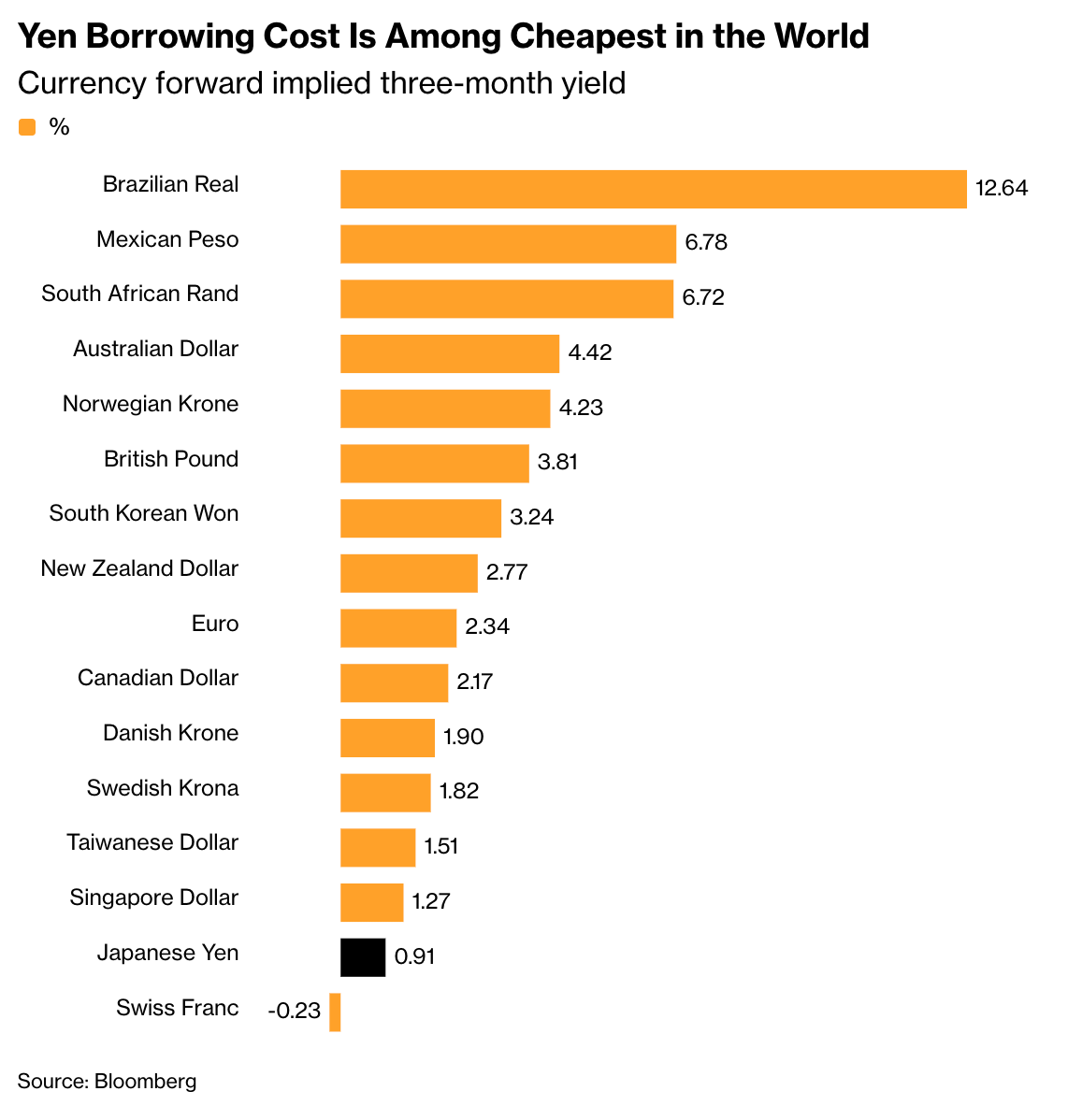
Yen borrowing costs are now just 0.91%, making it one of the cheapest major currencies to borrow.
Traders are taking advantage of it again.
They are borrowing cheap yen and moving the money into higher-yielding currencies and assets.
The Brazilian real, for example, offers an implied yield of 12.64%.
Japan and the U.S. spent around $87 billion defending the yen over just two days in July.
Yet the yen has already erased around half of those gains.
Now traders are rebuilding carry trades while Japan’s policy rate remains at just 1%.
The bigger this trade gets, the more dangerous the next BOJ hike or intervention becomes.
One sharp yen rally could force traders to unwind and trigger selling across global markets.
🚨 GLOBAL BOND MARKETS ARE IMPLODING
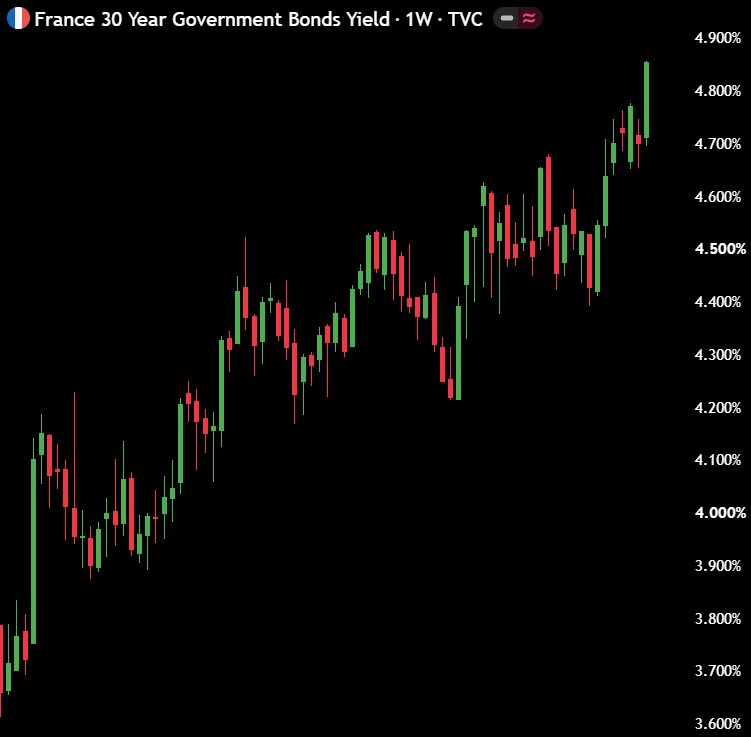
🇫🇷 France's 30Y bond yield hit 4.855% this week, its highest level since the 2008 Financial crisis.
After the US, Japan, Korea, and the UK, France is moving towards a bond crisis too.
🇯🇵 Japan's 10 year yield jumped to 2.88% today and appears ready to go vertical.
So far the Bank of Japan (BoJ) and 🇺🇸 U.S. Treasury interventions in the yen have failed.
History has proven purchasing yen is ineffective at preventing its further devaluation. The only solution is to dramatically raise interest rates.
Doing so narrows the gap between U.S. yields and the Japanese yield, which effectively destroys the $20 trillion yen carry trade that has been supporting global asset prices and U.S. bonds.
If the BoJ loses control of the 10 year yield and it suddenly rises to 4%, emergency measures will be needed to prevent a Dollar shortage and global sovereign debt crisis... unless that's the plan. 🤫
🚨 THE U.S. ECONOMY JUST GOT A VERY BAD WARNING.
Retail sales fell 0.6% in July vs +0.1% expected, while the GDP-linked retail control measure fell 0.4% vs +0.3% expected.
Every major retail reading flipped negative in a single month.
Consumer spending drives nearly 70% of the U.S. economy.
Americans are pulling back on spending.