My travel schedule this week has been: MIA -> LAX -> JFK -> MIA
Every single flight had one thing in common: There was a person in first class playing a mobile game on their phone.
Today we’re publishing our latest research report on AppLovin.
Long known as a mobile gaming ad network, AppLovin has become one of the most discussed performance channels in DTC. The pitch is compelling: Massive mobile app inventory, unskippable video format, a powerful optimization engine, and a user base that many brands have not meaningfully reached through existing platform powerhouses.
But adoption and platform momentum don’t always translate into incremental outcomes. Does the AppLovin hype hold up when we look at actual business impact?
22x spend increase in 3 months. Not a typo.
This was just one of the highlights shared in our webinar with Home Chef's [@realhomechef] paid media manager.
He who broke down exactly how they scaled AppLovin to one of their top 3 highest-spending digital channels, starting with a willingness to test something new.
Watch the full recording here: https://t.co/A1e0E8vQrB.
This should answer some of the questions around whether @AxonAdsManager can hold ROAS at scale.
A brand was able to scale past $1K/day on AppLovin after 30 days of testing.
NC ROAS: 3x
ROAS: 6x
Source: Triple Whale
Still early, but glad they were able to get it working like that. Takes the right product, offer, creative volume, and testing period, but the channel is clearly starting to work for more ecomm categories.
#AppLovin #Axon #Shopify #MetaAds #DTC #EcommerceMarketing
(5/5) Measurement on this channel is a triangulation problem, not a single-source-of-truth problem.
The advertiser who uses all of them together is in a much better position than the one waiting for one number that doesn't exist.
Shirley Deng and Sue Deng from our Product Partnerships and Marketing Science team wrote up how to think about it here. 👇https://t.co/B4LwrbcuKn
(1/5) Many advertisers come to us with the same question.
AppLovin looks strong in-platform, but their third-party tool doesn't see it.
Or their MMM is attributing more than the platform reports.
Neither is wrong. Here's how to think about it 🧵
(4/5) Prescient's MMM data adds another layer.
Roughly 50% of AppLovin's modeled value comes through halo effects, higher than Meta and Google.
For brands with a heavy Amazon presence, it climbs to around 60%. Nearly half of that halo lands on Amazon.
What actually happens when a major DTC brand bets on a new performance channel?
Home Chef is one of the most recognized meal kit brands in the US, and their paid media manager is going live to share how they’re scaling on Axon.
In this live webinar, you’ll get real learnings from someone hands-on the account and walk away with practical tips you can actually apply to your own brand.
DTC founders, media buyers, performance marketers. This one’s for you.
Register here: https://t.co/kIM2VDvtkm
Most advertisers still think mobile gaming is a niche channel. The stereotype is stubborn.
In reality, the typical casual mobile gamer is an adult playing puzzle games, crosswords, and card games, many of whom make financial decisions at home.
70% of these gamers drive most household purchasing decisions, vastly outpacing the general population.
They shop online at least weekly.
77% spend $100 or more per month online.
Their intent to purchase in categories like travel, electronics, furniture, and vehicles is also strong.
These are consumers with real purchasing power.
More on the mobile gaming consumer here: https://t.co/lWHzFctfxm
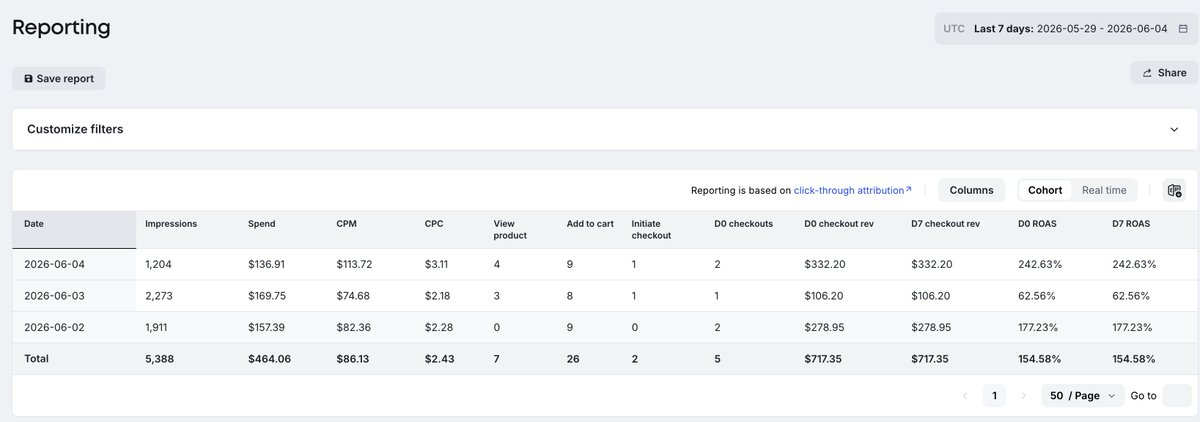
Brand new Axon Ads account, 3 days in.
Brand: Skincare for women 50+
ROAS goal: 120%
Optimization: 7 Day
Country: US
Creative set: 1
Videos: 10 videos
Interactives: 10 images by Thumbstop
Page: Bundle page (same as Meta)
Results: 1.5x ROAS, so closer to a 1.7x backend.
If you want to break through six figures monthly of spend on AppLovin you HAVE to prioritize end cards.
Nearly 40-60% of your clicks come from end cards.
Test and iterate on them nearly as much as your video ads.