Larry Ellison has a clear bar for healthcare AI: the highest quality care at a price that "doesn't threaten Western civilization."
He says he isn't exaggerating.
Healthcare spending already competes with education and infrastructure in every developed economy. Ellison frames AI-driven cost reduction in medicine as an obligation, not just a market.
That is a very different level of urgency than "improving patient outcomes."
Whoever makes healthcare cost-efficient at scale builds some of the most important infrastructure of the next 50 years.
More on what this means for founders in AI Market Fit: https://t.co/N3QwyFjJNx
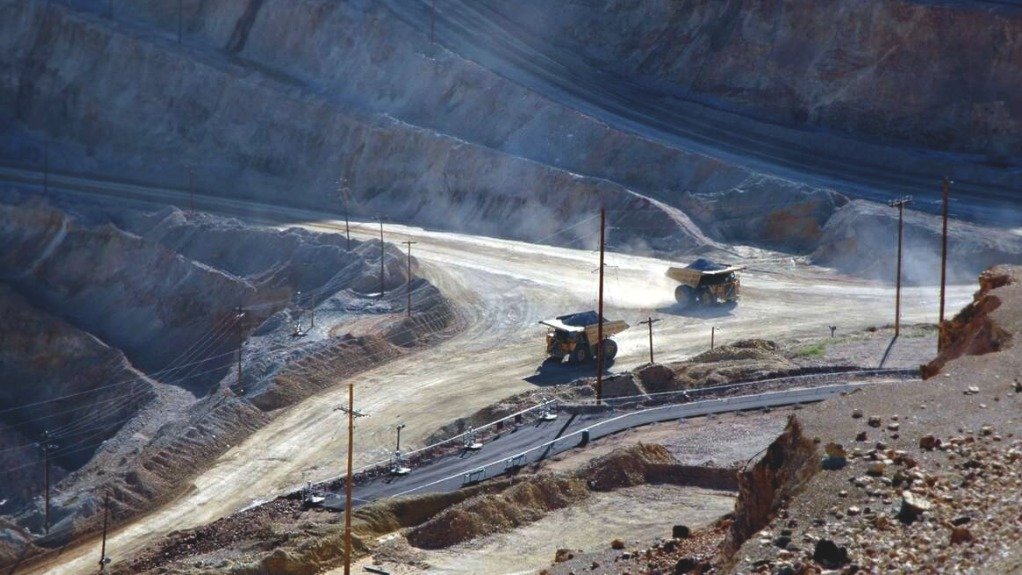
Open-pit optimization aims to extract the maximum economic value from the deposit by determining the most efficient configuration of mining operations.
One of the key concepts in this regard is the stripping ratio, which represents the volume of waste material per ton of ore extracted.
To determine the economic borders of the mine, engineers use the Break-Even Stripping Ratio (BESR) or the maximum amount of waste material that can be economically extracted to expose ore. Essentially, it is the point where waste stripping costs become equal to the net profits from the extracted ore.
What's the practical method for calculating break-even strip ratio in an open-pit optimization? Share your thoughts in comments.
Video rights: @pareedu (YouTube)
Read more: https://t.co/LQmcPervh7
Subscribe to Mining Doc to know more about Mining: https://t.co/v8NF3k4pUy
Promote your mining technology to a global audience of mining professionals with Mining Doc. Contact us today at [email protected].
Can AI Diagnose Parkinson’s Disease? My Interview with Reid Hoffman’s AI Digital Twin. Will earlier be better and and give doctors more time to care for their patients? At the Masters of Scale Summit in Silicon Valley, I had a fascinating conversation with an AI digital twin of Reid Hoffman about the future of artificial intelligence in healthcare and how emerging technologies could transform the diagnosis and treatment of neurological diseases.
- One of the most exciting developments we discussed was Neuropacs, an AI-powered technology that analyzes brain MRI scans to help distinguish Parkinson’s disease from conditions that can look remarkably similar, including progressive supranuclear palsy (PSP) and multiple system atrophy (MSA).
- Why does this matter? Getting the diagnosis right, and getting it right early, can change how we counsel patients, select treatments, plan care, and approach clinical trials. Parkinson’s disease, PSP, and MSA may share symptoms, but they are different diseases with different prognoses and treatment considerations.
- What excites me most about AI is not the possibility of replacing physicians. It is the opportunity to make physicians better. If AI can help us interpret complex diagnostic information more efficiently, we can spend less time sorting through data and more time sitting with patients and families, explaining what the diagnosis means, answering questions, and developing a personalized plan.
- The future of AI in medicine should not be about replacing the human connection. It should be about strengthening it.
- Join me for this amazing conversation (with Reid's digital twin) about Parkinson’s disease, brain MRI, artificial intelligence, and the future of neurological care.
https://t.co/mfckMgMU2j
The AR4 Robot mapped hidden minerals in mine walls with a geoelectric sensor mount
This build was part of the European ROBOMINERS project.
Their goal was high-resolution subsurface mapping to guide autonomous drilling robots.
The AR4 holds an electrical resistivity tomography (ERT) sensor in contact with the wall so the team can measure resistivity changes at close range and map deposit boundaries and composition.
Thanks for using the AR4 on this project!
Then he said if you didn't co operate they would kill you which made me question because hey he lives in a nice place that maybe the reason why he's family is so well off is cause they were impimpi but hey that's me just over anylizing🤣
So yesterday in the car this guy probably olde enough to be my father told me about how apartheid was like I really had no Idea I actually asked him was he affected by it and yeah that's what he said like my mother never really explained apartheid like that
So yesterday in the car this guy probably olde enough to be my father told me about how apartheid was like I really had no Idea I actually asked him was he affected by it and yeah that's what he said like my mother never really explained apartheid the way this guy did
I truly believe that AR in mining could be THE enabled going into a mine and knowing how safe that certain mine is better yet how about using AR in mines even AI to go dig up the mineral you need without causing harm to the area you mining and not putting a miners life at risk
[𝗠𝗜𝗡𝗘 𝗠𝗘𝗖𝗛𝗔𝗡𝗜𝗦𝗔𝗧𝗜𝗢𝗡 & 𝗠𝗢𝗗𝗘𝗥𝗡𝗜𝗦𝗔𝗧𝗜𝗢𝗡] @ericsson’s Private 5G solution is increasingly becoming an enabler of mining transformation as companies scale automation and improve operational efficiency. 𝗥𝗲𝗮𝗱 𝗺𝗼𝗿𝗲: https://t.co/s3mrBS51TC
Basically I do think that mining companies should use anything that. Helps them do the job better imagine going into a mine and you already know where to mine or making sure you know where you're miners are incase something happens to them
Rare earths power EVs and wind turbines. Mine water runoff is full of them. A new colour-change test could flag which sites are worth recovering them from — once researchers solved an unexpected metal-interference problem. 💡
📖 Read the story: https://t.co/wM7LP9W0wx
@arc_gov_au
Imagine what if she didn't have chatgpt could've been a different story my app isn't chat gpt but it could help you get a better understanding https://t.co/8k8Eg13Obm
Greg Brockman shared a story about a friend in the hospital where ChatGPT flagged an antibiotic that could have killed her.
Her doctor agreed, he had missed a key detail in her medical history: “I only had 5 minutes to read your chart.”
Many such cases...
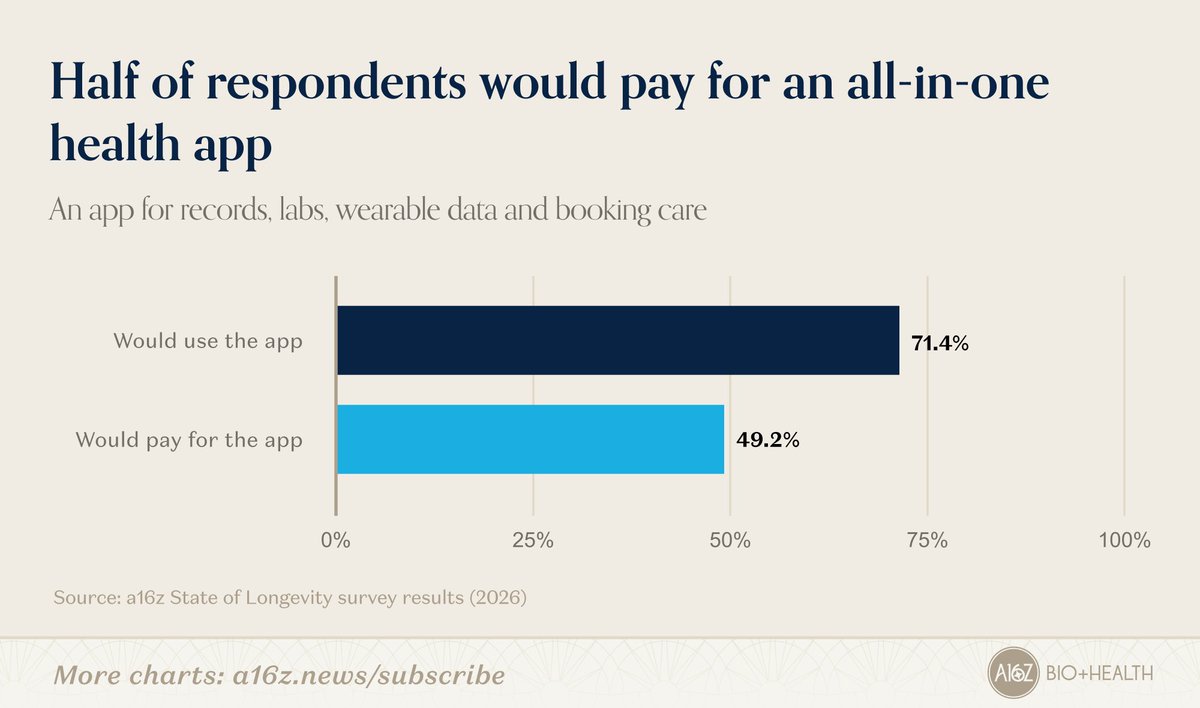
Half of 500 Americans surveyed would pay for one app that handles their records, labs, wearable data, and booking care.
That's the race to become the "healthcare home," one of six trends identified. The others:
- Non-toxic everything, from water filters to organic mattresses
- Peptides beyond GLP-1s
- Cholesterol treatment that can reverse some of the plaque in your arteries
- Wearables that measure far more than steps
- Brain-computer interfaces and wearables for the brain
Across all six, consumers are ready to act. They're seeking out tests, trying new products, and spending their own money on health. The opening for founders is helping them follow through.
"As AI makes answers and interpretation cheaper, value will migrate to the companies that can figure out the action layer."
Full piece from a16z's Daisy Wolf and Eva Steinman: https://t.co/8o8ETrGQar
How can we responsibly use AI to predict a patient’s future?
Jay Shah, MD from @concurrencehq, and @Dr_PJay, MD, PhD from Optum and Dell Medical School joined us at the Second Opinion Summit to discuss how decision intelligence, strong data foundations, and patient trust will shape the next era of healthcare.
Tune in to the full Lifers episode: https://t.co/ZZAnTxkw9J
This great sometimes when you believe in something and ay the moment you dont have the funds you tend to think that everything is gloom but look at the work other companies are doing great stuff!!
📈 Global annual CO2 capture capacity reaches 68M tons across 113 operational commercial facilities
📌 Over 400M tons of CO2 permanently stored since 1996, with another 56M tons of annual capture capacity under development at 59 facilities under construction
If carbon pricing policies under development are fully implemented by 2030, nearly 1/3 of global GHG emissions could be covered by an Emissions Trading System or carbon tax. Learn about the latest carbon pricing trends in this report: https://t.co/n2mgCOc727 #PriceOnCarbon
Can crushed volcanic rock remove CO₂ and help farmers? Discover the climate idea behind Mati Carbon. Watch on @PlanetClassroom ➡️ https://t.co/XUg0Q4f6SN #CarbonRemoval#COP31
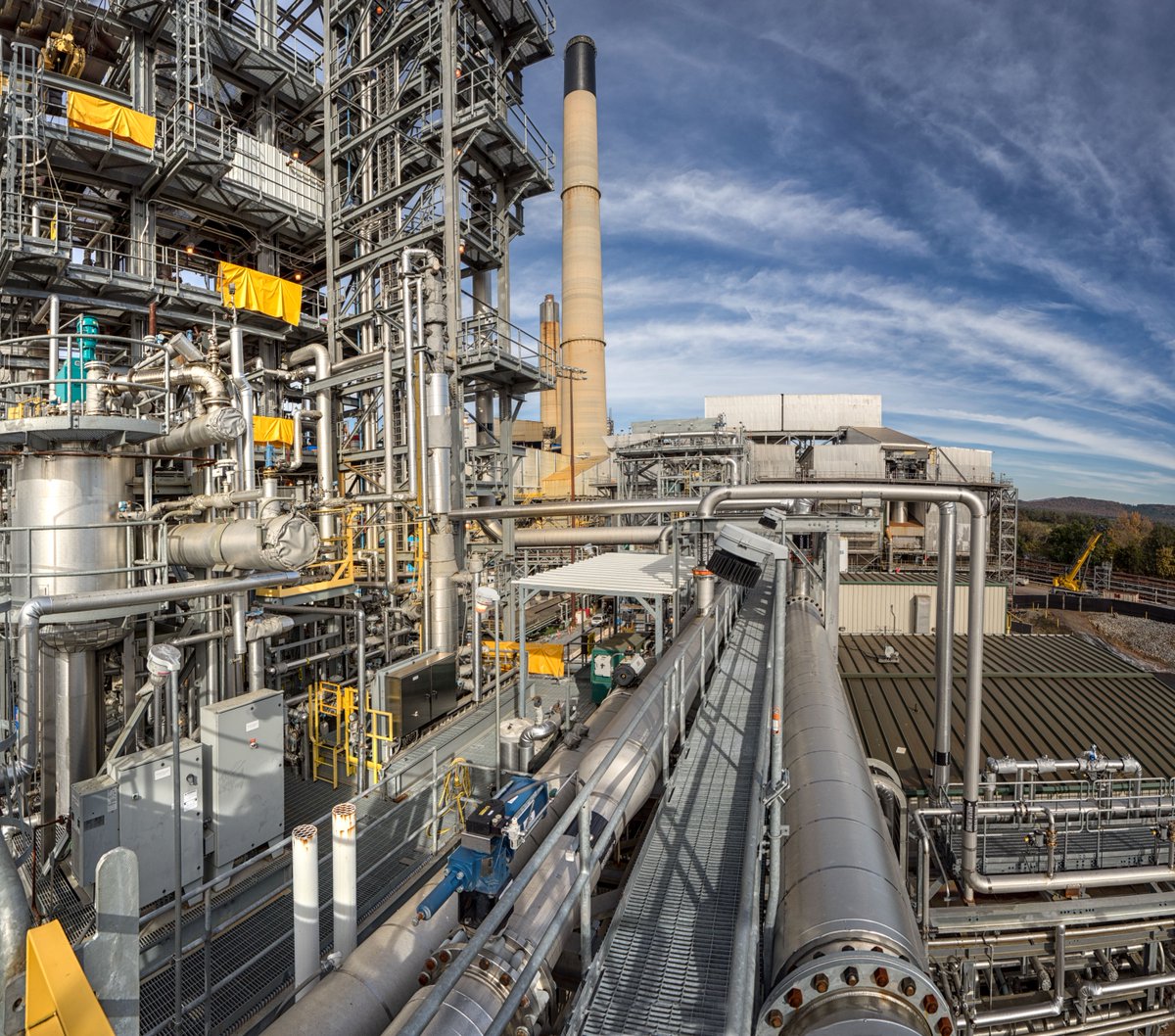
Carbon capture has a long history, and its applications continue to evolve.
Because coal once represented a dominant share of U.S. electricity generation, much of the early carbon capture research and deployment in the power sector naturally focused on coal-fired plants.
But carbon capture is not simply a coal technology. It is part of a broader set of carbon management technologies with applications across power generation and other energy-intensive industries.
Carbon capture has decades of experience in industrial applications such as natural gas processing. Today, projects are also advancing its application to natural gas-fired power generation, expanding the knowledge base for how capture technologies can perform across different facilities and operating conditions.
That accumulated experience matters. Lessons from one generation of projects can inform the engineering, integration and deployment of the next.
Progress is not just about developing innovative technologies. It is also about putting decades of experience to work in new ways.
#EPRI #CarbonManagement #CarbonCapture #CCS #EnergyTechnology #EnergyInnovation