Just saw that the LLMs-from-scratch repository passed 100,000 stars on GitHub!
This is super cool and motivating. I am really happy to see that this open-source repo has helped so many people.
Thanks also to everyone who shared ideas and opened PRs with improvements!
Of course, I plan to keep adding new material, including new attention variants and architectures (while bigger projects like RL and Reasoning From Scratch live in their separate repositories).
I am also currently working on a larger applied custom “small” LLM project. It has been keeping me super busy this month, but I will share more on that soon.
If you are new to it, some of the highlights include
1. Of course, the complete code path from tokenization and attention to pretraining, classification, and instruction fine-tuning, etc. All of it FROM SCRATCH, of course! (RL lives in a companion repo.)
2. From-scratch implementations of Llama, Qwen, Gemma, and Olmo (smaller variants that run locally and can be plugged into the training scripts).
3. From-scratch implementations of attention alternatives and other architecture components, such as GQA, MLA, sliding-window attention, Gated DeltaNet, DeepSeek Sparse Attention, cross-layer KV sharing, and mixture-of-experts
4. Materials on KV caching, training performance, memory-efficient weight loading, DPO, evaluation, and LoRA
So, if you don’t have any weekend plans yet, happy tinkering!
HISTORY!!!
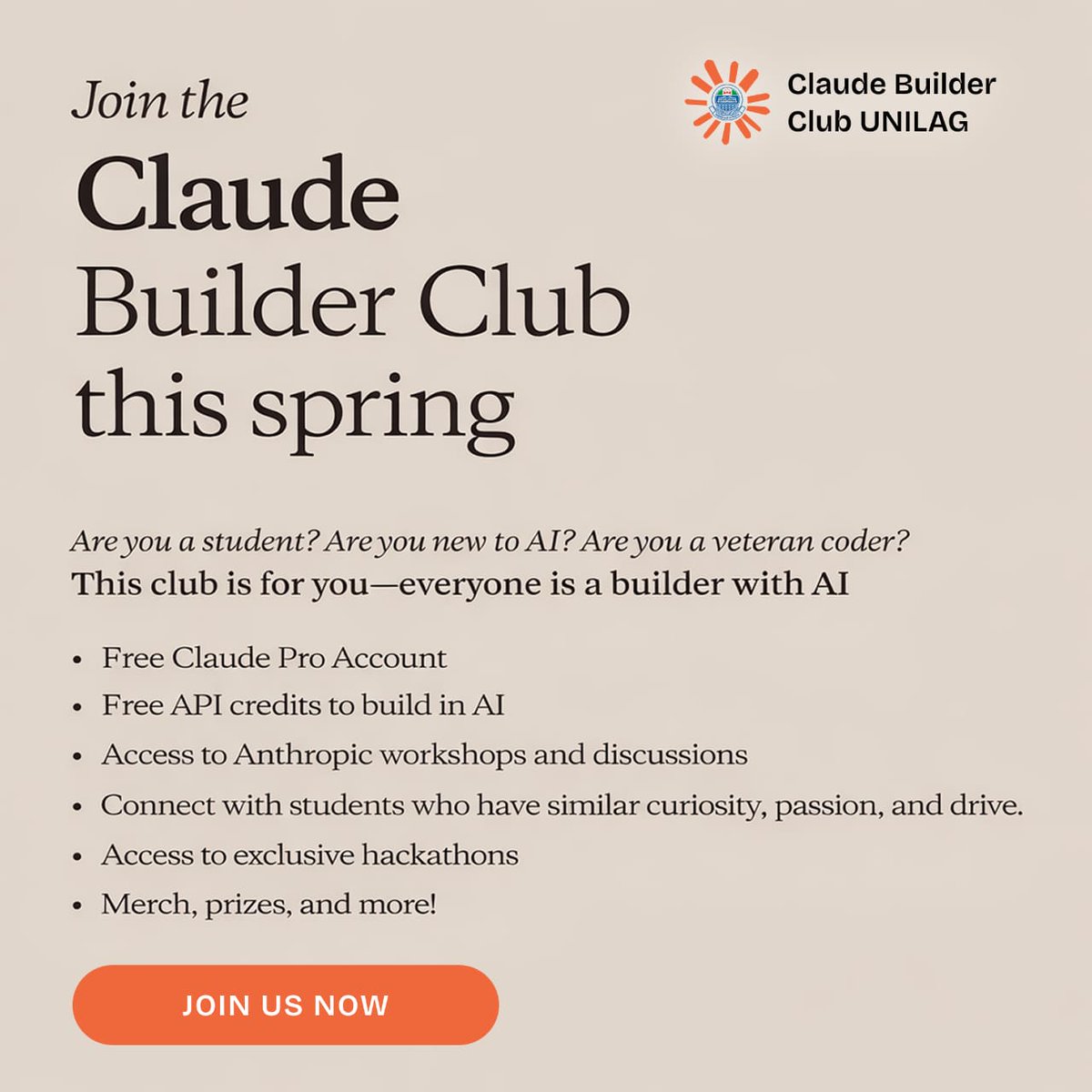
🚀 FIRST EVER Claude Builder Club in Nigeria launches at UNILAG! 🇳🇬
✨ Free Claude Pro ✨ Free AI API credits ✨ Hackathons & workshops ✨ Community, merch & prizes
Building the future of AI in Nigeria starts here.
More updates soon!!!
Let's make history! 💪🏾🔥
I am of the school of thought, that Nigerian tech ecosystem will scale a lot more, if we can move away most of our focus from software. I think foodtech would be the most scalable sector locally.
By foodtech, I’m not talking about ordering food online, I’m talking of food production, preservation, quality control and research and development of food products.
I might be wrong, but I think there’s only a limit to how much software one can sell in Nigeria. I feel software in Nigeria is still extractive to a large part, and unless we build things that add value, the average Nigerian will not connect with the products.
I get that there are tons of govt inefficiencies hindering the growth foodtech in Nigeria, but it’s something I believe that money can solve.
I saw the video of the lady who made frozen soup to export. It might sound funny, but I know how much I spend to ship Nigerian food down here. Customs don know me now, as the guy that’s always fighting for his African food.
I know tons of others who will do the same too.
If we have companies repackaging our local delicacies to export to the rest of the world, turning them into “over the counter products” and promoting them globally, I believe there’s billions of dollars to be made.
Again, I might be wrong, but I have interacted with lots of startups from other emerging ecosystems, and most of the startups doing great are biotech, foodtech and even retailtech. Maybe, we need the same in Nigeria.
Lists like this can feel silly but I don't take for granted any opportunity to highlight the work I'm fortunate to do.
Feeling especially grateful for my @mozilla teammates @Abebab, @brianavecchione, @ryanbsteed & @OjewaleV🙏🏿 Excited for what's to come!
https://t.co/3ciRb6zGFR
Netflix's Tech Stack.
This post is based on research from many Netflix engineering blogs and open-source projects. If you come across any inaccuracies, please feel free to inform us.
Mobile and web: Netflix has adopted Swift and Kotlin to build native mobile apps. For its web application, it uses React.
Frontend/server communication: GraphQL.
Backend services: Netflix relies on ZUUL, Eureka, the Spring Boot framework, and other technologies.
Databases: Netflix utilizes EV cache, Cassandra, CockroachDB, and other databases.
Messaging/streaming: Netflix employs Apache Kafka and Fink for messaging and streaming purposes.
Video storage: Netflix uses S3 and Open Connect for video storage.
Data processing: Netflix utilizes Flink and Spark for data processing, which is then visualized using Tableau. Redshift is used for processing structured data warehouse information.
CI/CD: Netflix employs various tools such as JIRA, Confluence, PagerDuty, Jenkins, Gradle, Chaos Monkey, Spinnaker, Altas, and more for CI/CD processes.
–-
Subscribe to our weekly newsletter to get a Free System Design PDF (158 pages): https://t.co/uc5M7CdXXC
CEO of Alphabet Google 🇮🇳
CEO of Microsoft 🇮🇳
CEO of YouTube 🇮🇳
CEO of Adobe 🇮🇳
CEO of World Bank Group 🇮🇳
CEO of IBM ���🇳
CEO of Starbucks 🇮🇳
DogeDesigner 🇮🇳