Most people watch Binance Blockchain Week for the next big crypto narrative.
They are busy watching prices, tokens, trading but they miss the bigger story.
The real shift happening in finance isn't necessarily another coin going up.
It's the infrastructure underneath money itself.
While retail investors obsess over whether Bitcoin is up or down today, major financial institutions are exploring blockchain, stablecoins, and tokenization to solve a much older problem:
Moving money is still painfully slow.
Cross-border transfers can involve multiple intermediaries, outdated systems, operating-hour restrictions, and settlement delays.
Blockchain-based rails can potentially change that by enabling money and assets to move and settle digitally, around the clock.
When banks start looking at blockchain as financial infrastructure, the conversation changes completely.
This isn't about replacing your banking app with a crypto wallet.
It's about asking whether the pipes underneath the global financial system still make sense in a world that operates 24/7.
And if institutions can use stablecoins and tokenized assets to make settlement faster, more programmable, and more accessible across borders, that's a much bigger development than another token making headlines.
This is why the quieter announcements at major industry events can matter more than the loud ones.
The flashy stuff gets the attention.
Infrastructure gets adopted.
And infrastructure is what eventually changes how money moves.
So if you're only watching crypto prices, you're watching the least interesting part of the transformation.
The bigger story is happening underneath the charts.
Do your own research.
#Binance #BinanceBlockchainWeek #LearnWithBinance #binanceacademy
#Altcoins
Altcoins are on the verge of reclaiming a bullish triangle that has been forming for almost 6 YEARS.
That would mean that the past few months have been one big fakeout, designed to shake out the majority of the market before the big rally begins.
Good times ahead.
bitcoin:native impressively just tagged the 50-week moving average.
The strength from August 17 until today, just 1 week later, has been an impressive 29% move up.
The big question: is this move sustainable? Will it continue?
It would be difficult for anyone to argue a bear case if BTC closes above the previous high of $82.8k and the 50 week MA.
What if Gen Z didn't actually plan on becoming investors so early in life?
Everyone says young people suddenly became obsessed with financial markets out of nowhere. But the real truth is:
Investing just bumped into them while they were scrolling on their phones.
When was the last time a physical bank branch actually convinced anyone to start investing?
The old walls completely broke down.
Thanks to mobile-first platforms and fractional investing; where you can buy a tiny $5 piece of a giant stock instead of paying hundreds for a full share.
That's how getting into the market became as easy as tapping a screen.
Younger people didn't magically transform into financial experts overnight. Financial markets just moved directly into their daily social media feeds and everyday apps.
And did you make a planned, traditional choice to start growing your wealth, or did an algorithm just introduce you to it first?
Share your story. Always do your own research.
#Binance #BinanceAcademy #LearnWithBinance #FinancialLiteracy
Ever hand your entire bank statement to a landlord just to prove you can pay rent, feeling like your privacy just took a hit?
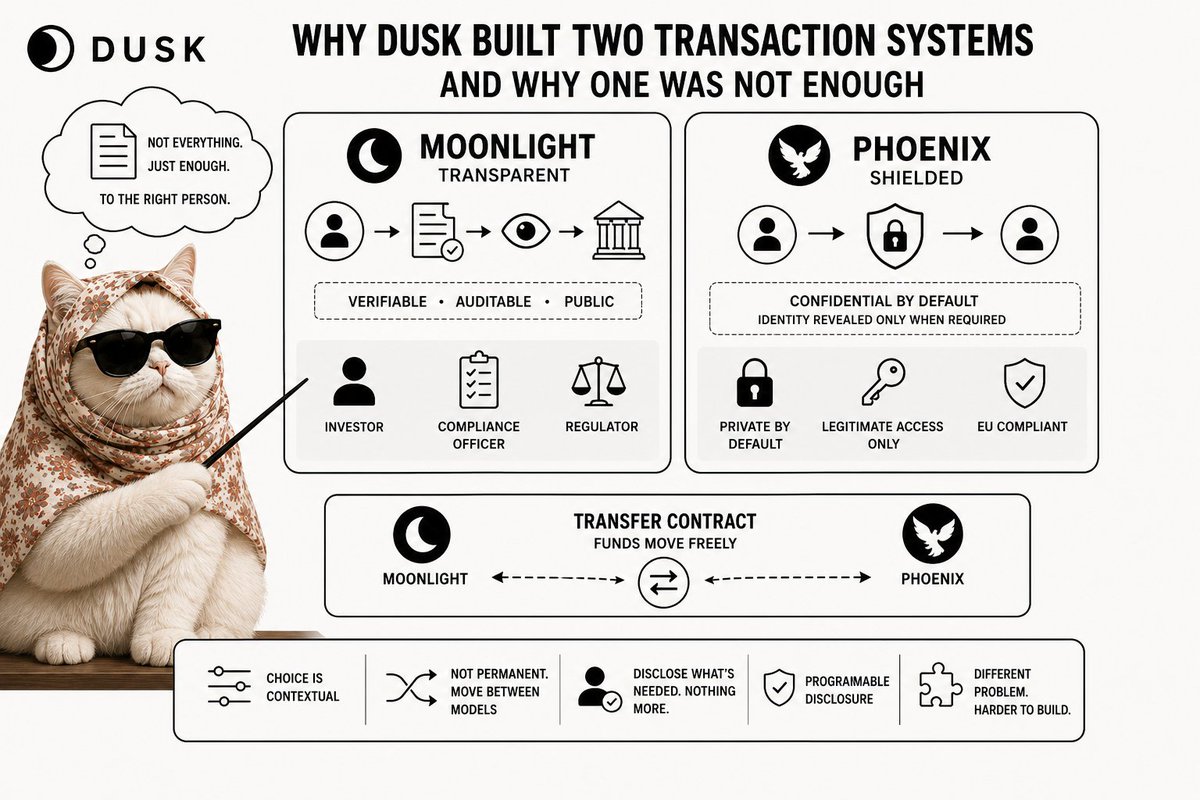
That awkward overexposure is why traditional finance and public chains feel so broken. But $DUSK solves this by refusing to choose between total exposure and total blackouts.
With its dual-model design, #Dusk separates public accountability from private ownership. Moonlight handles the transparent side, while Phoenix acts as a shielded layer that proves compliance without leaking your entire financial history.
This is programmable disclosure. You share the right key with the right person at the right time.
If crypto wants real institutional money, hiding everything doesn't work. Controlling what gets seen does.
@DuskFoundation
The first paycheck hits differently.
You finally have money that came from your own work, and the temptation is to spend it all...
But that first income can also be the moment you start thinking differently about money....
Keep some aside. Know where your money is going. Learn how investing works before putting money at risk....
And don’t depend on just one option when you can understand how to spread risk....
You don’t need to have everything figured out from day one....
Start by learning. Build good habits. Let your financial decisions improve with experience.....
That’s a better return from your first salary than anything you could buy with it.....
#LearnWithBinance
#Binance #BinanceAcademy
Your First Salary: What Do You Actually Do With It?
Getting your first salary feels exciting, but knowing what to do with it can be confusing.
The best place to start isn't investing. It's understanding the basics.
1. Build a budget
Know how much is coming in, where it’s going, and how much you can realistically set aside.
2. Build an emergency fund
Unexpected expenses happen. Having money set aside can give you a financial cushion before taking on additional financial risk.
3. Saving ≠ investing
Saving and investing serve different purposes and can involve different levels of risk. Understanding the difference matters.
4. Understand diversification
Diversification means spreading your exposure rather than relying entirely on one asset or investment.
5. Know your risk tolerance
Before making investment decisions, understand how much risk you're comfortable taking. Don't let social-media hype make the decision for you.
If you're interested in crypto, learn first. Binance Academy offers educational resources covering Bitcoin, blockchain, crypto markets, risk management, and DYOR.
Your first salary is just the beginning. Learn the basics, understand your options, and make financial decisions based on your own circumstances.
Educational content only. Not financial advice. Always DYOR, understand the risks, and check official sources for information relevant to your region.
#Binance
#LearnWithBinance
#BinanceAcademy
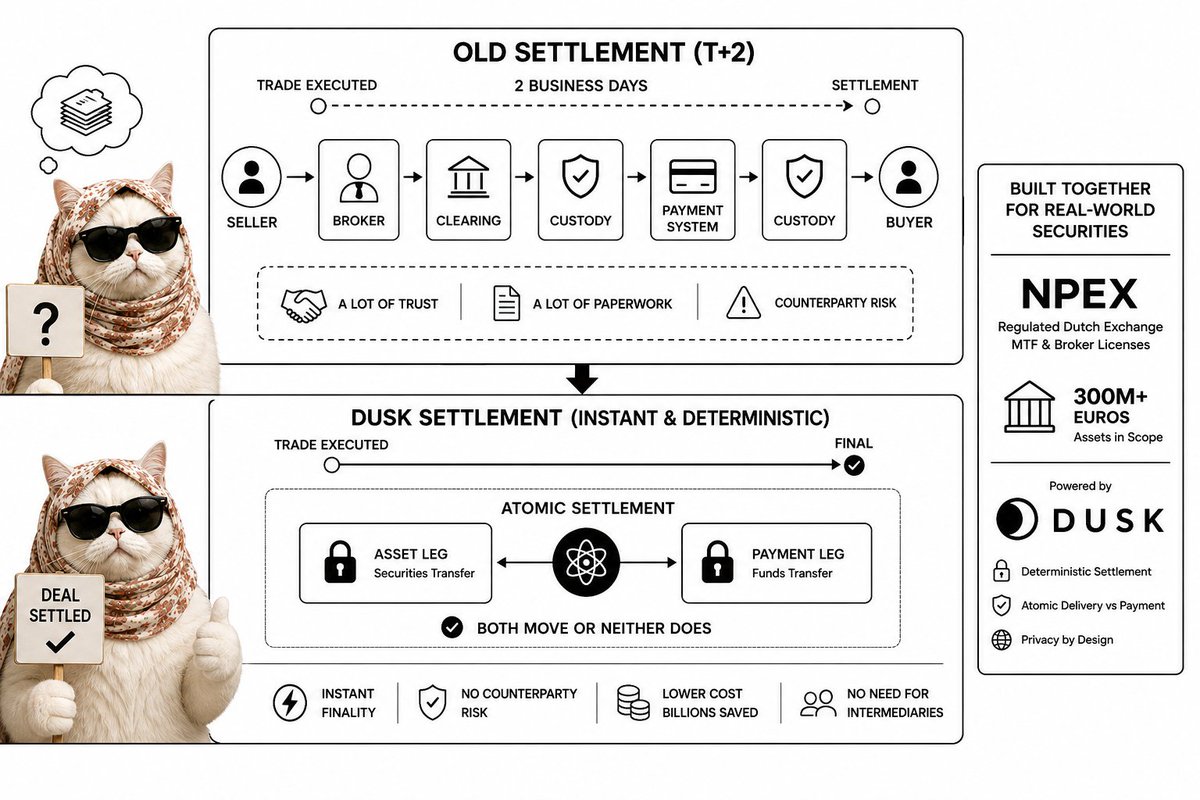
Ever wait two whole business days for a stock trade to settle and wonder why your money is stuck in digital limbo?
We tolerate an army of middlemen and paperwork because traditional finance treats settlement risk like a law of nature. But it is not. It is just bad infrastructure.
This is where #Dusk changes the conversation completely.
Instead of probabilistic guesses or waiting on confirmations, $DUSK delivers deterministic settlement. When a trade clears, it is final instantly. No gaps, no counterparty risk, and atomic execution meaning both sides move together or nothing happens at all.
Real institutional adoption is already testing this. Look at NPEX, a regulated Dutch exchange moving over 300 million euros of securities directly onto Dusk's infrastructure. Legal compliance and technical rails are solved as one single unit.
Dusk isn't just making finance faster. It is rebuilding the foundation.
@DuskFoundation
Bitcoin doesn't know it's Saturday or Sunday.
Seriously.
Try opening a stock market on Sunday and you'll be waiting.
Open a crypto exchange instead and the market is still moving.
Why?
Because crypto wasn't built around the same market-hours system as traditional stock exchanges.
But here's the part that's easy to miss:
Why does the stock market close at all?
A stock market isn't just an app where buyers and sellers meet. It runs through a traditional financial system involving exchanges, brokers, banks, custodians and other institutions.
These institutions need scheduled operating hours to process trades, settle transactions, manage records and coordinate with each other. So stock exchanges have defined trading sessions, with opening times, closing times, weekends and holidays.
When the exchange closes, regular stock trading stops.
Crypto works differently.
Bitcoin runs on a global blockchain network. There isn't one central exchange that controls the entire Bitcoin market and says, “Okay everyone, we're done for today.”
The network keeps running.
Crypto exchanges can therefore continue offering trading around the clock.
So at 2 PM on Tuesday or even Sunday?
It's still trading.
That's why crypto markets operate 24/7.
And this changes something important for beginners.
In traditional markets, there is usually a period when trading stops and everyone gets a break.
Crypto doesn't give you that pause.
A major event can happen on a Sunday. Prices can react while you're asleep. You don't get to wake up and say, “Wait for the market to open.”
It never closed.
That's the convenience of a market that never sleeps.
It's also the reason you don't need to watch it every second.
The market is always open.
You don't have to be.
Educational only. Not financial advice. DYOR.
#Binance #BinanceAcademy #LearnWithBinance
Traditional markets feel like office buildings.
Open at a certain time.
Closed after hours.
Weekends off.
Crypto feels more like the internet.
Always online.
Global.
Moving across time zones.
That is why crypto markets trade 24/7.
There is no single global closing bell telling everyone to stop.
But this is where beginners need balance.
Just because the market is open all the time does not mean every moment is important.
Some hours are noisy.
Some moves are thin.
Some reactions are emotional.
Understanding crypto is not only about coins.
It is also about market structure.
Before asking “what should I buy?”
Ask:
How does this market even work?
Educational only. Not financial advice. Always do your own research.
#Binance #BinanceAcademy #LearnWithBinance
A trader built a QUANT bot using Claude Fable 5.
Result: $81,323 profit on Polymarket.
25,511 predictions in 54 days.
46% win rate.
$1,506 per day on average.
The strategy is surprisingly simple:
1. Fast market-making model focused on short crypto Up/Down markets
2. No need for both sides at once. System accumulates one side when prices dislocate, then completes the position when the opposite side gets cheap
3. Edge comes from temporal arbitrage + partial hedging + constant inventory rotation across nearby windows
Biggest winning trades:
$1,277 → $2,516 (+$1,239 profit | 97% gain)
$1,059 → $2,205 (+$1,146 profit | 108% gain)
$1,372 → $2,487 (+$1,115 profit | 81% gain)
The entire profit curve is built on one small edge repeated thousands of times.
This is not about predicting the market.
This is about reading price dislocations faster than everyone else and exploiting the gap before it closes.
The system runs autonomous:
→ Claude handles decision logic
→ Monitors crypto markets 24/7
→ Executes when arbitrage windows open
→ Rotates inventory continuously
No emotions.
No guessing.
Just math and execution speed.
💡 I'm sharing the complete Claude prompt and workflow behind this QUANT bot.
Free for 24 hours.
To get it:
1️⃣ Comment the word "Fable"
2️⃣ Like and Repost
3️⃣ Follow @codewithimanshu
I'll DM you the setup.
For the longest time we have seen "stocks" as another entity. But now you can find “stocks” on a crypto platform.
Sounds weird, right?
Stocks belong to Wall Street. Crypto belongs to blockchains. Why are the two suddenly connecting to each other?
That’s basically the idea behind Binance bStocks.
A bStock is a tokenized security that tracks a corresponding traditional stock. The underlying US shares are held 1:1 with a regulated custodian (Trusted Bank or Asset Keeper), while the bStock exists as a blockchain-based representation of that interest.
So if a bStock tracks a US company’s stock, you aren't simply taking the original stock certificate and putting it on the blockchain.
There’s an extra layer in between.
Think of it like this:
Traditional system:
You → broker → stock market → shares
Tokenized system:
You → bStock → underlying shares held with a custodian
That difference matters.
A bStock is not the same as directly owning the company's shares, and it doesn't give you the same shareholder rights as holding the traditional stock itself.
But the tokenized format can bring some very crypto-native features to stock exposure, such as blockchain-based transfer and trading through Binance's supported infrastructure.
So the bigger idea isn't really “stocks became crypto.”
It's that a traditional financial asset can be represented in a form that can interact with blockchain infrastructure.
That's why “tokenized stock” is worth understanding instead of simply thinking “stock + crypto.”
And yes, availability depends on your region and eligibility.
Educational only. Not financial advice. DYOR.
#Binance #BinanceAcademy #LearnWithBinance